IPCC Officially Recognizes Seaweed as a Carbon Sink
NASA, ARPA-E, and World Bank Also Take Notice
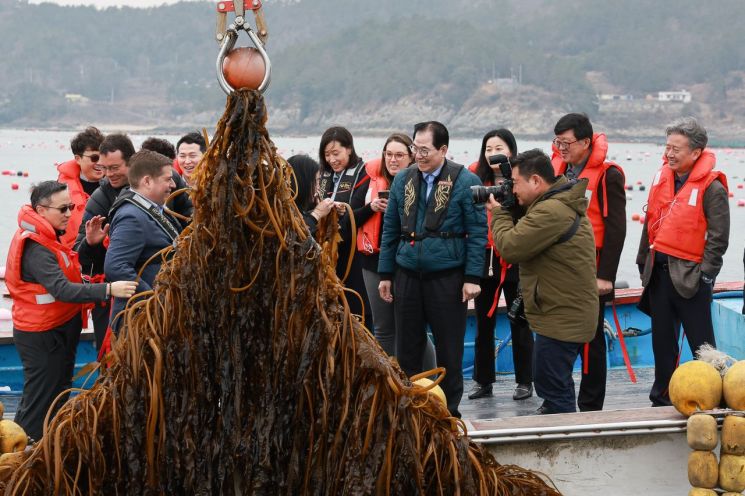
Wando County in South Jeolla Province is accelerating its plan for a "Wando-style Ocean Pension," which aims to return profits generated from seaweed blue carbon trading to local residents. As the international community moves toward officially recognizing seaweed as a new carbon sink, momentum is building for Wando’s vision of a seaweed-based carbon economy.
According to the county on November 6, guidelines to designate seaweed as a new carbon sink were agreed upon at the 63rd session of the Intergovernmental Panel on Climate Change (IPCC), held from October 27 to 30 in Lima, Peru.
 Wando County agreed on guidelines to designate seaweed as a new carbon sink at the 63rd session of the Intergovernmental Panel on Climate Change (IPCC) held in Lima, Peru. Photo by Wando County
Additionally, with the approval of the outline for the "Report on Carbon Dioxide Removal, Carbon Capture, Utilization, and Storage Methodologies," scheduled for publication in 2027, the blue carbon value of seaweed has gained international recognition.
If seaweed is ultimately designated as a carbon sink, it is expected to significantly contribute not only to achieving national greenhouse gas reduction targets but also to realizing the government’s 2050 carbon neutrality policy and revitalizing the local economy. Wando County is the largest seaweed production area in Korea, accounting for over 50% of the nation’s production of laver, sea mustard, kelp, and hijiki.
Since 2021, when the National Aeronautics and Space Administration (NASA) in the United States spotlighted Wando’s seaweed farms via satellite imagery, the county’s pristine marine environment and eco-friendly aquaculture system have attracted global attention.
Subsequently, international organizations and experts, including the Advanced Research Projects Agency-Energy (ARPA-E) under the U.S. Department of Energy, the World Bank, and the World Wide Fund for Nature (WWF), have visited Wando to establish a global cooperation network centered on seaweed.
Last year, Wando County visited the United States to discuss blue carbon certification methods for seaweed with NASA and explored the establishment of an "offshore seaweed aquaculture technology system," a joint Korea-U.S. marine project, with ARPA-E.
In collaboration with the Korea Fisheries Resources Agency, Wando County is also promoting a "Blue Credit Pilot Project," which converts the amount of carbon absorbed through seaweed cultivation and management into carbon credits for trading, with profits returned as income to fishers. In the long term, this project is expected to develop into an "ocean pension" system, providing a basic income for fishers.
Wando County is also working with private companies such as Hyosung Group and Korea Electric Power Corporation to create and expand sea forests to conserve and enlarge seagrass habitats, which have been recognized as blue carbon sinks. The county plans to increase seagrass habitats to 60% of the national total.
To become a "global seaweed blue carbon hub," the county will establish a dedicated seaweed blue carbon task force and a carbon absorption belt council, while strengthening cooperation networks with central government agencies, local governments, domestic and international research institutions, and experts.
To further promote international consensus on the value of seaweed and the necessity of blue carbon, Wando County is preparing to host the "Pre-Wando International Seaweed Expo" in 2026 and the "Wando International Seaweed Industry Expo" in 2028.
In particular, the county plans to create "blue carbon-specialized aquaculture zones" by utilizing idle sea areas within offshore wind farms, establish a seaweed seed supply center, and gradually build a carbon absorption certification and trading system (MRV), thereby taking the lead in establishing a seaweed blue carbon economic ecosystem in Wando.
County Governor Shin Woochul stated, "The agreement at the IPCC to designate seaweed as a new carbon sink is a recognition by the international community of its value. As the nation’s largest seaweed production area, Wando will lead the era of seaweed blue carbon. Ultimately, we will realize the 'Wando-style Ocean Pension' system, linked to a basic income for county residents."
© The Asia Business Daily(www.asiae.co.kr). All rights reserved.
![Clutching a Stolen Dior Bag, Saying "I Hate Being Poor but Real"... The Grotesque Con of a "Human Knockoff" [Slate]](https://cwcontent.asiae.co.kr/asiaresize/183/2026021902243444107_1771435474.jpg)
















