People’s Solidarity for Participatory Democracy and Lawmakers Hold National Assembly Forum on Next Year’s Health and Welfare Budget
"Budget Increased, but Falls Short of Qualitative Improvements in Welfare"
"Focus Remains on Industrial and Technological Growth Rather Than Securing Public Interest"
Although the Ministry of Health and Welfare has significantly increased its budget for artificial intelligence (AI) in line with the government's goal of becoming an "AI powerhouse," concerns have been raised that this move is disconnected from the national policy objective of strengthening public health services. Analysts point out that the budget allocation is focused more on "industrial and technological growth" rather than "expanding essential and public healthcare."
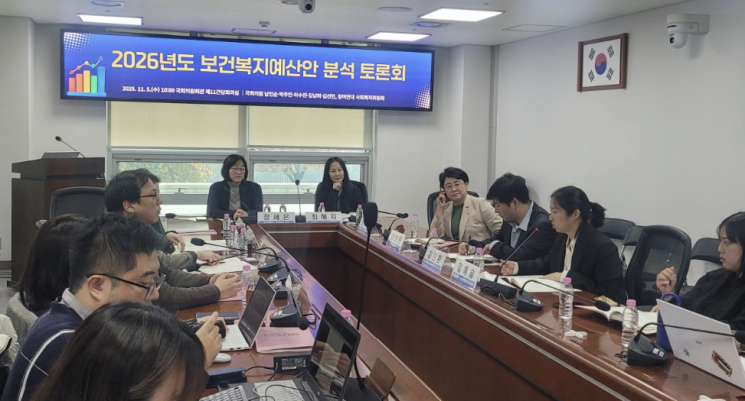 On the 5th, at the "2026 Health and Welfare Budget Analysis Forum" co-hosted by Kim Sunmin of the National Innovation Party and the Social Welfare Committee of the People's Solidarity for Participatory Democracy, Choi Hyeji, Chairperson of the Social Welfare Committee at the People's Solidarity for Participatory Democracy; Kim Yoonmin, Professor of Social Welfare at Changwon National University; Kim Jinhwan, Professor at the Seoul National University Institute of Health and Environment; Kim Hyungyong, Professor of Social Welfare at Dongguk University; and Lim Yesul, Administrative Officer of the Planning and Coordination Office at the Ministry of Health and Welfare, spoke.
At the "2026 Health and Welfare Budget Analysis Forum" held on the 5th and co-hosted by Assemblyman Kim Sunmin of the National Innovation Party, Assembly members Nam Insoon, Park Jumin, Lee Sujin, and Kim Namhee of the Democratic Party, and the Social Welfare Committee of People’s Solidarity for Participatory Democracy, experts criticized that despite the apparent quantitative expansion in next year's budget, it falls short in terms of qualitative improvements, such as regional care and public healthcare infrastructure.
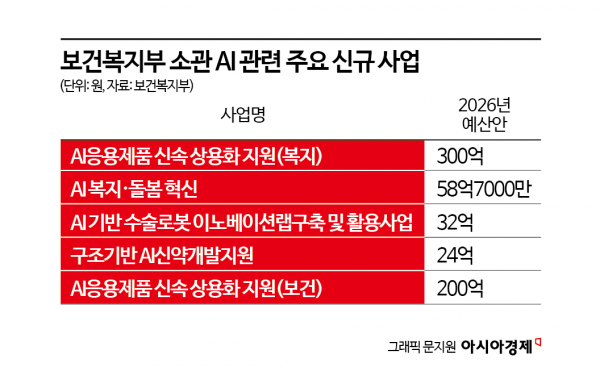
The total budget for the Ministry of Health and Welfare for 2026 is set at 137.648 trillion won, a 9.7% increase from this year. Of this, the health sector budget is 18.9868 trillion won, up 3.7%. Within the health sector, the health insurance budget is 14.3161 trillion won, a 1.3% increase, while the healthcare budget is 4.6707 trillion won, an 11.8% increase. Notably, the welfare and medical AI budget has been set at 247.8 billion won, which is 2.5 times higher than this year’s 93 billion won.
Kim Jinhwan, Professor at the Seoul National University Institute of Health and Environment, who attended the forum, pointed out that while the health insurance budget increased by 1.3%, the budget for research and development (R&D) programs classified as health industry promotion rose by 32.8% to 1.492 trillion won. He argued, "The government's fiscal allocation is aligned with an industry- and technology-centered growth framework, rather than the expansion of essential and public healthcare." He further claimed that although the government describes the significantly expanded budgets for biohealth industry promotion and bio big data construction as "public R&D," in reality, the state is taking on responsibilities that should be borne by the private sector.
Professor Kim also noted that the budget for dispatching personnel to local medical centers is 7.5 billion won, while the budget for building AI medical systems at regional centers and national university hospitals is 14 billion won, nearly double. He stated, "The root cause of the regional healthcare crisis is a shortage of personnel, yet the structure of the public healthcare budget is concentrated on strengthening AI capabilities at large hospitals."
Choi Hyeji, Chairperson of the Social Welfare Committee at People’s Solidarity for Participatory Democracy, expressed concern that while the budget for expanding public infrastructure for social services such as basic pensions, disability pensions, childcare, and long-term care has stagnated or decreased, the budgets for health industry R&D and AI-based services have increased. She warned that this could lead to the further marketization of health and welfare services under the pretext of industrialization.
Chairperson Choi stated, "On the surface, the budget for strengthening the public nature of regional base hospitals has increased by more than 330%, but if the effect of merging budget items is excluded, the actual increase is only 5%. Similarly, although the budget for training specialized medical personnel in underserved areas has increased by 252%, if the transfer of the regional essential doctor system budget is excluded, the growth rate drops to 167%." She concluded, "Ultimately, the industrialized healthcare system centered on large hospitals will be further strengthened, and inequality in regional and public healthcare will persist."
Kim Hyungyong, Professor of Social Welfare at Dongguk University, remarked, "Although 'care' is frequently mentioned across 123 national policy tasks, the content is primarily designed around AI and IoT smart care services and the development of care robot technologies. Most of the increase in the elderly welfare budget is due to the rise in the number of basic pension recipients." He added, "This reflects a growing perspective that regards care not as a domain of public welfare, but as a pillar of growth industries."
With the AI project budget increasing rapidly in a short period, there are growing concerns about overlapping projects and lack of quality. In the "2026 Budget Bill Committee Analysis" report published by the National Assembly Budget Office on November 3, the Ministry of Health and Welfare's new project, "Support for Rapid Commercialization of AI Application Products," was cited as a prime example of hasty budget allocation. This project aims to commercialize services such as preventing solitary deaths, elderly care, and welfare counseling using AI technology. However, as this policy was established in August as part of the government's ongoing "AX-Sprint 300 Project," the preliminary feasibility study was waived and a budget of 30 billion won was allocated.
The report emphasized, "Not only was there insufficient time to prepare for the project, but concrete criteria for determining eligible AI commercialization items and management and operation expense rates have yet to be established." It recommended, "To prevent project delays, it is necessary to strengthen management and develop guidelines and project instructions that can be jointly utilized by all relevant ministries."
© The Asia Business Daily(www.asiae.co.kr). All rights reserved.
![Clutching a Stolen Dior Bag, Saying "I Hate Being Poor but Real"... The Grotesque Con of a "Human Knockoff" [Slate]](https://cwcontent.asiae.co.kr/asiaresize/183/2026021902243444107_1771435474.jpg)

















