At the National Assembly Budget and Accounts Special Committee public hearing held on the 5th, ahead of the review of next year's 728 trillion won budget proposal, the ruling and opposition parties clashed. The Democratic Party of Korea argued that expansionary fiscal policy is necessary to secure future growth engines, while the People Power Party countered that the budget should be cut, warning that increased debt could lead to a downgrade in the country's credit rating.
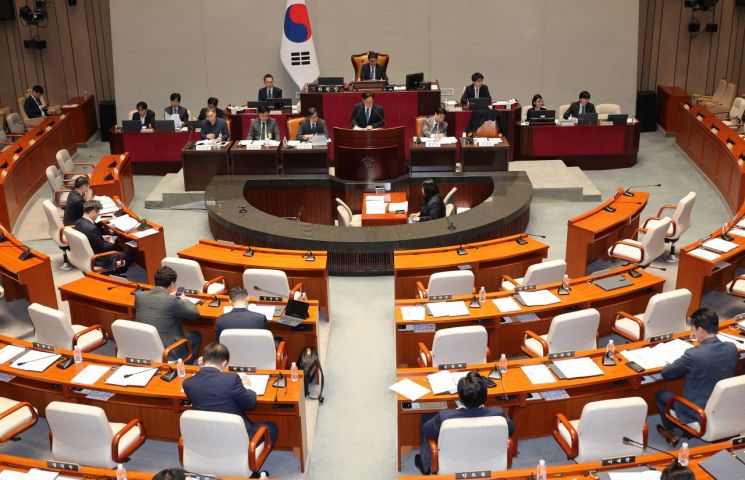 On the 5th, Professor Kim Daejong of the Department of Business Administration at Sejong University is speaking at the Budget and Accounts Special Committee public hearing held at the National Assembly in Yeouido, Seoul. Photo by Yonhap News
Jung Jinwook, a member of the Democratic Party, stated at the hearing, "This expansionary fiscal policy is not simply an increase in spending, but a transformative budget aimed at helping the stagnant economy recover, creating new growth engines for the future of Korea, and bringing together youth, regions, industries, and technology as one. I believe the state's role is to create opportunities even in times of crisis."
Lee Soyoung, also of the Democratic Party and the party's secretary on the Budget and Accounts Special Committee, defended next year's budget proposal by noting that the general grants to local governments have increased roughly threefold compared to previous years. She said, "By granting autonomy to local governments, we aim to improve the efficiency of local fiscal policy, and I believe this could also serve a positive function in terms of balanced national development."
In response, the People Power Party expressed concern that expansionary fiscal policy could lead to increased debt. Park Hyungsoo, the opposition secretary on the Budget and Accounts Special Committee, pointed out, "By adopting an expansionary budget, national debt will reach 1,425 trillion won, with the debt-to-GDP ratio rising to 51.6%. This could result in a downgrade of our international credit rating."
Expert witnesses representing both parties at the hearing also expressed differing views. Cho Youngchul, adjunct professor of economics and finance at Hanshin University, argued, "Compared to the supplementary budget, this is actually austerity, not expansion, and it does not align with the current administration's identity." Woo Seokjin, professor of business statistics at Myongji University, assessed, "This budget is fundamentally about restoring the original role of fiscal policy."
On the other hand, Yang Junmo, professor of economics at Yonsei University, cited policies such as the government and ruling party's consumer coupons for livelihood recovery, the Yellow Envelope Act, and the 10·15 real estate measures, emphasizing, "The new administration is implementing policies that cause fiscal deficits, which is negatively impacting the economy." In particular, Kim Daejong, professor of business administration at Sejong University, stated, "The national budget should also be balanced at a 2% level, in line with the rates of inflation and minimum wage increases. Excessive fiscal expansion could place a serious burden on the country's credit rating and price stability."
© The Asia Business Daily(www.asiae.co.kr). All rights reserved.

















