New York Elects First Muslim Mayor, 'Democratic Socialist' Mamdani
Moderates Spanberger and Sherrill Win Governorships
"Public Discontent with Trump Clearly Expressed"
On November 4 (local time), which served as a barometer of public sentiment during the first year of President Donald Trump's term, the Democratic Party won all three major races: the gubernatorial elections in Virginia and New Jersey, as well as the New York City mayoral race. The results are expected to serve as a check on the Trump administration's governance and significantly impact the Democratic Party's strategy for next year's midterm elections.
In New York, the largest city in the United States and the center of capitalism, Zohran Mamdani, a New York State Assembly Member and self-described 'democratic socialist,' became the first Muslim ever elected as mayor. The 34-year-old political newcomer, who was virtually unknown, secured his second victory against political heavyweight Andrew Cuomo, the former Governor of New York.
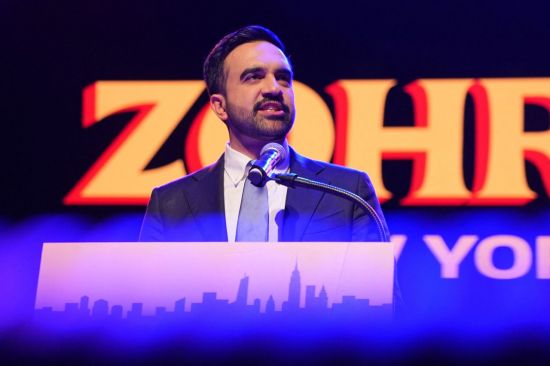 Zohran Mamdani, New York State Assembly Member elected as New York City Mayor. Photo by AFP Yonhap News
Mamdani, an Indian-American Muslim politician in his 30s, sparked a sensation with progressive pledges such as free bus service, expanded free childcare, raising the minimum wage, and increasing taxes on the wealthy. The Republican Party and the business community criticized his platform as populist.
After losing to Mamdani in the Democratic primary, former Governor Cuomo ran as an independent in the general election, setting up a contest between generations and between the establishment and anti-establishment forces. President Trump further intensified the spotlight by calling Mamdani a 'communist' and announcing that he would suspend federal funding for New York.
According to the Associated Press and The New York Times, more than two million voters participated in the New York City mayoral election, marking the highest turnout in over 50 years.
In the Virginia gubernatorial race, Abigail Spanberger, a former Democratic member of the U.S. House of Representatives, defeated Lieutenant Governor Winsome Earle-Sears.
The incumbent governor of Virginia was a Republican, so the Democrats reclaimed the governorship. This marks the first time a woman has been elected governor in Virginia.
Spanberger, age 46, previously served three terms representing Virginia’s conservative 7th district and has a background working at the Central Intelligence Agency (CIA). During her tenure in Congress, she was classified as a moderate within the Democratic Party, at times opposing some of then-President Joe Biden’s policies.
In the Virginia lieutenant governor race, Democrat Ghazala Hashmi won, while in the attorney general race, Democrat Jay Jones secured victory.
Since 2008, Virginia has consistently voted for Democratic presidential candidates, earning it the label of a 'blue state' (a state with a strong Democratic leaning). However, the gap between Republican and Democratic support narrowed in last year's presidential election, and the 2021 gubernatorial race saw Republican Glenn Youngkin win, reflecting a recent shift toward the political center.
In the New Jersey gubernatorial race, Mikie Sherrill, a Democratic member of the U.S. House of Representatives, defeated Jack Ciattarelli, a former New Jersey state legislator who was endorsed by President Trump.
Representative Sherrill served nine years in the Navy and has worked as both a lawyer and a federal prosecutor. After winning her seat in the 2018 midterm elections, she has served four terms in the House. Sherrill is also considered a centrist within the Democratic Party.
New Jersey has been a Democratic stronghold, consistently voting for Democratic presidential candidates since 1992.
The U.S. political establishment and major media outlets paid close attention to this election, noting that it reflected public opinion on President Trump’s administration. In particular, the results are seen as an indicator for next year’s midterm elections, scheduled for November, which will help gauge the direction of the latter half of Trump’s second term. As of this day, the federal government shutdown (shutdown) had entered its 35th day, and the election results revealed that public sentiment was not particularly favorable toward President Trump and the ruling Republican Party.
CNN assessed that this election vividly expressed public dissatisfaction with President Trump as he approached the one-year mark of his second term. The network also observed that the winning candidates shared a common campaign focus: while their solutions differed, all centered their campaigns on the issue of rising living costs and strongly criticized President Trump’s record.
Bloomberg News reported that, according to an Associated Press exit poll, six out of ten voters in Virginia and New Jersey said they were angry or dissatisfied with the current state of the United States. The outlet noted that these findings are consistent with national polls showing negative evaluations of President Trump’s economic management, and explained that his approach to immigration and foreign policy has failed to appeal to independent voters who often decide elections.
Meanwhile, in California, a referendum on a temporary redistricting plan for congressional districts passed with 64.1% approval based on 68% of votes counted. This will allow the Democratic Party to secure up to five additional U.S. House seats in California in next year’s midterm elections.
This referendum was a direct response to President Trump’s successful push for redistricting in Texas to increase Republican congressional seats. The initiative was led by California Governor Gavin Newsom, who is considered a leading Democratic presidential hopeful.
© The Asia Business Daily(www.asiae.co.kr). All rights reserved.
![Clutching a Stolen Dior Bag, Saying "I Hate Being Poor but Real"... The Grotesque Con of a "Human Knockoff" [Slate]](https://cwcontent.asiae.co.kr/asiaresize/183/2026021902243444107_1771435474.jpg)
















