Interview with Kim Heesung, Chairman of Bright Energy Partners (BEP)
BlackRock, the world's largest asset manager, invests a cumulative 381 billion won
Started with small and medium-sized solar power plants... Now the largest private solar operator
"Our mission is to achieve net zero as quickly as possible." This is the mission stated by Kim Heesung, Chairman of Bright Energy Partners (BEP). It is not just a common slogan for ESG. Since its establishment in 2017, BEP has been carrying out renewable energy projects as a practical way to reach net zero. The company started with small- and medium-sized solar power plants ranging from 1 to 3 MW. Now, it operates more than 540 power plants with a combined capacity of 800 MW. BEP's strategy of starting with small- and medium-sized projects and then scaling up aligns with the findings of BlackRock, the world's largest asset management firm, in its preliminary research before entering the Korean solar market. This is why BlackRock has invested a cumulative 381 billion won in BEP. Having started as a startup, BEP has rapidly built one of the largest clean energy portfolios among private solar operators in Korea, moving closer to the vision of accelerating net zero. We met Chairman Kim at BEP's headquarters in Jongno-gu, Seoul.
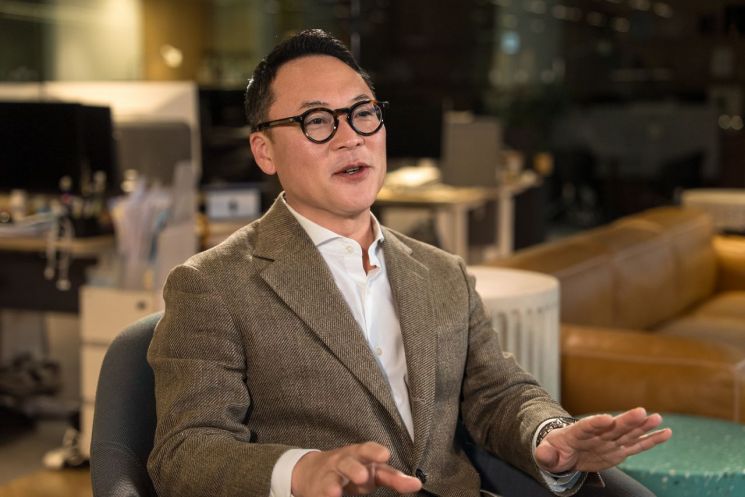
On the 6th, Chairman Kim said, "BEP's strategy was the complete opposite of existing solar development companies, which focused on large-scale projects," and added, "We started with small- and medium-sized projects because they generate cash flow and provide employees with small but meaningful successes." BEP's strategy was to pursue multiple relatively stable small- and medium-sized projects, rather than large-scale projects that, while profitable, are lengthy and carry a risk of failure. This approach proved successful. The 800 MW of solar assets that BEP has steadily accumulated through these experiences is enough to supply electricity to about 250,000 households for a year. It also reduces annual carbon dioxide emissions by 480,000 tons, which is equivalent to the amount of carbon absorbed by 22 million fully grown trees in one year.
Through this, BEP has gradually built the capacity to undertake large-scale projects. Currently, the company is directly developing and operating large solar power plants with a capacity of 55 MW in Yeonggwang, Jeollanam-do, and 90 MW in Goheung, Jeollanam-do. Chairman Kim said, "Based on the experience and reputation gained from developing small- and medium-sized projects, local partners are now strategically choosing BEP for large-scale solar development in their regions," and added, "In the past, we benefited from the name recognition of receiving investment from BlackRock, but now, within Korea's energy industry, BEP itself has become a brand."
The foundation for BEP's business expansion was the trust-based relationship with BlackRock, its largest shareholder. Chairman Kim said, "There have been very few cases where we needed to seek BlackRock's approval for business decisions; the guarantee of management rights allows BEP to make quick decisions, which is a key advantage," and added, "BlackRock also promotes BEP externally as an exemplary case."
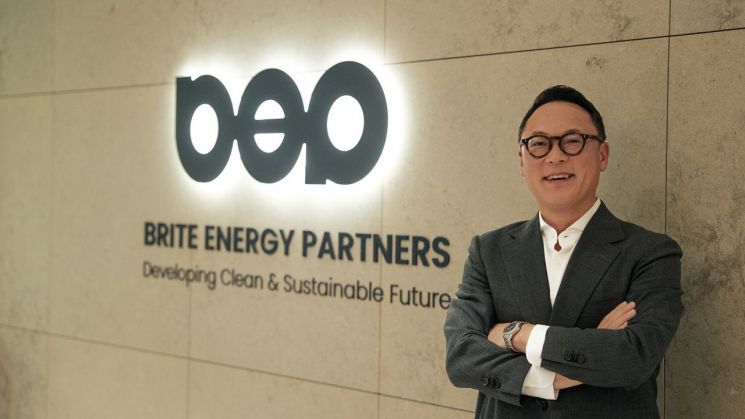
As an extension of its climate infrastructure investments to achieve net zero, BEP is also engaged in the electric vehicle charging station business. BEP's electric vehicle charging network, "Water," currently operates 658 fast chargers and 92 slow chargers at 162 charging stations nationwide. The company has also won the contract for the Korea Expressway Corporation's highway rest area charging station project. Upon completion, BEP will become the leading provider of fast-charging infrastructure on highways, where charging station utilization rates are overwhelmingly high. Chairman Kim said, "One of the most important areas for reducing greenhouse gases is mobility. We need to expand the use of electric vehicles, but charging inconveniences must be resolved," and added, "Expanding infrastructure to address this is our mission."
Chairman Kim has consistently pursued what he considers the solution to net zero: scaling up the transition to renewable energy. This is not something that a few companies can achieve alone. Everything must be interconnected, from government policy to market investment. Chairman Kim said, "Domestic institutions such as pension funds, mutual aid associations, and insurance companies are passive in investing in the renewable energy sector. I hope that institutional incentives will be introduced and financial regulations relaxed so that more investment can flow into climate infrastructure," and added, "If, in the future, consumers in the energy market have a wider range of choices and can purchase 'clean energy,' I would like BEP to become a 100% clean energy-based energy retailer."
© The Asia Business Daily(www.asiae.co.kr). All rights reserved.
![Clutching a Stolen Dior Bag, Saying "I Hate Being Poor but Real"... The Grotesque Con of a "Human Knockoff" [Slate]](https://cwcontent.asiae.co.kr/asiaresize/183/2026021902243444107_1771435474.jpg)

















