South Korea's Net Foreign Assets Reach 55% of GDP, Near Record High
Positive: Improved Income Balance and Stronger External Soundness
Negative: Weaker Domestic Capital Market Base and Ongoing Currency Weakness
"Need to Improve Domestic Stock Market Conditions and Promote Pension Fund Investment at Home"
There is an analysis suggesting that, in order to prevent the increase in South Korea's net foreign assets (NFA) from leading to negative outcomes such as the weakening of the domestic capital market investment base due to capital outflows and continued downward pressure on the exchange rate, it is necessary to improve the investment environment in the domestic stock market and to promote domestic investment by pension funds.
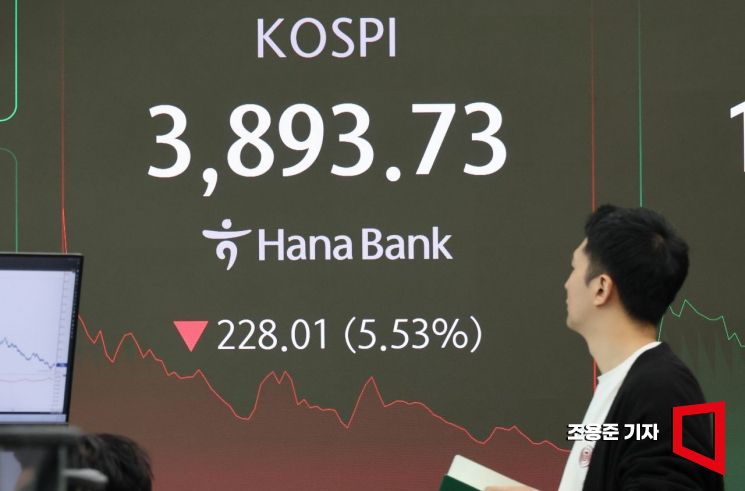 On the 5th, the status board in the dealing room of Hana Bank in Jung-gu, Seoul displayed the KOSPI, KOSDAQ, and others.
According to the "BOK Issue Note - Assessment of Net Foreign Asset Stabilization Potential and Implications (Hee-Eun Lee, Yejin Jang)" published by the Bank of Korea on the 5th, South Korea's NFA has been rising rapidly since 2010 as external financial assets have increased faster than external financial liabilities, turning positive from the third quarter of 2014. In the fourth quarter of last year, it exceeded 1 trillion dollars for the first time. As of June, it stood at about 55% of the country's gross domestic product (GDP), which is the second highest annual level in history, following 58.8% at the end of December last year.
NFA fluctuations are determined by both flow (current account balance) and valuation effects (exchange rates and asset price assessments). Over the long term, they are linked to fundamental factors such as demographics and fiscal conditions. In terms of flow, current account surpluses have led to increased overseas investment and foreign exchange reserves, thereby boosting NFA. The valuation effect has generally worked to reduce NFA in the past, because most external financial assets were in reserve assets and bonds, while external financial liabilities had a high proportion of equities-thus, increases in liabilities due to rising stock prices outpaced asset growth. However, since the 2020s, the negative impact has weakened due to a higher proportion of overseas equities and the strength of the US stock market.
Hee-Eun Lee, head of the Overseas Investment Analysis Team at the Bank of Korea's International Department, diagnosed, "For countries like South Korea with current account surpluses, NFA is likely to continue increasing as overseas investment flows persist." She added, "Despite the Trump administration's tariff and reshoring policies, it is uncertain whether the US trade balance can fundamentally improve, and it is expected to take a considerable amount of time before any real effects are seen. The Organisation for Economic Co-operation and Development (OECD) has also assessed that reshoring or relocating entire supply chains is realistically impossible and involves high risks."
Domestic factors that expand NFA, such as the continued overseas investment by the National Pension Service and declining domestic investment returns, are also unlikely to be resolved in the short term. In Japan, where NFA began to increase earlier than in South Korea under similar circumstances, NFA continued to rise even after reaching the current Korean level (55% of GDP) in 2009.
While the increase in NFA has positive aspects, such as improving income balance and strengthening external soundness, there are also persistent negative aspects, including the weakening of the domestic capital market investment base due to capital outflows, ongoing downward pressure on the exchange rate, greater exposure to global risks, and increased trade friction due to trade imbalances. Lee emphasized, "In particular, from a foreign exchange perspective, it is important to note that the increase in NFA has been driven mainly by private sector overseas investment, shifting the composition of NFA from a focus on reserve assets and the banking sector to the private sector." Since 2019, when the private sector's net overseas investment turned positive, the share of banks and the public sector (other assets + reserve assets) in total NFA has declined. This means that most or even more than all of the foreign exchange inflows generated by the current account have flowed out through private sector overseas investment, with banks and the central bank absorbing the resulting foreign exchange demand (selling foreign currency). As a result, the scale of foreign currency assets held by banks and the public sector has stagnated. It is necessary to pay attention to the fact that the NFA of banks and the public sector plays a role in buffering sudden changes in foreign exchange supply and demand.
Lee stressed the need to enhance the attractiveness of domestic investment in order to ease the excessive concentration of private sector overseas investment. To this end, she explained, it is necessary to improve the investment environment in the domestic stock market and to promote domestic investment by the National Pension Service. In February 2023, Japan implemented a government-led "Value Up" program to enhance stock value, and as a result, stock prices hit record highs for the first time in 35 years. Lee stated, "It is worth referring to Japan's virtuous cycle, in which improved corporate value led to an active domestic stock market, which in turn eased the concentration of overseas investment and slowed the growth of NFA."
© The Asia Business Daily(www.asiae.co.kr). All rights reserved.

















