Kim Jeongsu, Vice Chairman of Samyang Foods, unveils new "Samyang Ramen 1963"
Beef tallow incident rooted in prejudice against animal fats
"Father-in-law" Jeon Joongyun's lifelong regret
Taiwanese-style Castella franchise collapse due to misconce
"It is truly a case of things returning to their rightful place." On November 3, Kim Jeongsu, Vice Chairman of Samyang Foods, became emotional during a new product presentation held at the Bocco Seoul Myeongdong Hotel in Seoul. On this day, Samyang Foods unveiled its new ramen product, "Samyang Ramen 1963," made with beef tallow. It was the first time in 36 years since 1989 that Samyang Foods released ramen fried in beef tallow. Vice Chairman Kim stated, "Beef tallow, which was once considered almost taboo, is the ingredient that completes the authentic flavor of Samyang Ramen," and added, "I believe this may have helped ease, even if just a little, the lifelong regret held by the late Honorary Chairman Jeon Joongyun, founder of Samyang Foods and also my father-in-law."
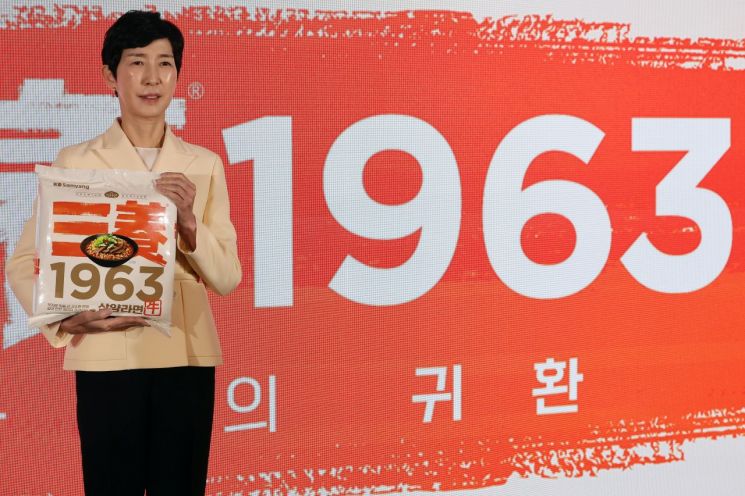 Vice Chairman Kim Jeongsu is introducing Samyang 1963, made with Wooji frying oil, at the Samyang Foods new product launch event held on the 3rd at the Bocco Seoul Myeongdong Hotel in Jung-gu, Seoul. Photo by Yonhap News
The reason Honorary Chairman Jeon harbored such regret was due to the "beef tallow incident." The beef tallow incident occurred on November 3, 1989, when suspicions arose that five food companies-Samyang Foods, Samlip Oil, Seoul Heinz, Ottogi Foods, and Busan Oil-had used industrial-grade American beef tallow in their products. Once this was revealed, consumer groups demanded that companies such as Samyang Foods, which had used industrial beef tallow, halt sales and issue public apologies. Prosecutors arrested the heads and key staff of companies that had used beef tallow.
Samyang Foods maintained that it had been wronged. At the time, the company explained, "The use of beef tallow in ramen since the 1960s was intended to provide animal fat to the public," and argued, "Compared to palm oil, importing beef tallow costs an additional 100 dollars per ton." The Ministry of Health and Social Affairs (now the Ministry of Health and Welfare) confirmed that there was no problem with beef tallow, but Samyang Foods was already facing difficulties. After the beef tallow incident, Samyang Foods' market share in the ramen sector dropped from 31% to 10%. In addition, out of 3,000 employees, about 1,000 left for other companies.
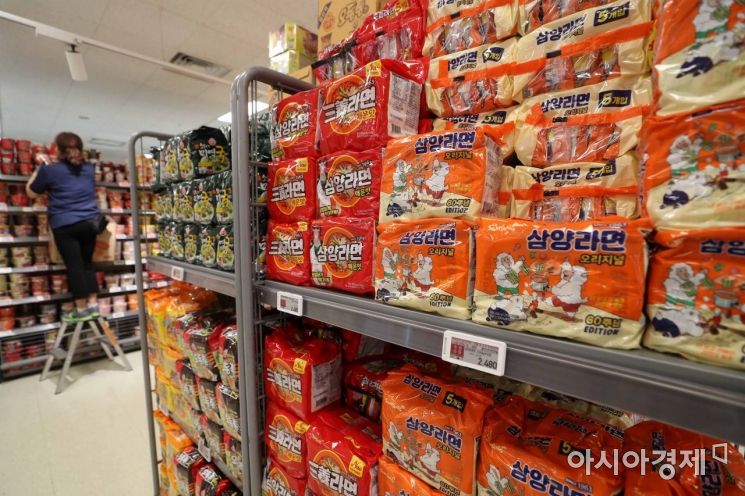 On the 15th, ramen was displayed at a large supermarket in downtown Seoul. With the rising popularity of Korean dramas and movies, ramen is gaining global popularity. According to the industry, Nongshim's cumulative overseas sales of Shin Ramyun in the third quarter have surpassed domestic sales. Samyang Foods reported that overseas sales accounted for 57% of total sales last year. Photo by Moon Honam munonam@
The beef tallow incident stemmed from the prejudice that animal fats are unhealthy. This bias originated from the "lipid hypothesis" proposed by American physiologist Ancel Keys in the 1950s. Keys conducted an epidemiological study of over 12,000 people in seven countries and announced that higher saturated fat intake was associated with higher mortality from cardiovascular disease. Subsequently, in 1961, the American Heart Association and the Nutrition Committee, referencing the lipid hypothesis, recommended consuming vegetable oils instead of animal fats.
However, subsequent studies have disproved Keys' lipid hypothesis. In 2014, the international journal "Annals of Internal Medicine" reported no correlation between saturated fat intake and cardiovascular disease. In fact, recent research suggests that unsaturated fatty acids, which are mainly found in vegetable oils, may have negative health effects. In 2023, researchers at the University of Maryland School of Medicine in the United States argued that linoleic acid, an unsaturated fatty acid found in vegetable oils, contributed to chronic diseases among Americans. There have even been allegations that Keys' research team manipulated data while studying the lipid hypothesis. Although the team conducted epidemiological research in 22 countries, they only published results from the seven countries that suited their narrative.
A Flawed Hypothesis Led to the Beef Tallow Incident... Taiwanese-Style Castella Made with Cooking Oil Also Under Fire
Samyang Ramen made with beef tallow is not the only food that disappeared due to public prejudice and misunderstanding.
Taiwanese-style Castella, a popular food in the 2010s, was also driven out of the market due to misunderstandings about cooking oil. In 2017, a television program reported that, in making Taiwanese-style Castella, cheap cooking oil was being used instead of the more expensive butter, a premium ingredient. The program also emphasized that excessive use of cooking oil resulted in high fat content. Taiwanese-style Castella shop owners expressed their frustration, explaining that cooking oil is necessary to achieve the cake's soft texture and that it was not used as a substitute for expensive butter. However, the public ignored these explanations, and eventually, franchise businesses selling Taiwanese-style Castella disappeared from the market.
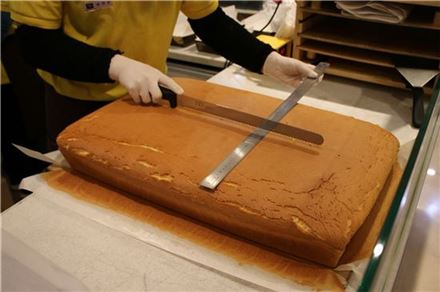 Taiwanese-style Castella
Saccharin, Once Restricted Due to Carcinogenic Concerns, Returns Thanks to Successive Positive Studies
The artificial sweetener saccharin was long misunderstood as a carcinogen. Discovered in 1878 at Johns Hopkins University in the United States, saccharin is an artificial sweetener about 300 times sweeter than sugar. However, in 1977, a study by Canada's Health Protection Branch sparked widespread concern about saccharin. When laboratory mice were given large amounts of saccharin, the incidence of bladder cancer increased. As a result, many countries classified saccharin as a carcinogen and restricted its use.
Misunderstandings about saccharin were dispelled as follow-up studies were published. First, it was pointed out that the Canadian study itself was problematic: laboratory mice were administered saccharin at doses equivalent to 500 times the daily allowable intake for humans, every day for two years. Furthermore, because the urine composition and osmotic pressure of mice and humans differ, no link was found between saccharin intake and bladder cancer in humans. Based on these findings, the World Health Organization (WHO) declared in 1992 that saccharin is not a carcinogen. Subsequently, in 1998, the International Agency for Research on Cancer (IARC), the United States National Toxicology Program (NTP), and in 2000, the U.S. Food and Drug Administration (FDA) all removed saccharin from their lists of human carcinogens.
Today, saccharin is even being studied as an anticancer agent. In 2015, researchers at the University of Florida College of Medicine reported that saccharin slowed the growth of breast cancer cells. The research team expects that saccharin could help prevent the spread of rapidly metastasizing cancers such as breast, liver, and kidney cancer. There are also studies suggesting that saccharin could be used to eliminate antibiotic resistance. In April of this year, a team from Brunel University London published in the journal "EMBO Molecular Medicine" that saccharin killed drug-resistant bacteria and enhanced the effectiveness of existing antibiotics. Professor Ronan McCarthy of Brunel University stated, "A sweetener used in diet foods has opened up the possibility of being used as a future alternative to antibiotics."
© The Asia Business Daily(www.asiae.co.kr). All rights reserved.
![Clutching a Stolen Dior Bag, Saying "I Hate Being Poor but Real"... The Grotesque Con of a "Human Knockoff" [Slate]](https://cwcontent.asiae.co.kr/asiaresize/183/2026021902243444107_1771435474.jpg)

















