South Korea and U.S. Officials Finalize Joint Fact Sheet
Tug-of-War Over Tariff Reduction Timing Continues
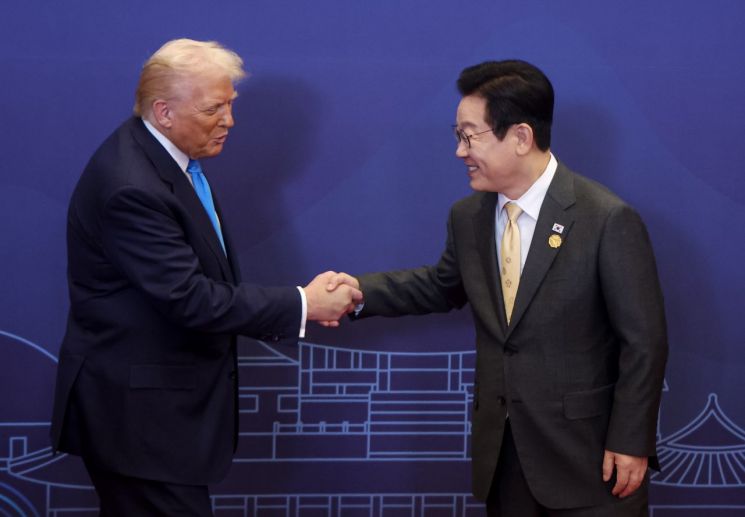 President Lee Jae-myung is greeting U.S. President Donald Trump ahead of the special summit dinner hosted by the president on the 29th at the Grand Ballroom of Hilton Hotel in Gyeongju, Gyeongbuk. Photo by Yonhap News
The announcement of the 'Joint Fact Sheet,' which contains the details of tariff and security negotiations between South Korea and the United States, is imminent. As the national interest will be affected by how the two countries specify the implementation of their agreements, attention is focused on the content and wording of the fact sheet.
According to the Office of the President and government sources on November 5, South Korea and the United States have nearly finalized the fact sheet summarizing their agreements in the areas of tariffs and security, as well as a memorandum of understanding (MOU) related to $350 billion in investment in the United States. Policy Chief Kim Yongbeom stated that the process is "almost complete," and Minister of Trade, Industry and Energy Kim Jeonggwan also said on November 4 that "the announcement will not be delayed."

In the area of tariffs, the timing of the reduction is a key issue. Although South Korea and the United States agreed to lower automobile tariffs in July, the reduction has not yet been implemented. If the fact sheet sets the reduction date as early as possible, more tariffs can be retroactively refunded. In the case of the European Union, the fact sheet was announced at the end of July, published in the official gazette at the end of September, and tariffs were retroactively applied from August 1.
Accordingly, it appears that the South Korean government has proposed August 7 as the reduction date. On November 4, a text message from Minister Kim was made public, in which Deputy Minister of Trade Park Jeongseong wrote, "Regarding the timing of the tariff reduction... instead of the August 7 date we proposed." August 7 is the day South Korea finalized and implemented the mutual tariff rate. However, it is reported that the U.S. side insists that the date of the MOU signing should be used as the reference point.
For semiconductors, it is expected that the fact sheet will include the agreed details. U.S. Secretary of Commerce Howard Lutnick caused controversy by stating on his social media that "semiconductors are not part of this agreement." However, the Office of the President clarified that this simply means the MOU for the U.S. investment fund does not include semiconductors, and that the wording for the fact sheet has already been finalized.
Another key issue is the extent to which South Korea can secure a U.S. commitment to 'tariff reduction.' It is known that South Korea wants the official gazette announcing the U.S. tariff reduction on Korean goods to be published simultaneously with the signing of the MOU. This is because, even after signing the MOU, it takes time for the official gazette, which gives legal effect, to be published. However, the U.S. government reportedly maintains that the publication in the official gazette is a process that takes place after the MOU is signed, and that Secretary Lutnick's confirmation is not necessary since the fact sheet exists.
In the area of security, it is highly likely that the fact sheet will include content regarding nuclear-powered submarines. However, as the issue quickly emerged as a key topic at the Asia-Pacific Economic Cooperation (APEC) Summit in Gyeongju and was discussed for only a short period, it is generally agreed that it will be difficult to specify detailed matters. If the wording simply reaffirms the two countries' commitment to cooperation, further discussions will be inevitable regarding where and how South Korea's nuclear-powered submarines will be constructed.
U.S. President Donald Trump previously posted on social media that South Korea would build nuclear-powered submarines at the Philly Shipyard in Philadelphia, United States. However, the Philly Shipyard is outdated and faces the drawback of having to go through complex approval procedures under U.S. law.
Meanwhile, at the 57th Security Consultative Meeting (SCM) between South Korea and the United States on November 4, agreements were reached on key issues such as the introduction of nuclear-powered submarines, the transfer of wartime operational control, and the modernization of the South Korea-U.S. alliance. U.S. Secretary of War (Defense) Pete Hegseth stated regarding the introduction of nuclear-powered submarines, "I reaffirm the parts approved by President Trump." Other issues discussed included increasing the defense budget to 3.5% of gross domestic product (GDP) and strengthening the strategic flexibility of U.S. Forces Korea.
© The Asia Business Daily(www.asiae.co.kr). All rights reserved.
![Clutching a Stolen Dior Bag, Saying "I Hate Being Poor but Real"... The Grotesque Con of a "Human Knockoff" [Slate]](https://cwcontent.asiae.co.kr/asiaresize/183/2026021902243444107_1771435474.jpg)

















