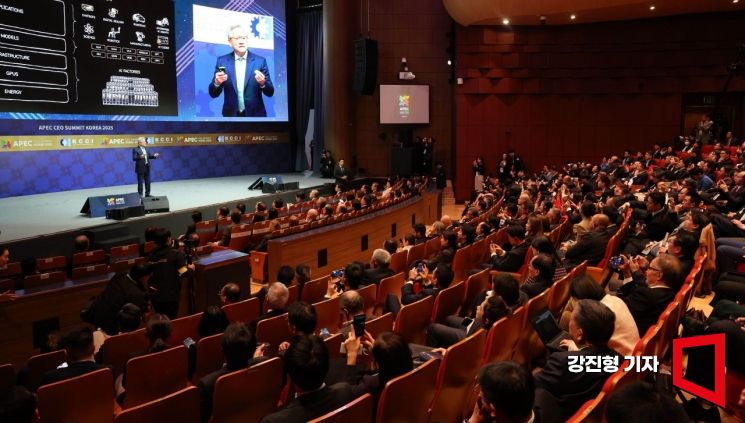
 Jensen Huang, CEO of Nvidia, is delivering a speech at the Asia-Pacific Economic Cooperation (APEC) CEO Summit held on the afternoon of the 31st at Gyeongju Arts Center, Gyeongbuk. 2025.10.31 Photo by Kang Jinhyung
With the explosive growth of the artificial intelligence (AI) industry, demand for data center infrastructure is surging, which is in turn driving a sharp increase in the need for components required to build 800G (bps) ultra-high-speed optical communication networks.
The traffic generated during AI training and inference processes is increasing by dozens of times compared to traditional cloud environments. As a result, demand is rising for core components essential to the 800G ecosystem-including optical transceivers, optical multiplexers, and high-density interconnect (HDI) substrates-that are crucial for boosting inter-server connection speeds and transmission bandwidth.
According to industry sources, global big tech companies are actively pursuing the transition to 800G as a key strategy for advancing next-generation data centers and AI networks. In practice, Nvidia, a leader in the AI semiconductor market, has unveiled its xAI 'Colossus' network featuring 800G spectrum switches, while social media company Meta has announced the adoption of 800G infrastructure for its next-generation data center expansion. American optical transceiver manufacturer AOI is expanding its 800G production lines and has mentioned the possibility of collaboration with Amazon.
800G-class optical communication refers to next-generation high-speed communication infrastructure capable of transmitting data at 800G per second. With transmission speeds significantly improved over existing 100G and 400G networks, it can efficiently handle the massive data traffic generated during AI training and inference. This ultra-high-speed transmission capability is essential not only for inter-server connections within data centers but also for medium- and long-distance communication between clusters and racks.
Opticore, a domestic company specializing in optical transceivers and optical multiplexers, is expected to expand its orders based on its experience as the world's first to commercialize '800G optical transceivers for intelligent information networks.' The 800G optical transceiver is a core device for resolving high-speed data transmission bottlenecks between AI servers, with transmission speed and power efficiency more than doubled compared to previous models.
Opticore is the only company in Korea capable of independently handling the entire process from design to production by utilizing its own optical communication laser technology. Leveraging its stable business relationships and technological capabilities with Korea's three major telecom operators-SK Telecom, KT, and LG Uplus-the company is strengthening its position as a key supplier for AI data centers.
In September, Opticore signed a contract worth 6.7 billion won with a major domestic cloud service provider (CSP) to supply optical transceivers for AI data centers, marking a full-scale expansion of its business portfolio into AI infrastructure. Since AI data centers require high-spec, medium- to long-distance (2 to over 10 km) optical transceivers instead of conventional short-distance (under 100m) models, these products are priced at roughly double the previous rate.
MDS Tech, the exclusive domestic distributor of the Nvidia Jetson series and a supply partner for AI servers based on A100, H100, and Blackwell, possesses a unique level of engineering capability in Korea. The company can provide integrated services beyond simple distribution, including server design, system construction, and technical support.
Meanwhile, according to global market research firm Markets and Markets, the AI data center market is expected to grow at a compound annual growth rate of 31.6%, from 236.4 billion dollars this year to 933.7 billion dollars by 2030.
© The Asia Business Daily(www.asiae.co.kr). All rights reserved.

















