"Many Technical and Institutional Challenges Remain"
Request Made to Ease Qualification Criteria for Integrated Environmental Managers
Small and medium-sized automotive parts manufacturers in Ulsan have requested the government to streamline the administrative procedures for temporary vehicle operation permits.
On November 5, Choi Seungjae, the Small and Medium Business Ombudsman, announced that the 'S.O.S. Talk (Small and Medium Business Roundtable)' was held at the Ulsan Regional Office of the Korea SMEs and Startups Agency.
S.O.S. Talk is a joint roundtable meeting that has been co-hosted by the Small and Medium Business Ombudsman and the Korea SMEs and Startups Agency since 2015 to address regulatory challenges faced by small and medium-sized enterprises. This meeting was attended by approximately 20 people, including Ombudsman Choi Seungjae, representatives of local SMEs and startups in Ulsan, Ban Jeongsik, Regional Innovation Director of the Korea SMEs and Startups Agency, Noh Hyungseok, Head of the Ulsan Regional Office of the Ministry of SMEs and Startups, and Park Mijeong, Head of the Ulsan Regional Office of the Korea SMEs and Startups Agency.
The main topic of discussion at the roundtable was the administrative processing system for temporary vehicle operation permits. As Ulsan is a hub of the domestic automotive industry, the procedures for temporary operation permits for test vehicles and similar cases occur frequently in the region.
Company A stated, "To temporarily operate a vehicle for purposes such as performance testing without registering it, companies must visit and apply in person at the local government office to obtain a permit. For small and medium-sized businesses, which have high frequencies of test drives and limited personnel, this creates a significant administrative burden." The company emphasized the need for a non-face-to-face application system for temporary operation permits, as well as the simplification of application documents through electronic document and administrative information sharing systems.
In response, the Ombudsman explained that, after consulting with the Ministry of Land, Infrastructure and Transport, this work falls under the jurisdiction of local governments, and there are difficulties in standardizing the different administrative processes across municipalities. The Ombudsman also noted that building a new system or improving the existing one for temporary operation permits would require a number of technical and institutional considerations, such as amending relevant legislation. "The Ministry of Land, Infrastructure and Transport believes that, to improve this, it is necessary to review technical feasibility and secure the required budget over the mid- to long-term," the Ombudsman explained.
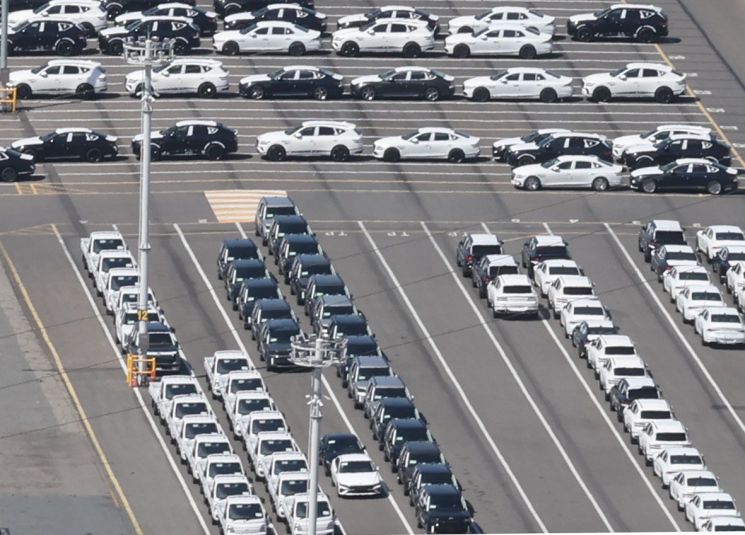 Finished vehicles are waiting in the storage yard next to the export shipment dock at Hyundai Motor Company's Ulsan plant.
Next, Company B requested a relaxation of the qualification criteria for integrated environmental managers at workplaces subject to the Environmental Pollution Facilities Act, such as air and water pollution emission facilities. Company B pointed out, "Since January last year, workplaces above a certain size with environmental pollution emission facilities have been required to appoint an integrated environmental manager who oversees air, water, and other environmental media. However, small and medium-sized enterprises face difficulties in securing personnel who have obtained an air or water environment engineer license and have at least four years of experience in environmental work."
The Ministry of Climate, Energy and Environment, which is responsible for this matter, explained that for small and medium-sized enterprises, the implementation of the system has already been deferred by one year, and the appointment requirements have been relaxed to allow a general manager to serve concurrently as the chief manager. The ministry also stated that it is working to revise relevant regulations to allow environmental specialists from outsourced agencies to be appointed as integrated environmental managers.
In addition, participants proposed various on-site regulatory challenges, including rationalizing industrial safety management standards through the use of fire safety certified products, diversifying the management units for extended work hours, and reducing administrative costs through integrated management of hazardous chemicals.
Ban Jeongsik, Regional Innovation Director of the Korea SMEs and Startups Agency, said, "Going forward, the Korea SMEs and Startups Agency will continue to work at the frontlines with the Ombudsman to ensure that the challenges faced by SMEs and startups in the field are reflected in policy."
Ombudsman Choi Seungjae stated, "Since improving unreasonable regulations is directly linked to strengthening the competitiveness of regional industries, we will continue to expand field-oriented communication channels in each region. I hope that this discussion will serve as an opportunity to promote innovation activities among Ulsan's SMEs and strengthen the foundation for the continued growth of Ulsan's key industries, such as automotive and chemicals."
© The Asia Business Daily(www.asiae.co.kr). All rights reserved.
![Clutching a Stolen Dior Bag, Saying "I Hate Being Poor but Real"... The Grotesque Con of a "Human Knockoff" [Slate]](https://cwcontent.asiae.co.kr/asiaresize/183/2026021902243444107_1771435474.jpg)

















