Despite Palantir's "Surprise Earnings,"
Overvaluation Concerns Grip the Market
Wall Street Titans Like Solomon and Pick Warn of a 10?20% Correction
Fed Divisions Deepen... December Rate Cut Outlook Remains Uncertain
All three major indices on the New York Stock Exchange began the session lower on November 5 (local time). Despite Palantir reporting a surprise earnings beat, concerns about overvaluation in artificial intelligence (AI) stocks have come to the fore, prompting investors to take profits. In addition to growing fears of a prolonged U.S. federal government shutdown, internal disagreements within the Federal Reserve over a potential December rate cut are also dampening investor sentiment.
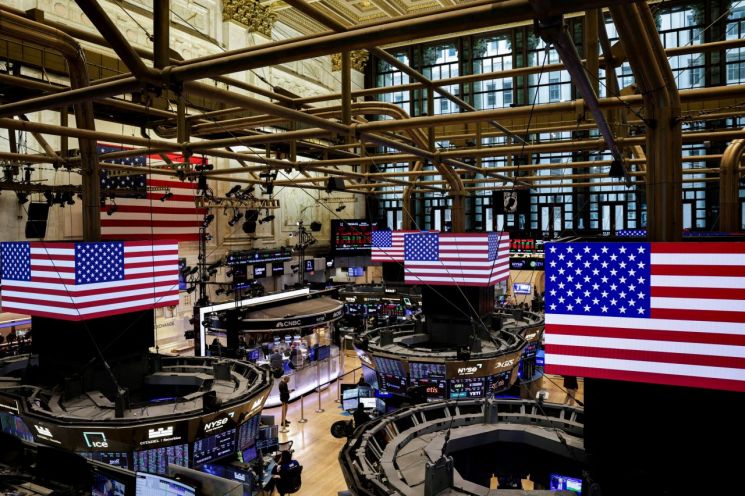
As of 10:07 a.m. on the New York Stock Exchange, the blue-chip Dow Jones Industrial Average was down 140.5 points (0.3%) from the previous session, trading at 47,196.18. The large-cap S&P 500 Index had dropped 41.03 points (0.6%) to 6,810.94, while the tech-heavy Nasdaq Index had fallen 214.82 points (0.9%) to 23,619.903.
By stock, Palantir was plunging by 7.6%. Despite reporting better-than-expected earnings, the company failed to provide a full-year 2026 outlook, leading to a wave of disappointment-driven selling. Oracle was down 1.53%. Nvidia and AMD were down 2.13% and 2.09%, respectively.
While the rally in AI-related stocks continues, concerns about valuations are also intensifying. Palantir’s share price has soared 173% so far this year, and its forward price-to-earnings ratio (PER) exceeds 200 times projected earnings. Oracle’s forward PER stands at around 35. According to financial data provider FactSet, buoyed by the rise in AI stocks, the S&P 500’s forward PER has surpassed 23, nearing its highest level since 2000.
Wall Street heavyweights are also warning about valuation pressures.
David Solomon, CEO of Goldman Sachs, predicted the previous day that “there is a high likelihood the stock market will fall by 10-20% over the next 12 to 24 months.” Ted Pick, CEO of Morgan Stanley, also stated, “We must accept the possibility of a 10-15% correction, not due to a macroeconomic shock, but because of the market’s overvaluation.”
Adam Crisafulli, founder of Vital Knowledge, pointed out, “Our biggest complaint about U.S. equities is that market participation is extremely fragmented,” adding, “A handful of large technology stocks are leading the market and masking significant warning signs beneath the surface.”
Additionally, the prospect of a prolonged U.S. federal government shutdown is weighing on the market. This shutdown has now reached its 35th day, and if it continues past midnight, it will break the previous record for the longest shutdown, which lasted from December 22, 2018, to January 25, 2019 (35 days).
Furthermore, within the Fed, there is a growing divergence of views among members between “holding” and “cutting” rates for December, weakening expectations for a rate cut. The market hopes the Fed will support stock prices and mitigate the slowdown in the economy and employment through a rate cut.
U.S. Treasury yields are falling. The yield on the benchmark 10-year Treasury note is at 4.09%, while the policy-sensitive 2-year Treasury yield is at 3.58%, down 1 basis point (1bp = 0.01 percentage point) and 2 basis points, respectively, from the previous day.
© The Asia Business Daily(www.asiae.co.kr). All rights reserved.

















