- Record-High Transactions in Regulated Areas After October 15 Measures
Driven by Market’s Learned Response to Past Policies
- Sharp Price Surges in Regulated Zones Following Stringent Regulations
Now Dubbed “Speculative Hot Spots”
Despite the stringent real estate measures announced on October 15, the property market in regulated areas remains steady. The recurring pattern of property prices rising in these regions after the implementation of strong real estate regulations by successive governments appears to have created a learning effect among buyers, influencing their expectations and behavior.
On October 15, the government designated all 25 districts of Seoul, as well as Sujeong, Bundang, and Jungwon districts in Seongnam, Gwacheon, Gwangmyeong, Yeongtong, Jangan, and Paldal districts in Suwon, Dongan district in Anyang, Suji district in Yongin, Uiwang, and Hanam as regulated areas. These locations were simultaneously designated as speculative zones, adjustment target areas, and land transaction permit zones, resulting in the application of a wide range of stringent regulations.
First, the stress rate (DSR) has been raised, and the loan-to-value ratio (LTV) for first-time home buyers is being reduced from 70% to 40%. If a borrower has unsecured loans exceeding 100 million won, home purchases within regulated areas are restricted for one year from the date of the loan, and resale of the property is prohibited for three years after acquisition.
Additionally, the transfer of association membership rights in redevelopment and reconstruction projects is strictly prohibited. Depending on the property price, the mortgage loan limit is reduced to 400 million won for homes priced over 1.5 billion won up to 2.5 billion won, and to 200 million won for homes priced over 2.5 billion won. As these areas are designated as land transaction permit zones, a two-year mandatory residence requirement is also imposed.
Nevertheless, even with such strong regulations, the property market in key regulated areas-such as the three Gangnam districts-remains unshaken.
In fact, record-high transactions continue to occur in regulated areas even after the new measures. According to the Ministry of Land, Infrastructure and Transport’s actual transaction data, a 117-square-meter unit in Olympic Family Town in Munjeong-dong, Songpa-gu, Seoul, set a new record price on October 16, selling for 2.79 billion won-90 million won higher than the previous record.
Similarly, a 48-square-meter unit in Hillstate Cheonggye in Dapsimni-dong, Dongdaemun-gu, was sold at a record price of 1.105 billion won, up 57 million won. In Guro-dong, Guro-gu, a new owner purchased an 84-square-meter unit in Singuro Xi at a record price of 815 million won.
Experts point to the shared perception that previous rounds of strong regulation have ultimately led to price increases as the reason for the resilience of regulated real estate markets. One real estate expert commented, “Among buyers, there is a belief that regulated areas are essentially a bible for prime locations and that the government has identified them as key investment spots. Because the high value and scarcity of these areas remain fundamentally unchanged, it is inevitable that prices will rise again once regulations are lifted.”
This trend was clearly observed after the Moon Jae-in administration’s August 2, 2017 real estate measures. The August 2 measures reintroduced speculative zones for the first time in seven years, designating all of Seoul, Gwacheon, and Sejong as regulated areas. They drew attention for unprecedentedly strict regulations, including lowering LTV and DTI to 40%, tightening subscription eligibility, reinstating price caps on private land, and reintroducing the reconstruction excess profit recovery system.
However, after the August 2 measures, these regulated areas became known as “speculative hot spots,” with prices soaring. According to the Korea Real Estate Board’s monthly apartment sales price index, the index for Seoul apartments, which stood at 84.85 in August 2017, remained steady at an average of 85.61 for about half a year, but then began to surge, reaching 93.22 in November 2018-an increase of 9.86% in just over a year.
This year has been no different. In the three Gangnam districts and Yongsan district-where speculative zone and land transaction permit regulations were applied-the sales price index rose sharply from January to September: Songpa-gu saw a 14.92% increase (from 96.14 to 110.49), while Gangnam-gu (up 11.49%), Seocho-gu (up 11.65%), and Yongsan-gu (up 7.81%) also posted significant gains.
This is why new residential developments in regulated areas are drawing strong interest.
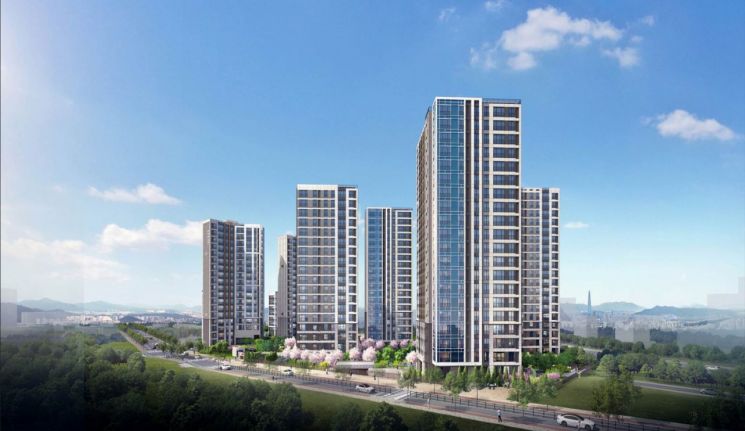
In Bokjeong-dong, Sujeong-gu, Seongnam, Gyeonggi Province, the Bokjeong Station Epitte project in Block B1 of Bokjeong District 1 is scheduled to launch sales in November. The project will consist of six buildings, each with two basement levels and up to 20 floors above ground, offering 315 units-all of which are the highly popular 84-square-meter type. HL D&I Halla is the construction company. Located in the Bokjeong Station area, which is served by both Line 8 and the Suin-Bundang Line, residents can access the Gangnam area in just one stop and have easy access to Wirye New Town, making it part of both the Gangnam and Wirye lifestyle zones. The project is subject to price caps, and the surrounding area is set to benefit from major developments, including a Bokjeong Station transfer center complex, the Posco Global Center, and a large-scale Bokjeong Station area development project worth over 10 trillion won.
© The Asia Business Daily(www.asiae.co.kr). All rights reserved.
![Clutching a Stolen Dior Bag, Saying "I Hate Being Poor but Real"... The Grotesque Con of a "Human Knockoff" [Slate]](https://cwcontent.asiae.co.kr/asiaresize/183/2026021902243444107_1771435474.jpg)
















