3 a.m., speeding at 128 km/h, crashes into motorcycle
Female passenger killed
Immediately after accident, asks acquaintance for help to flee
Prison sentence reduced from 10 years to 7 years 6 months on appeal and at Supreme Court
Requesting a ride does not constitute "instructing to aid escape"
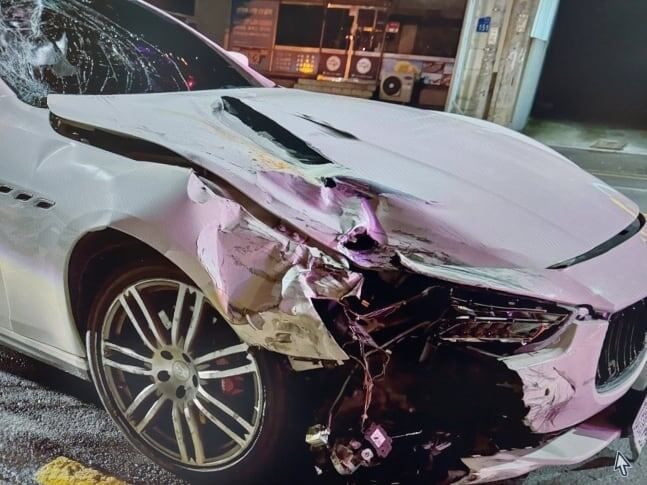 At around 3:11 a.m. on the 24th, a Maserati passenger car that collided with a motorcycle carrying a man and a woman was damaged due to the impact on a road in Hwajeong-dong, Seo-gu, Gwangju Metropolitan City. As a result of the accident, the woman on the motorcycle died, and the man was seriously injured and is receiving hospital treatment. /Gwangju Western Police Station
The so-called "Maserati hit-and-run" case, in which a driver, while intoxicated, drove at a speed of 128 km/h, struck a motorcycle and killed one person before fleeing the scene, has resulted in a final Supreme Court sentence of seven years and six months in prison.
According to the legal community on November 5, the Supreme Court's Second Division (Presiding Justice Eom Sangpil) sentenced the male driver to seven years and six months in prison. The court also dismissed the prosecution's appeal regarding the charge of instructing another person to help him evade arrest, ruling that the driver could not be held criminally liable for instructing someone else to help him escape in this case.
This incident, known as the "Gwangju Maserati hit-and-run accident," occurred on September 25 of last year. At around 3:10 a.m. that day, the man was driving a foreign luxury car at approximately 128 km/h when he rear-ended a motorcycle. The female passenger on the back of the motorcycle died as a result. The man then told an acquaintance, "I caused a traffic accident. Please give me a ride to Daejeon," and fled the scene.
The main issues in the case were: ① whether it could be proven that the driver was intoxicated (with a blood alcohol concentration of at least 0.03%), and ② whether he could be held criminally liable for asking an acquaintance to drive him to Daejeon. The court of first instance sentenced him to 10 years in prison, but the appellate court reduced the sentence to seven years and six months. This was due to a lack of evidence to substantiate the prosecution's estimate of the driver's blood alcohol concentration at the time of the accident (0.093%). The appellate court also did not accept the prosecution's charge of instructing another person to help the perpetrator escape.
The Supreme Court upheld this ruling. It found that the driver's request for an acquaintance to move the vehicle was merely a request for assistance and did not constitute instructing or encouraging concealment or obstruction of the investigation. The Supreme Court also agreed with the lower court that there was insufficient evidence to prove drunk driving, finding no legal error in the appellate court's judgment. Meanwhile, the man who helped the driver escape was sentenced to eight months in prison with a two-year suspended sentence for aiding and abetting the escape of a criminal. As he did not appeal, the appellate court's ruling became final.
© The Asia Business Daily(www.asiae.co.kr). All rights reserved.

















