Usually Patrolled with Police Wearing a Bulletproof Vest
Mexican Criminal Organizations Continue to Assassinate Officials and Journalists
Over 20 Politicians Killed in the Past Year
As drug-related issues have emerged as the greatest risk in Mexico, the country has been engaged in a "war on drugs" for 20 years. However, brutal retaliatory killings targeting public officials continue unabated, with a significant number of victims being mayors of local cities. Amid this situation, an incumbent mayor of a Mexican city was shot and killed by a criminal organization while attending the traditional Day of the Dead festival. In an interview before his death, the mayor had referenced the ordeals faced by previous Mexican local city mayors who fell victim to criminal organizations, stating, "I don't want to die," but ultimately could not escape the bullets.
 At the "Day of the Dead" event, Carlos Manso (40), mayor of Uruapan city in Michoac?n state, Mexico, was shot and killed by an assailant while attending the event held in the city square. Photo by Reuters Yonhap News
On November 2, Yonhap News reported, citing local Mexican media, that while the Mexican government condemned the killing of an incumbent mayor who had been taking strong action against violent groups, it expressed a negative stance on resuming the so-called "war on drugs" as it was conducted in the past. The previous day, Carlos Manso (40), mayor of Uruapan in Michoacan state, was shot and killed by an assailant while attending a Day of the Dead event in the city square. The suspects fired seven shots at the mayor during a ceremony in which citizens were mourning their deceased relatives and acquaintances. Mayor Manso was known for wearing a bulletproof vest as a precaution against terror attacks, but it is unknown whether he was wearing one at the time of the shooting.
 A tribute to Mayor Manso, who gained recognition as the "mayor fighting crime wearing a cowboy hat and bulletproof vest." Photo by Reuters Yonhap News
The police shot and killed one suspect at the scene and arrested two others. The killing of an incumbent mayor in Mexico came just two weeks after Miguel Bajena Solorzano, mayor of Pisaflores in Hidalgo state, was shot and killed by an assailant on his way home. Police believe the attack was carried out by a criminal organization harboring resentment against Mayor Manso, who had publicly called for the eradication of criminal groups. Uruapan is known as the "avocado capital of Mexico," being a major center for the cultivation of avocados, one of Mexico's key export crops. Criminal organizations are known to engage in extortion and violence against farmers over control of the avocado industry. The area is also a key transit point for drug smuggling, as it contains fields where drug-producing crops are grown.
Mayor Manso, who took office in September last year, declared a "war on crime" immediately after his inauguration. He also asserted that "criminals resisting arrest should be shot." He personally patrolled with the police, wearing a bulletproof vest and a white cowboy hat. Gaining recognition as the "mayor fighting crime wearing a cowboy hat and bulletproof vest," he publicly requested support from President Claudia Sheinbaum.
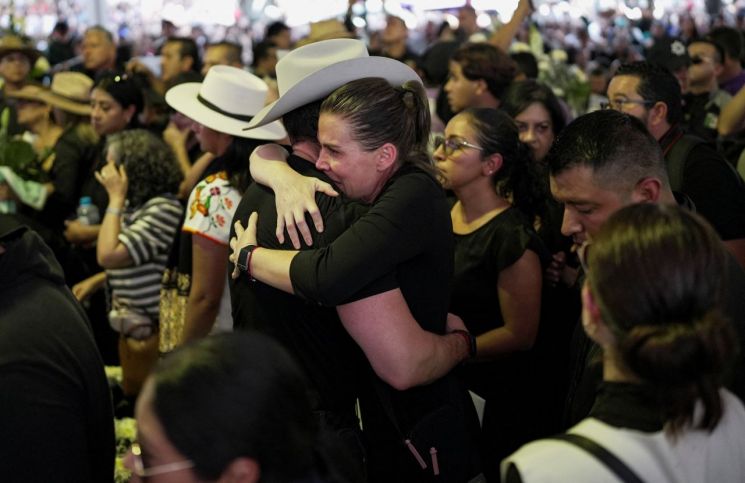 On the day of the funeral for Mayor Manso, hundreds of citizens in Uruapan and Michoacan staged protests demanding an end to violence and government corruption. Participants, dressed in black and holding photos of Mayor Manso, shouted "Justice" and "Morena, step down" at the ruling party, the National Regeneration Movement (Morena). Reuters Yonhap News Agency
On the day of Mayor Manso's funeral, hundreds of citizens in Uruapan and Michoacan staged protests demanding an end to violence and government corruption. Participants, dressed in black and holding photos of Mayor Manso, shouted "Justice" and "Morena, step down" at the ruling party, the National Regeneration Movement (Morena). In a local media interview last September, he stated, "I don't want to be added to the list of murdered mayors," but ultimately became yet another Mexican mayor killed by a criminal organization. Mexico serves as a key route and intermediate base for drugs entering the United States, and Mexican cartels have grown into global drug organizations rivaling the mafia.
Mexico's 20-Year "War on Drugs"
Mexico's "war on drugs" began at the end of 2006. Then-President Felipe Calderon (in office from 2006 to 2012) launched the war by deploying the military and federal police to Michoacan state to crack down on drug trafficking organizations immediately after taking office. This policy was continued by his successor, former President Enrique Pena Nieto (2012-2018).
As a result, for more than a decade, armed clashes between the military and police and cartels continued in some regions of Mexico.
In particular, during Calderon's presidency, frequent clashes occurred between the military, police, and drug organizations, and more than 90 local politicians, including mayors of local cities, fell victim to shootings and other attacks by criminal groups. Later, centrist President Enrique Pena Nieto (2012-2018) focused more on cracking down on serious crimes instead of armed conflict, while leftist President Andres Manuel Lopez Obrador (2018-2024) adopted the so-called "cartel inclusion policy," aiming to change the social atmosphere through various programs. Despite these policy shifts, nearly 100 cases of mayors and city council members being killed occurred during the tenures of these two leaders.

Meanwhile, President Sheinbaum, the political successor to former President Obrador, sought to shift to a more aggressive crackdown on drug organizations than her predecessor, but attacks targeting mayors and city council members have not abated, with more than 20 losing their lives during her tenure. Notably, shortly after President Sheinbaum took office in October last year, Alejandro Arcos, mayor of Chilpancingo in Guerrero state, was found beheaded just six days after his inauguration. In June, Marta Mendoza, mayor of Tepalcatepec in Michoacan state, was shot and killed along with her husband, and in the same month, Lilia Gema Garcia, mayor of San Mateo Pinas in Oaxaca state, and her staff were also shot and killed.
However, regarding the recent incident, President Sheinbaum drew a line, stating that her administration would not conduct large-scale cartel crackdowns as in previous governments. She said, "There are those who demand that our government control regions and militarize, as was done during the war on drugs, but such approaches are unlikely to be effective in suppressing crime," adding, "It has been empirically proven in Mexico that the 'war on drugs' only intensified the current level of violence."
In conclusion, local opinion is that the "war on drugs" policy has been a "failure." When the government dismantled drug trafficking organizations, the resulting power vacuum led to bloody turf wars among other groups seeking to control the now-unclaimed drug trafficking routes. In 2017, Mexico's homicide rate was among the highest in Latin America, reaching 25 per 100,000 people.
© The Asia Business Daily(www.asiae.co.kr). All rights reserved.



















