Largest Since COVID-19 Outbreak in 2020
White-Collar Positions Become Main Target
Active Restructuring Justified by AI Adoption
According to a report by the Nihon Keizai Shimbun (Nikkei) on November 4, major U.S. companies are carrying out large-scale layoffs, citing AI-driven efficiency improvements and tariff burdens as the main reasons.
According to Challenger, Gray & Christmas (CG&C), a U.S. employment information firm, the total number of layoffs at U.S. companies and institutions from January to September this year reached 946,426. Although this figure partially reflects public sector reductions by the Department of Government Efficiency (DOGE), even excluding these, the number increased by 10%. This is the highest level since 2020, when the COVID-19 pandemic spread.
While economic indicators and official employment statistics have yet to show signs of a slowdown, Nikkei pointed out that large corporations are competing to streamline their workforce, accelerating the trend of "jobless growth."
The biggest reason for the layoffs was "deteriorating market and economic conditions," accounting for about 20% of the total. In particular, the consumer and logistics sectors, which were hit hard by the Trump administration's tariff policies, saw the largest cuts. Layoffs in the retail sector tripled compared to the previous year, while the logistics sector saw a twofold increase. On October 28, logistics company UPS announced a reduction of 48,000 employees in the United States, and Procter & Gamble (P&G) carried out a global restructuring affecting 7,000 employees as consumer sentiment weakened due to higher tariffs.
Only 4% of companies identified AI as the direct cause of layoffs, but many companies have proactively begun restructuring with AI in mind. In particular, layoffs have been concentrated among white-collar positions that can be replaced by AI. For example, consulting giant Accenture announced a global restructuring plan worth approximately 130 billion yen, and has begun retraining workers and restructuring its business in response to AI adoption. PwC also cut 1,500 jobs in the United States.
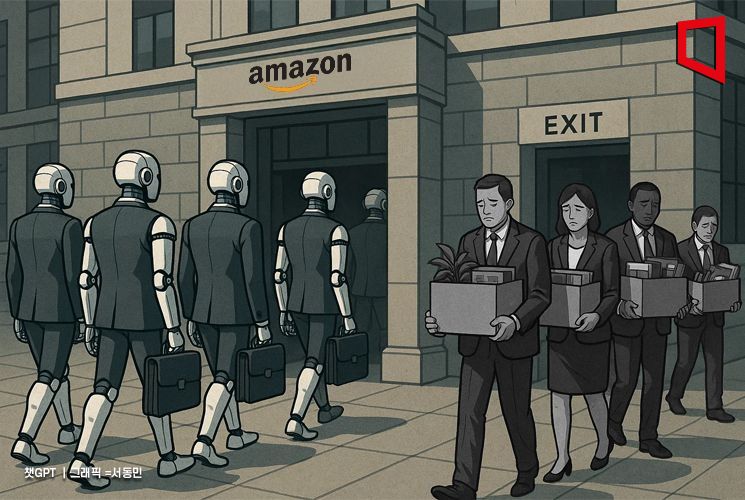
Big tech companies are no exception. As AI automation rapidly advances, major tech firms such as Microsoft (MS) and Amazon have also initiated large-scale layoffs. MS carried out two rounds of layoffs in May and July, totaling 15,000 employees, while Amazon announced a workforce restructuring of 15,000 employees, mainly targeting office and engineering positions.
Jessica Kriegel, Chief Strategy Officer (CSO) at Culture Partners, commented, "What is unusual about these layoffs is that they are happening regardless of the economic cycle," adding, "AI is becoming a new justification for restructuring."
Companies have explained that these large-scale layoffs are not solely due to AI itself, but are the result of efforts to optimize workforce structure. In June, Amazon CEO Andy Jassy stated, "The number of employees will decrease due to AI-driven efficiency," but clarified during the earnings announcement on October 30 that "at this point, it is not because of AI adoption."
Some analysts say that now is the most opportune time for companies to implement layoffs. Robin Erickson, a researcher at the Conference Board, a corporate psychology research institute, said, "Companies see now as the perfect time for restructuring under the pretext of AI adoption," and explained, "There is a perception that reducing staff now will go largely unnoticed."
Even within the U.S. Federal Reserve (Fed), concerns are being raised that the spread of AI could trigger workforce restructuring and limit job creation. According to the U.S. Department of Labor's Job Openings and Labor Turnover Survey (JOLTS), the layoff rate has remained low since the pandemic. At a press conference last month, Fed Chair Jerome Powell stated, "There has been no change yet in the number of new unemployment claims," and "There are no signs of a sharp contraction in the labor market." However, he added, "AI could have a significant impact on future job creation."
© The Asia Business Daily(www.asiae.co.kr). All rights reserved.

















