Economic Ministers' Meeting and Price Ministers' Meeting
Consumer Price Inflation Rises 2.4% in October
Koo Yoonchul, Deputy Prime Minister for Economy and Minister of Economy and Finance, announced on November 4 that, "To ease the burden of grocery prices during the kimchi-making season, the government will release 47,000 tons of available cabbage and radish, and around 5,000 tons of chili peppers, garlic, onions, and salt in a concentrated manner."
At the Economic Ministers' Meeting and Price Ministers' Meeting held on the same day, Deputy Prime Minister Koo stated, "We will make every effort to stabilize living costs, which are at the core of the people's livelihood economy."
He added, "We will invest a record-high 50 billion won in discount events for the kimchi-making season, offering up to 50% discounts on kimchi vegetables, salted shrimp, pork, and more. Relevant ministries will continuously monitor the prices and supply-demand situation for each item, and if necessary, we will immediately prepare additional response measures."
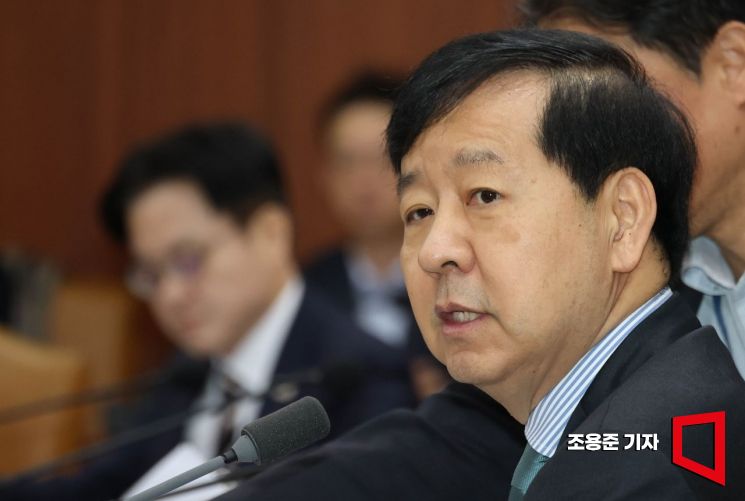 Koo Yoonchul, Deputy Prime Minister for Economy and Minister of Economy and Finance, is attending and speaking at the Economic Ministers' Meeting, Price-related Ministers' Meeting, and Industrial Competitiveness Enhancement Ministers' Meeting held at the Government Complex Seoul in Jongno-gu, Seoul on November 4, 2025. Photo by Jo Yongjun
According to the National Data Office, the consumer price inflation rate in October reached 2.4%, marking the highest level in one year and three months since July last year (2.6%). This was due to the rise in certain agricultural products and petroleum products resulting from last year's base effect, as well as a significant increase in service prices such as accommodation and travel caused by the extended Chuseok holiday period.
In response, Deputy Prime Minister Koo emphasized, "Given the uncertainties such as weather conditions, we will remain vigilant and do our utmost to stabilize living costs, which are at the core of the people's livelihood economy."
Furthermore, the government will fundamentally improve the distribution structure of the fisheries industry with the goal of reducing seafood distribution costs by 10% by 2030. This will involve revitalizing online wholesale markets, expanding production-area distribution centers and consumption-area distribution centers, and simplifying distribution channels. The entry requirements will also be eased, more than doubling the number of traded items (from 60 to 134).
Deputy Prime Minister Koo stated, "By 2028, we plan to establish five smart aquaculture clusters, swiftly develop an artificial intelligence (AI)-based seafood supply-demand forecasting model, and actively foster the smart aquaculture industry."
© The Asia Business Daily(www.asiae.co.kr). All rights reserved.
![Clutching a Stolen Dior Bag, Saying "I Hate Being Poor but Real"... The Grotesque Con of a "Human Knockoff" [Slate]](https://cwcontent.asiae.co.kr/asiaresize/183/2026021902243444107_1771435474.jpg)
















