Gangwon Police Investigate 560 Cases Nationwide; Damages Total 6.9 Billion Won
Cambodia Call Center Raided; 18 Key Members Detained
80% of Suspects in Their 20s and 30s, Four Teenagers Involved
Since the end of last year, a criminal group that impersonated military personnel, political parties, or the presidential security office and committed no-show or proxy purchase fraud targeting small business owners has been apprehended by the police. It was revealed that they were based in Cambodia, where they operated a local call center to carry out their crimes.
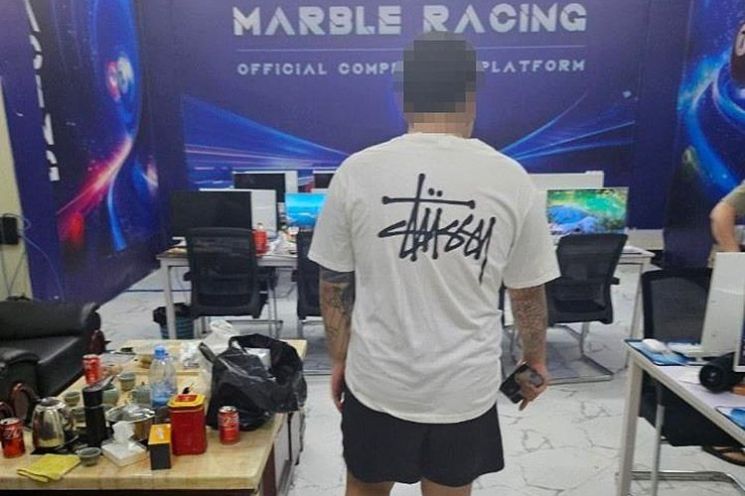 A gang based in Cambodia that impersonated military units, political parties, and the presidential security office to commit no-show or proxy purchase fraud has been arrested by the police. Gangwon Provincial Police Agency
The Gangwon Provincial Police Agency announced on the 3rd that they had arrested 114 members of the organization, both domestic and international, including those in Cambodia, on charges of fraud under the Act on the Aggravated Punishment of Specific Economic Crimes, fraud under the Criminal Act, and joining and participating in a criminal organization. Eighteen of them have been detained.
Designated as a special investigation unit for no-show fraud at the end of last year, the Gangwon police received a total of 560 fraud cases from across the country and conducted an intensive investigation. Of these, 402 cases involved impersonation of the military, while 158 cases involved impersonation of political parties or the presidential security office. The total amount of damages reached 6.9 billion won. By region, Gyeonggi Province recorded the highest number of military impersonation cases with 80, while Seoul had the most cases of impersonating political parties or the presidential security office, with 32.
The police identified the criminal group's base as a crime complex in Sihanoukville, Cambodia, and, in cooperation with the National Police Agency, the International Criminal Police Organization (ICPO/Interpol), and the National Intelligence Service, raided the local call center and apprehended the suspects. In addition, a total of 114 domestic and international members were successively arrested, including those responsible for money laundering, management, overall management, relay device management, call center staff, and domestic ringleaders.
Investigations revealed that the overseas ringleaders, known as the "executive team," operated a call center in Cambodia and managed both domestic and international money laundering and relay device management networks. The call center was divided into teams impersonating the military or political parties and teams pretending to be sales companies, each carrying out fraud. They would conceal their identities and make group reservations at restaurants, then ask the business owners to "purchase items needed for the event in advance," instructing them to order combat rations, wine, lunch boxes, and other goods from fake vendors designated by the criminals. Once the money was deposited, the group would disappear.
The overseas money laundering organization, in connection with domestic money laundering groups, transferred most of the stolen funds from domestic virtual asset exchanges to overseas virtual asset exchanges. The relay device managers evaded law enforcement by frequently changing locations in Seoul and Gyeonggi Province.
About 80% of the suspects were in their 20s or 30s, and there were four teenagers involved. One in four suspects was female. Those arrested in Cambodia were found to have voluntarily participated in the crimes through platforms such as Telegram.
Choi Hyunseok, Chief of the Gangwon Provincial Police Agency, emphasized, "We urge small business owners to always verify the actual contractual relationship through the official representative number of the relevant institution when asked to make proxy purchases. Please be aware that public institutions will never request a proxy purchase or ask for advance payment."
He added, "Any job offer, either domestic or overseas, that promises abnormally high returns compared to the difficulty of the work may result in kidnapping, confinement, or other harm, and could lead to being prosecuted as an accomplice to fraud and receiving severe punishment. Please be cautious of overseas job scams."
© The Asia Business Daily(www.asiae.co.kr). All rights reserved.

















