Microsoft AI Economy Institute "AI Diffusion Report"
"One in Four Koreans Uses AI... Korea Leads in AI Diffusion"
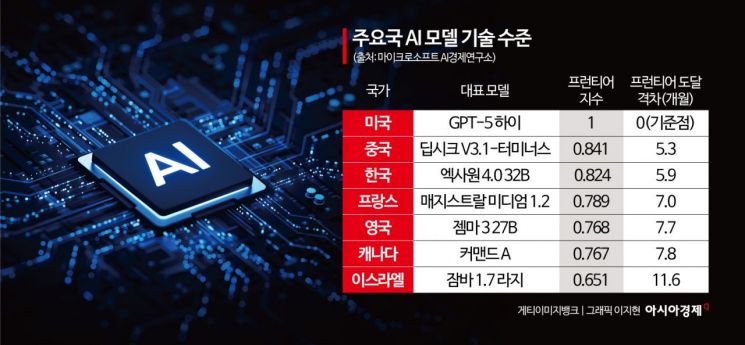
The AI Economy Institute (AIEI), an AI research institute under Microsoft, recently released its 'AI Diffusion Report,' in which Korea's large language model 'Exaone 4.0 (32B)' was evaluated to have performance approaching that of OpenAI's 'GPT-5,' with a gap of about six months (5.9 months). AIEI compared the top-performing AI models developed by each country and analyzed that Korea has secured the capability to implement frontier-level models within six months.
On November 5, Lim Woohyung, President of LG AI Research, commented on the AIEI report in a phone interview with The Asia Business Daily, saying, "This evaluation is based on a conversion to GPT-5 standards, meaning Korea has narrowed the gap with the world's best to within six months." He explained, "This means that a model with GPT-5-level performance could emerge domestically within six months, which is a very high assessment."
In the report released on October 31, AIEI calculated the 'AI Frontier Index' to compare the level of AI models developed by various countries. This index quantifies how close each country's top model is to the frontier, based on the model with the highest performance at a given point in time.
The metrics from 'Artificial Analysis,' an AI performance analysis agency cited by AIEI, serve as a data source for integrated evaluation of global AI models. Microsoft reprocessed this data to rank the performance of national models. For this, AIEI stated that it used seven benchmarks, including SciCode and LiveCodeBench for coding ability, and MMLU-Pro and HLE (Humanity's Last Exam) for knowledge measurement.
For example, China's DeepSeek V3.1, released in September 2025, showed similar performance to OpenAI's GPT-o3 (released in April of the same year), resulting in a '5.3 months to frontier' gap. Korea's Exaone 4.0 recorded a Frontier Index of 0.824, indicating that Korea is closing in on the world's top level with a lag of less than six months. Korea was recorded as the country with the third fastest 'frontier catch-up speed' in the world, following the United States and China.
Experts in the AI field also view these results positively. Lee Jaehui, Professor at the Department of Computer Science and Engineering at Seoul National University, said, "Given the rapid pace of AI research, a six-month gap essentially separates the 'leaders' from the 'chasers.' Even if you are not in the lead, with sufficient investment of funding and talent, you can catch up." He added, "This is the result of the overall technological capabilities of Korea's AI ecosystem advancing to a higher level compared to the past."
Additionally, AIEI analyzed that Korea's AI diffusion rate stands at 25.9%, significantly higher than the OECD average of 15.4%. Along with the United States, United Kingdom, and Japan, Korea is classified among the top-tier countries with high AI diffusion and infrastructure maturity, and is evaluated as one of the countries with the fastest AI diffusion speed in the world.
AIEI highlighted Korea as a representative example of successful diffusion, emphasizing the message that "diffusion is more important than invention." AIEI explained that, through a comparison of Korea and the Philippines-whose economies were of similar size in the 1960s-the ability to adopt and diffuse technology can be a turning point for national growth.
In 1960, the per capita income of both countries was about 2,000 dollars (approximately 2.86 million won) per year in today's currency, but Korea actively embraced modern manufacturing, export-led industrialization, and the expansion of higher education. In the late 1970s, the government designated semiconductors as a strategic industry and pursued joint public-private investment and technology adoption, enabling Korea to rapidly gain competitiveness in the global market. As a result, the Korean economy grew at an average annual rate of 6.2%, with living standards doubling every 11 years. In contrast, the Philippines remained focused on agriculture and mining, stagnating at an annual growth rate of 1.8%.
AIEI assessed, "Korea did not invent semiconductors, but it mastered how to produce them faster, cheaper, and better, becoming a global powerhouse in memory chip manufacturing." The report further emphasized, "Just as Edison invented the light bulb but widespread electricity required the development of power grids and everyday users, the same applies to AI."
© The Asia Business Daily(www.asiae.co.kr). All rights reserved.


















