Charge of “Engaging in Important Duties Related to Insurrection”
Special Prosecutor: “Seriousness of the Crime and Risk of Evidence Destruction”
“Sufficient Evidence of Collusion with Yoon in Insurrection”
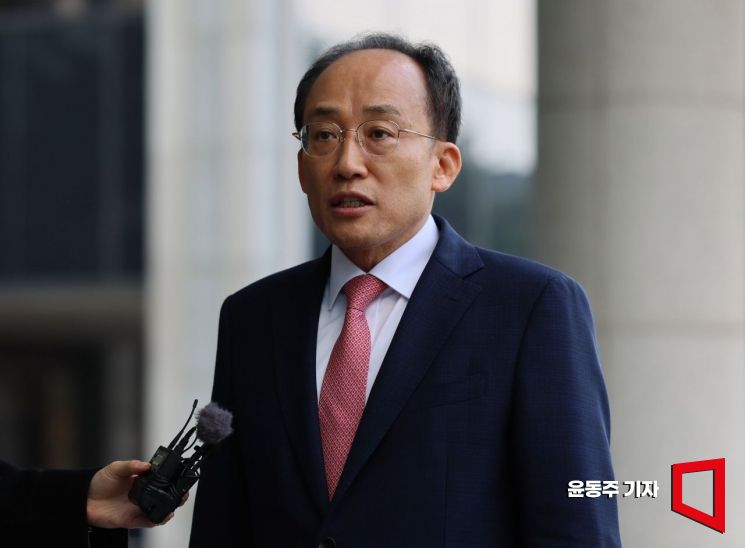 Former Floor Leader of the People Power Party, Choo Kyung-ho, is arriving at the Special Prosecutor's Office for Internal Affairs in Seocho-gu, Seoul, on the 30th.
The Special Prosecutor's Office for Internal Affairs (led by Special Prosecutor Cho Eunseok) has requested an arrest warrant for former Floor Leader of the People Power Party, Choo Kyungho, in connection with allegations of obstructing the resolution to lift martial law. This marks the first time the Special Prosecutor's Office has sought to detain a sitting member of the National Assembly.
At around 4 p.m. on November 3, the special prosecutor's team applied for an arrest warrant for Choo, charging him with engaging in important duties related to insurrection. The charge of abuse of authority, which was included when his residence and other locations were previously searched, was excluded from the crimes listed in this arrest warrant request.
Special Prosecutor Park Jiyoung stated, "We considered the seriousness of the crime and the risk of evidence destruction, and determined that there was sufficient evidence to support the issuance of a warrant. The key issue in the abuse of authority charge is whether anyone's rights were actually infringed, and since this requires further legal review, it was excluded. To minimize controversy at the warrant stage, we are seeking the arrest warrant solely on the charge of engaging in important duties related to insurrection."
Choo is suspected of obstructing other lawmakers from participating in the vote to lift martial law by repeatedly changing the location of the party caucus at the request of former President Yoon Sukyeol during the martial law declaration on December 3 last year. After the declaration of martial law, Choo convened an emergency caucus, changing the venue three times: from the National Assembly to the party headquarters, back to the National Assembly, and then again to the party headquarters.
The special prosecutor's team has also obtained records showing that Choo spoke by phone with former President Yoon and others immediately after the declaration of martial law. While traveling from his home to the National Assembly, Choo reportedly called former Senior Presidential Secretary for Political Affairs Hong Cheolho and former Prime Minister Han Ducksoo in succession, and then spoke with former President Yoon.
Special Prosecutor Park said, "The fact that Choo received instructions from former President Yoon is included in the alleged criminal conduct. While we cannot disclose the specific contents or methods of those instructions, we believe there is sufficient evidence of collusion."
Previously, on October 30, the special prosecutor's team summoned Choo as a suspect on charges of engaging in important duties related to insurrection and questioned him. The investigation, including the review of the written statement, lasted about 23 hours.
The special prosecutor's team stated that all prepared questions were covered during the investigation of Choo, and there are no plans for additional summons, leaving open the possibility of requesting an arrest warrant. During the investigation, Choo reportedly wrote in detail by hand the parts he wished to add to his statement and thoroughly reviewed the written record.
After completing the investigation, Choo told reporters, "I have explained in detail the facts that occurred on the day martial law was declared. I urge the administration to stop political oppression and retaliation and focus on the livelihood of the people."
Meanwhile, for a sitting lawmaker, the National Assembly must approve a motion for consent to arrest before the court can hold a substantive review of the warrant. Once the court sends the motion for consent to arrest to the special prosecutor's team, it is submitted to the National Assembly through the Ministry of Justice and put to a vote. The motion is passed if more than half of the total members are present and a majority of those present vote in favor. If passed, a date is set for the warrant hearing. If rejected, the court dismisses the warrant without a hearing.
© The Asia Business Daily(www.asiae.co.kr). All rights reserved.
![Clutching a Stolen Dior Bag, Saying "I Hate Being Poor but Real"... The Grotesque Con of a "Human Knockoff" [Slate]](https://cwcontent.asiae.co.kr/asiaresize/183/2026021902243444107_1771435474.jpg)











