International Academic Conference to Be Held on November 7
at the Main Auditorium of the National Folk Museum of Korea
The National Folk Museum of Korea, in collaboration with the National Museum of Japanese History, will hold an international academic conference on November 7 at the main auditorium of the National Folk Museum of Korea under the theme "Agricultural and Sericultural Life in Korea and Japan as Seen Through Gyeongjikdo (Scenes of Tilling and Weaving)."
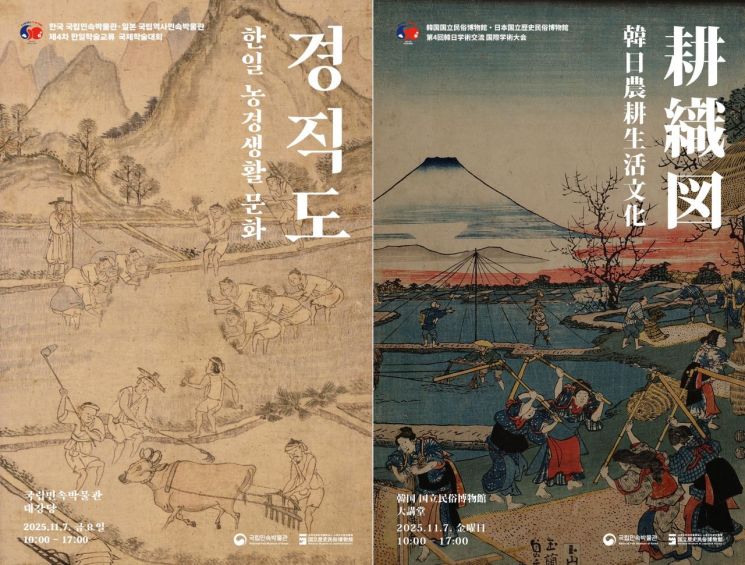
This academic conference is part of the fourth Korea-Japan academic exchange project jointly promoted by the two museums. It has been organized to share the achievements of their ongoing academic exchanges and to commemorate the 60th anniversary of the normalization of diplomatic relations between Korea and Japan.
The two institutions selected "Gyeongjikdo" as the subject of their research to compare the agricultural and sericultural cultures of both countries. Gyeongjikdo refers to paintings depicting people engaged in farming and sericulture. Originating from the "Lou Shu Gengzhitu" (耕織圖) presented by Lou Shu (1090-1162) of the Southern Song Dynasty to Emperor Gaozong, these paintings were transmitted to Korea and Japan, where they evolved to reflect the unique cultural characteristics of each country. Noting that Gyeongjikdo paintings were popular in both nations but reflect different customs and realities, the two museums are conducting a comparative research project on agricultural life and culture in Korea and Japan based on these works.
At this academic conference, ten Korean and Japanese researchers who participated in the fourth academic exchange project will present the initial results of their joint research, which has been underway since 2024. Experts from various fields-including art history, history, agricultural folklore, costume, architecture, and women’s folklore-have participated in the joint investigation to analyze Gyeongjikdo from multiple perspectives. In 2024, the research team studied a total of 42 paintings: 23 Gyeongjikdo from Korea and 19 from Japan. In 2025, they investigated actual sites depicted in the paintings, such as the Gyeori agricultural culture in Hongcheon, Korea, and the traditional rice-planting ritual at Dazaifu Tenmangu Shrine in Japan.
The academic conference is open to anyone who registers on-site, and the proceedings containing the presentations will be available for download from the museum’s website starting November 3. The fourth Korea-Japan academic exchange project plans to publish a final report in 2026 and to hold a joint exhibition based on the 2027 research findings.
© The Asia Business Daily(www.asiae.co.kr). All rights reserved.