Jang Donghyuk: "The Ruling Party Is Hiding Negotiation Details for Fear Their Lies Will Be Exposed"
Song Eonseok: "Handling by Special Law... An Unconstitutional Act Ignoring the Public's Right to Know"
On November 3, the People Power Party called on the government to disclose the text of the Korea-U.S. tariff agreement, which was concluded on the occasion of the Asia-Pacific Economic Cooperation (APEC) Summit. Regarding the government's and the ruling party's consideration of enacting a special law as a follow-up measure to the negotiations, the party made it clear that parliamentary ratification is necessary.
Jang Donghyuk, leader of the People Power Party, stated at the Supreme Council meeting held at the National Assembly that day, "It is clear that the Lee Jaemyung administration and the Democratic Party of Korea intend to enact a special law instead of seeking parliamentary ratification for the Korea-U.S. tariff agreement," adding, "They are trying to hide the details of the negotiations for fear that their lies will be exposed."
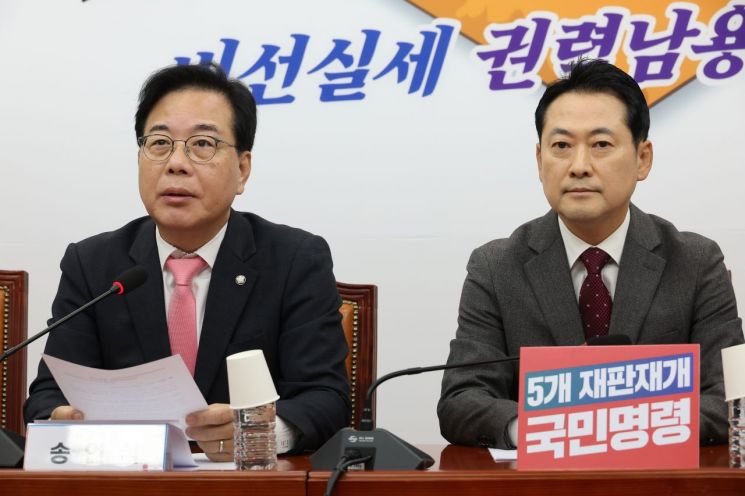 Song Unseok, floor leader of the People Power Party, is speaking at the Supreme Council meeting held at the National Assembly in Yeouido, Seoul on the 3rd. Photo by Yonhap News Agency
He continued, "Their intention is to quietly insert undisclosed side agreements and bundle them together," emphasizing, "The disclosure of the agreement should come first, not the enactment of a special law."
Jang criticized, "This blank-sheet diplomacy, which omits everything including even the agreement text or a joint statement, is exactly the so-called pragmatic diplomacy of the Lee Jaemyung administration," and added, "They are boasting about the conclusion of the Korea-U.S. tariff negotiations, but as with three months ago, neither the fact sheet nor the agreement has been made public."
He went on to say, "Even as soon as the Lee administration announced the negotiation results, the United States immediately made contradictory statements," and questioned, "Did our government engrave the agreement on a crown or sign it with a stamp on a baseball bat?"
Regarding the Korea-China summit, he pointed out, "It is the same situation where there are only photos but no important joint statement," and added, "They only discussed pending issues, but there are no concrete results at all."
Song Eonseok, floor leader of the People Power Party, reiterated the need for parliamentary ratification, stating, "The Korea-U.S. tariff agreement is a matter that has a significant impact on the lives of the people and the entire industry." He strongly criticized, "If the government tries to handle this through legislation, it would be a clear unconstitutional act that disregards the National Assembly's ratification authority and the public's right to know."
Song further stated, "Enacting a special law that allows the executive branch to arbitrarily handle matters related to this agreement without disclosing the details to the public could amount to a type of enabling act," and warned, "If this is pushed forward behind closed doors without the consent of the National Assembly, we will regard it as a dictatorial outrage that denies both the Constitution and the people."
Regarding the semiconductor negotiations, he said, "The government claims to have negotiated at a level not disadvantageous compared to competing countries. However, the next day, the United States denied this, stating, 'Semiconductors are not part of this agreement.' Since the agreement has not yet been disclosed, and the two sides' claims are completely at odds, the public is very anxious. The details and background of the semiconductor negotiations must be fully disclosed."
On the issue of steel industry tariffs, he pointed out, "As of last year, steel exports to the U.S. amounted to 2.9 billion dollars, accounting for 13% of the total, but as soon as a 50% tariff was imposed in May, exports plummeted by 16% year-on-year." He continued, "However, the steel issue was completely omitted from this negotiation," and warned, "If this continues, Korea's steel exports to the U.S. will be virtually blocked. Even if the MASGA (Make American Shipbuilding Great Again) project proceeds as planned, our steel industry will be structurally excluded from participating in the supply chain."
© The Asia Business Daily(www.asiae.co.kr). All rights reserved.
!["I'd Rather Live as a Glamorous Fake Than as a Poor Real Me"...A Grotesque Success Story Shaking the Korean Psyche [Slate]](https://cwcontent.asiae.co.kr/asiaresize/183/2026021902243444107_1771435474.jpg)
















