Secretary Besant Speaks Out in CNN Interview
Scott Besant, U.S. Secretary of the Treasury, emphasized that China is an unreliable partner and stressed that the United States must reduce its dependence on China for rare earth elements. His remarks came just three days after the U.S.-China summit, and although tensions between the two countries have temporarily eased due to a 'trade truce,' there are concerns that conflicts could reignite at any time.
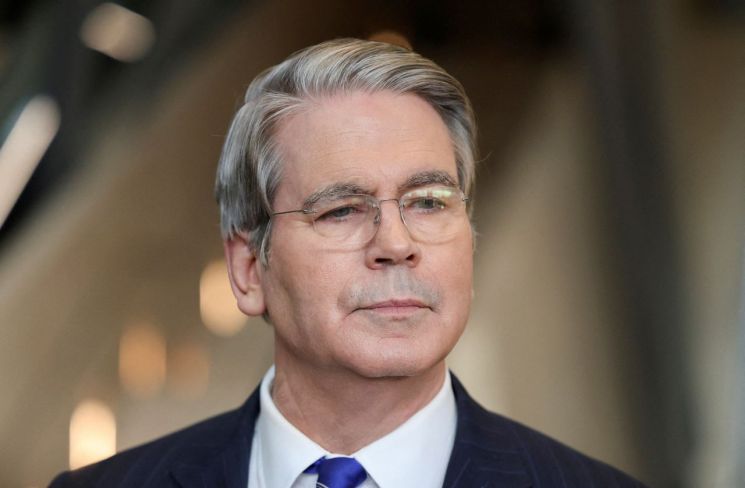
In an interview with CNN's 'State of the Union' on the 2nd (local time), Secretary Besant stated, "We do not seek decoupling from China, but risk reduction is necessary," adding, "China has demonstrated in various areas that it is an unreliable partner."
He highlighted that breaking free from China's control over rare earth minerals-essential for hundreds of advanced technology products-is the most urgent task. Currently, China accounts for more than 70% of the global supply of rare earth elements.
Secretary Besant said, "This is an issue of 'China versus the world,'" and added, "When China imposed sanctions on the world, the world pushed back." He continued, "We will move forward at a very rapid pace over the next one to two years," stressing that "we will escape from the knife-edge that China holds over us and the world."
He also argued, ahead of a U.S. Supreme Court hearing on the legality of reciprocal tariffs imposed by the Donald Trump administration, that China's controls on rare earth exports and inadequate crackdowns on fentanyl distribution constitute a national emergency, which justifies the imposition of reciprocal tariffs. He explained, "On October 8, China's threat to control rare earth exports, which could slow down or halt Western manufacturing systems, in itself constitutes an emergency. The President threatened 100% tariffs under the International Emergency Economic Powers Act (IEEPA), which forced China to delay those measures."
Secretary Besant's remarks came just three days after the U.S.-China summit held in Busan, South Korea, on October 30. Based on the results of the summit, both sides released a fact sheet the previous day outlining concrete agreements, including China's suspension of rare earth export controls, the resumption of U.S. soybean imports by China, and the reduction of U.S. tariffs on Chinese fentanyl-related products.
However, despite both countries promising to ease trade tensions immediately after the summit, they continued to make strong statements targeting each other. This has raised concerns that the summit served only as a temporary pause rather than a resolution of conflicts. On October 31, the day after his meeting with President Trump, Chinese President Xi Jinping delivered a speech at the Asia-Pacific Economic Cooperation (APEC) Summit in Gyeongju, stating, "We must oppose protectionism, resist unilateral bullying, and prevent the world from returning to the law of the jungle." This was interpreted as a criticism of President Trump's protectionist policies and a call for other countries not to side with the United States but to unite against it.
© The Asia Business Daily(www.asiae.co.kr). All rights reserved.

















