Early Detection Is Difficult Due to Cold-Like Symptoms
Consistent Monitoring and Endoscopic Examinations Are Essential
Interest in sinonasal cancer has grown after it was reported that lawyer Paek Sungmoon, who became well-known through his active broadcasting career, passed away following a battle with the disease after being diagnosed last year.
 The late lawyer Paek Sungmoon (left) and YTN announcer Kim Sunyoung, a married couple. Instagram capture
On November 1, YTN announcer Kim Sunyoung posted a tribute on the late lawyer's social media, stating, "My husband, lawyer Paek Sungmoon, who approached me with a kind and gentle smile, has entered eternal rest." Kim explained that Paek had been diagnosed with the rare cancer sinonasal cancer last summer and had fought the disease for about a year.
According to Seoul National University Hospital, sinonasal cancer is a rare cancer that develops in the paranasal sinuses, which are the air-filled spaces surrounding the nasal cavity. Malignant tumors occurring in the nasal cavity and paranasal sinuses account for less than 1% of all malignant tumors in the human body and represent 3-5% of head and neck malignancies. According to the 2021 National Cancer Registration Statistics released by the Ministry of Health and Welfare and the National Cancer Center, sinonasal cancer occurs in approximately 0.2 to 0.5 people per 100,000 population annually, with men having an incidence rate two to three times higher than women.
The symptoms of sinonasal cancer vary depending on how the tumor invades surrounding structures. If it invades the oral cavity, symptoms may include loose dentures or teeth, difficulty opening the mouth (trismus), and the presence of a mass in the hard palate. If it invades the facial area, facial asymmetry, facial pain, and abnormal sensations may occur. Invasion of the cranial nerves can result in multiple cranial nerve palsies. If the tumor invades the area around the eyes, symptoms may include swelling, conjunctival edema, double vision due to dysfunction of the extraocular muscles (which move the eyeball), eye protrusion, and decreased vision.
Kim previously revealed that Paek lost vision in one eye during chemotherapy.
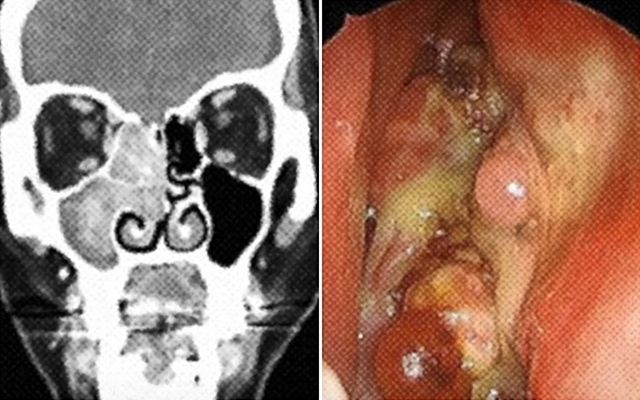
Sinonasal cancer often presents no symptoms in its early stages, or only symptoms similar to rhinitis such as simple nasal congestion, runny nose, or reduced sense of smell, making early detection difficult. If the cancer is found while still localized, treatment outcomes are favorable, but in most cases, the disease is already quite advanced by the time it is discovered. Not only is early detection challenging, but the disease also tends to progress rapidly. Although the tumor is located near critical organs such as the brain and eyes, there is still no established treatment protocol. Until the 1960s, the treatment success rate was around 28%, but with advances in diagnostic techniques and more aggressive surgery and therapies, the overall survival rate rose to 51% in the 1990s. The five-year survival rate has been reported at 59.5%.
Therefore, if you experience persistent or recurrent symptoms such as nasal congestion, runny nose, or nosebleeds, or if symptoms of rhinitis or sinusitis last for several months or longer, early detection through nasal endoscopy is the only way to improve treatment outcomes. In addition, as a correlation with smoking has been reported, quitting smoking is also essential for the prevention of sinonasal cancer.
© The Asia Business Daily(www.asiae.co.kr). All rights reserved.


















