Citizen Participation Organized and Amplified Through Social Media
Grassroots Political Engagement Beyond Borders and Barriers
In October, on the Indian Ocean island nation of Madagascar, President Andry Rajoelina was impeached following large-scale, citizen-led protests. Recently, there has been a noticeable increase across Africa in movements that use social media to voice political opinions.
At the 28th Africa Seminar, titled "Social Media Use in Africa and Youth Political Participation," held online by the Asia-Africa Center of the Seoul National University Asia Center (Director: Kim Taekyun) on October 31, Solomon Winnie, a professor in the Department of Political Science at Makerere University in Uganda, analyzed that "social media is changing the political culture of Africa." He explained that with the spread of information technology such as smartphones and the internet, citizens are now able to both receive and directly produce and share information, thereby exerting political influence.
He stated, "Social media has created a space for 'two-way communication,' where people can both receive and produce and share information," adding, "This is fundamentally different from traditional media, which is limited to one-way communication." As smartphones and internet access have become more widespread, people are no longer confined to traditional forms of participation such as voting or party activities, but instead make their voices heard directly in digital spaces. Shaping public opinion and turning it into action through social media has become commonplace.
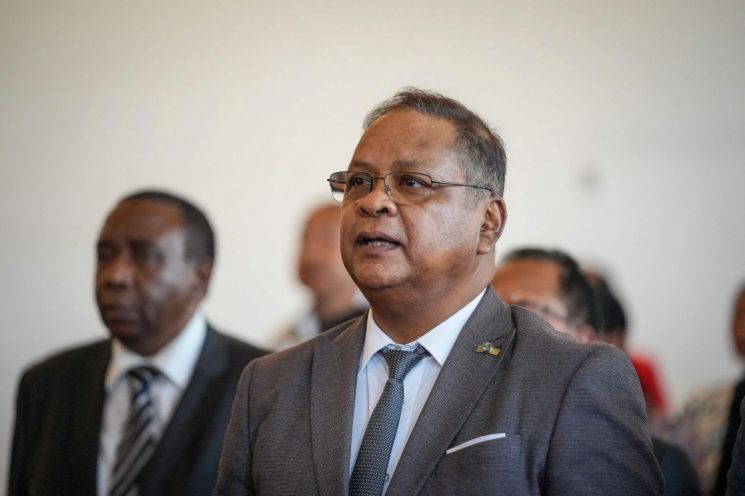 Heriniralama Rajoanarivelo, newly appointed Prime Minister of Madagascar, is attending a meeting at the Senate Palace in Anosy, Antananarivo, on October 21, 2025. Photo by AFP Yonhap News
In fact, not only in Madagascar but also in Kenya and Morocco, citizens have used social media to organize protests against government policies. In Kenya, large-scale demonstrations against tax increases, government corruption, and police brutality spread throughout the capital, Nairobi. In Morocco, nationwide protests demanding improvements in education and healthcare services continued for two months, from September to October.
Experts believe that these political actions are evolving beyond past protests centered on nationalism or local issues, and are now focused on public agendas such as economic inequality and government failures.
Professor Winnie noted, "Citizens are able to organize and communicate protests through various platforms such as Discord and Telegram, even without specific leaders." He added that people continue their activities by circumventing state controls such as censorship or internet shutdowns, using methods like VPNs and Bluetooth messengers.
What is particularly interesting is that this solidarity is spreading beyond national borders. During the protests in Madagascar, citizens used social media to seek help from activists in Nepal and Morocco.
Experts assess that social media lowers the barriers to political participation, activates citizen engagement around public agendas, and promotes international solidarity.
© The Asia Business Daily(www.asiae.co.kr). All rights reserved.

















