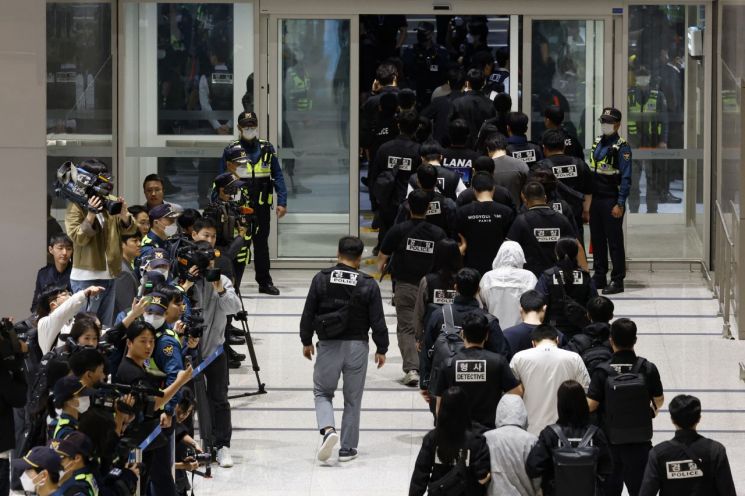
 Koreans detained for involvement in online scams in Cambodia were repatriated through Incheon International Airport Terminal 2 on the morning of the 18th of last month. Photo by Yonhap News Agency
Two Korean men who acted as recruiters for a "romance scam" organization, commonly referred to as a dating scam in Cambodia, have been sentenced to prison.
On November 2, the Busan District Court Criminal Division 12 (Presiding Judge Ji Hyunkyung) announced that it had sentenced a man in his 30s, referred to as A, to four years in prison and a forfeiture of 22 million won, and a man in his 20s, referred to as B, to three years in prison and a forfeiture of 20 million won, on charges of fraud, joining a criminal organization, and criminal organization activity.
They were accused of traveling to Cambodia after seeing local job postings in an online band between May and June 2024, joining the romance scam organization, and working as recruiters and in other roles for seven months.
They approached victims via Telegram and other platforms, falsely claiming to be managers at agencies introducing women, and told victims that they could arrange compensated dates if they registered on their website. They then demanded remittances under the pretense of "coupon activation fees." A total of 20 victims were deceived by this method, suffering losses amounting to 840 million won.
Individual A acted as a mid-level manager, overseeing the training and management of recruiters. The training took place in an office inside a casino building, where a strict hierarchy was enforced. Members used aliases and worked under strict discipline, including 12-hour shifts each day.
The organization operated in a manner similar to a business. Senior members reported the work attitude, outings, and performance of other members to higher-ups, and reprimanded or encouraged those with poor results.
Salaries were paid on the 15th of each month, ranging from 2,000 to 8,000 US dollars depending on position. Incentives were also given based on the amount of money scammed from victims.
If a member wanted to leave the organization before three months had passed, they were required to pay a 20,000 US dollar penalty and cover the "gaebasi" (the cost of setting up computer programs and other tools needed for the crimes). When someone actually left, the cost burden was shifted to the remaining members.
© The Asia Business Daily(www.asiae.co.kr). All rights reserved.

















