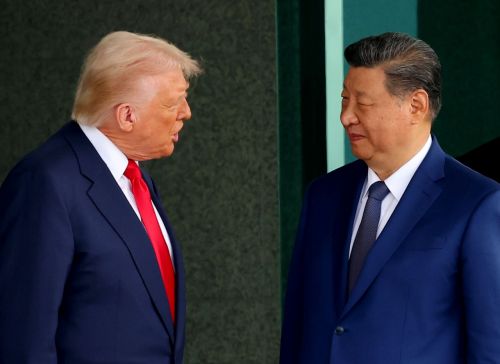
 Donald Trump, President of the United States, and Xi Jinping, President of China, are seen leaving the meeting room while conversing after concluding the US-China summit at the Naraemaru Protocol Room of Busan Gimhae Air Base on the 30th of last month. Photo by Yonhap News Agency
There is a possibility that China may lift sanctions imposed on the U.S. subsidiaries of Hanwha Ocean as a result of the trade agreement reached between the United States and China.
According to the fact sheet on the U.S.-China trade agreement released by the White House on the 1st (local time), China has agreed to withdraw measures implemented in retaliation for the United States' "Section 301" investigation into China's maritime, logistics, and shipbuilding industries. China will also lift sanctions imposed on various shipping companies.
Earlier, on the 14th, China placed five U.S. subsidiaries of Hanwha Ocean-Hanwha Philly Shipyard, Hanwha Shipping, Hanwha Ocean USA International, Hanwha Shipping Holdings, and HS USA Holdings-on a sanctions list that bans transactions with Chinese companies. The reason was their cooperation with the United States Trade Representative's (USTR) Section 301 investigation.
Under this agreement, the United States will also suspend, for one year starting from the 10th, measures targeting China's maritime, logistics, and shipbuilding industries that were implemented based on the Section 301 investigation.
The United States had imposed measures such as port entry fees on Chinese vessels, but the fact sheet did not specify exactly which measures would be suspended. The White House stated that, while the United States continues its historic cooperation with South Korea and Japan to rebuild its shipbuilding industry, it plans to negotiate with China under Section 301.
The fact sheet contains detailed information on the U.S.-China trade agreement introduced by President Donald Trump.
China has agreed to globally suspend the rare earth export controls and related measures announced on the 9th of last month. China plans to issue comprehensive licenses for the export of rare earths, gallium, germanium, antimony, and graphite for U.S. end-users and their global suppliers. The White House explained that these comprehensive licenses effectively mean the withdrawal of export controls implemented by China in April 2025 and October 2022.
China will also block North American shipments of certain chemicals used in the manufacture of the synthetic drug fentanyl, and strictly control the global export of other specific chemicals.
Additionally, China has agreed to suspend all retaliatory tariff and non-tariff measures announced against the United States since March 4. This includes tariffs on U.S. agricultural products such as chicken, wheat, corn, cotton, sorghum, soybeans, pork, beef, seafood, fruits, vegetables, and dairy products, as well as designating U.S. companies for export control measures.
China will purchase at least 12 million tons of U.S. soybeans over the remaining two months of this year and will buy at least 25 million tons annually for the next three years.
Furthermore, China will ensure that Nexperia, a semiconductor company, can take necessary measures to export semiconductors produced in China to the global market. China will also end antitrust and anti-dumping investigations targeting U.S. companies involved in the semiconductor supply chain.
China will extend the tariff exemption process for certain U.S. products and maintain related tariff exemptions until December 31 of next year. In response, the United States will reduce by 10 percentage points certain tariffs imposed on China under the pretext of blocking fentanyl inflows, starting from the 10th. The two countries have agreed to maintain the significantly reduced tariff rates, achieved through high-level negotiations, until November 10 of next year.
The United States had allowed exceptions for certain items subject to tariffs imposed on China under Section 301 until the 29th, and has decided to extend this exception period until November 10 of next year.
The United States will also suspend, for one year starting from the 10th, export control measures targeting subsidiaries of Chinese companies designated as subject to export controls.
© The Asia Business Daily(www.asiae.co.kr). All rights reserved.

















