Detected Cases of Counterfeit Goods on SNS Triple in Four Years
Only Six Specialists Monitor Thousands of Channels
Since the COVID-19 pandemic, video platforms such as YouTube and TikTok have emerged as new distribution channels for counterfeit goods. There has been a surge in cases where counterfeit luxury brand products are sold through live broadcasts in a home shopping format, but critics point out that the government's response remains stagnant due to a lack of personnel.
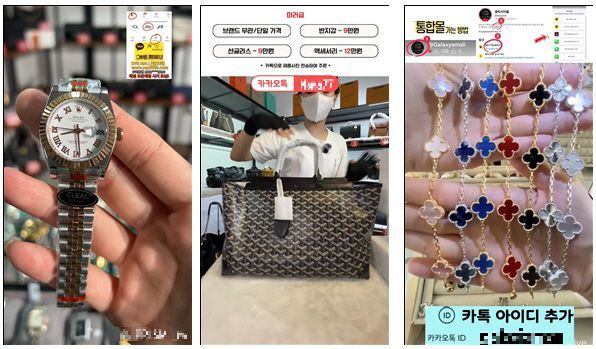 Counterfeit products actually sold on video platforms. Provided by the office of Assemblyman Kim Donga.
According to data submitted by Assemblyman Kim Donga of the National Assembly's Trade, Industry, Energy, SMEs and Startups Committee, based on information from the Korea Intellectual Property Protection Agency, the number of online counterfeit product detections nearly doubled from approximately 137,000 cases in 2020 to about 272,000 cases in 2024. By August of this year alone, more than 174,000 cases had already been detected, and the annual total is expected to surpass the previous record high by the end of the year.
In particular, distribution through social networking services (SNS) has grown explosively. The number of detected cases soared from about 52,000 in 2020 to 164,000 in 2024, more than tripling. Recently, live sales broadcasts on video platforms such as YouTube and TikTok, using phrases like "luxury group purchase" and "parallel import limited edition," have become a new distribution channel that lures consumers.
In response to this trend, the Korea Intellectual Property Protection Agency included YouTube and TikTok as regular monitoring targets for the first time this year. As a result, by September, 993 sales suspension actions had been taken, with 732 related to YouTube-nearly three times as many as TikTok, which accounted for 261 cases.
However, there is a severe shortage of enforcement personnel. Currently, only six online specialists are dedicated to monitoring video platforms. Critics argue that it is physically impossible for such a small team to monitor thousands of pieces of content uploaded daily in real time.
Assemblyman Kim criticized, "On platforms like YouTube and TikTok, anyone can easily create and delete accounts, so even if a channel is blocked, a new one can be created immediately. With just six personnel, real-time enforcement is virtually impossible."
He also pointed out, "Even when consumers report violations, it often takes several weeks to process due to internal review procedures at the platforms. During this time, sellers can delete their channels and open new ones, causing the damage to spread."
He added, "The government must not only increase personnel but also establish a real-time cooperation system with platform operators. Unless swift channel closures and blocking of illegal content are implemented simultaneously, the counterfeit market will continue to grow."
© The Asia Business Daily(www.asiae.co.kr). All rights reserved.
![Clutching a Stolen Dior Bag, Saying "I Hate Being Poor but Real"... The Grotesque Con of a "Human Knockoff" [Slate]](https://cwcontent.asiae.co.kr/asiaresize/183/2026021902243444107_1771435474.jpg)











