Nvidia is joining forces with the South Korean government, Samsung Electronics, SK Group, Hyundai Motor Group, Naver Cloud, and others to build a large-scale artificial intelligence (AI) infrastructure utilizing more than 250,000 graphics processing units (GPUs). This is a nationwide AI transformation project that goes beyond semiconductor supply to fundamentally reshape the structure of entire industries.
On October 31, Nvidia announced, "The Korean government and major companies will introduce more than 250,000 GPUs together to expand AI infrastructure," adding, "This infrastructure will accelerate AI development and innovation in key industries such as automotive, manufacturing, semiconductors, and telecommunications."
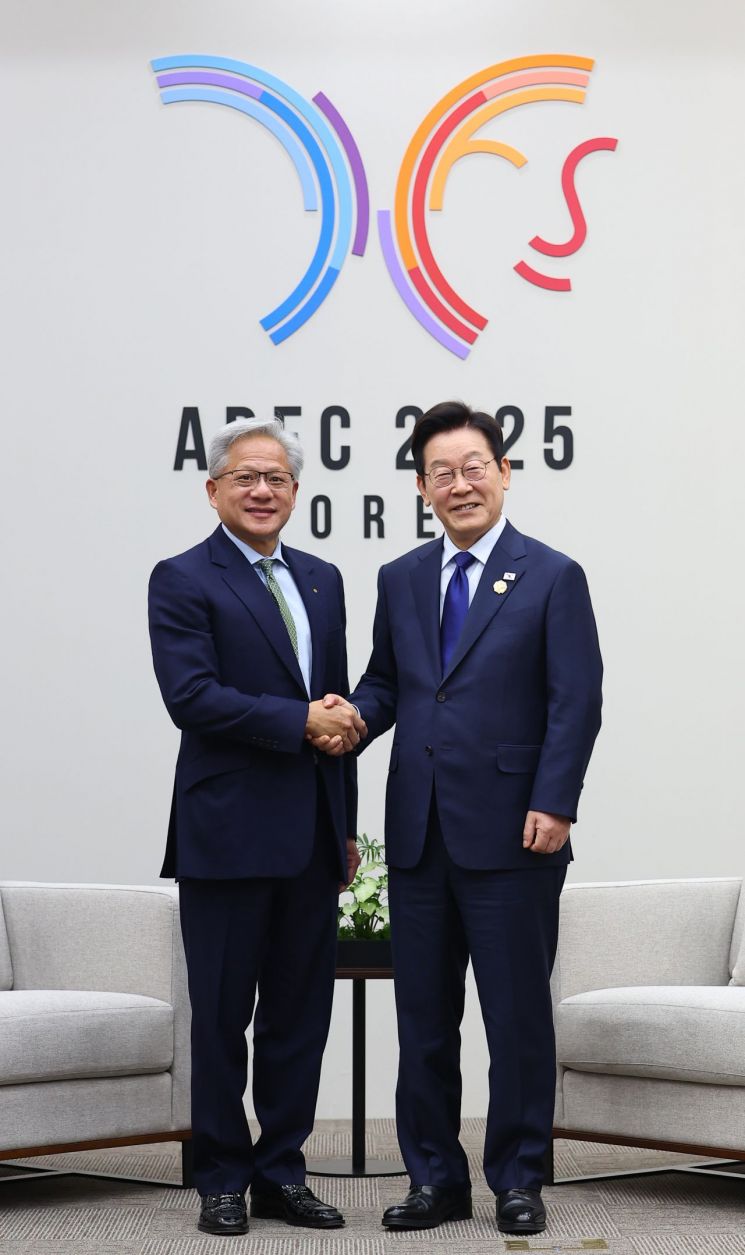
Samsung, SK, Hyundai Motor, Naver: Transforming Industries into 'AI Factories'
The core of this collaboration is the 'AI Factory.' An AI Factory is an evolved concept beyond traditional data centers, referring to intelligent factories that learn from industrial data through large-scale GPU computing and directly connect this intelligence to manufacturing and service sites.
Samsung Electronics will introduce more than 50,000 GPUs to build an AI Factory that applies artificial intelligence to semiconductor manufacturing processes. By leveraging Nvidia's CUDA-X, CuLitho, and Omniverse AI platforms, Samsung aims to enhance process speed and yield, while also incorporating AI technology into the development of home robots.
SK Group will also utilize 50,000 GPUs to improve semiconductor research and development as well as production efficiency, and will establish an industrial AI cloud specialized in robotics and digital twin technology. SK Telecom will support the expansion of the AI ecosystem by building an industrial cloud environment based on RTX 6000 Blackwell servers, which domestic companies can utilize.
Hyundai Motor Group will use 50,000 Blackwell GPUs to train AI models for autonomous driving and smart factories, thereby advancing the entire manufacturing process. The group will also jointly invest approximately 3 billion dollars with the government to foster a physical AI ecosystem.
Naver Cloud will add more than 60,000 GPUs to develop large-scale language models and industry-specific customized AI. The Ministry of Science and ICT will deploy 50,000 Nvidia GPUs to establish a national AI computing center, and will collaborate with NHN Cloud, Kakao, and others to develop sovereign AI based on Korean language and industrial data.
Vice Prime Minister and Minister of Science and ICT Baek Kyunghoon stated, "Now that AI has become the foundation of future industries, going beyond mere innovation, Korea stands on the threshold of transformation." He added, "Expanding national AI infrastructure and developing technology together with Nvidia is an investment that will further strengthen Korea's advantages, including its manufacturing capabilities." He continued, "This will support Korea's prosperity as the country strives to become one of the world's top three AI powerhouses."
 Samsung Electronics Chairman Jay Y. Lee is shaking hands with Jensen Huang, CEO of Nvidia, at the GeForce Gamer Festival held at the K-POP Square in COEX, Gangnam-gu, Seoul, on the afternoon of the 30th. 2025.10.30 Photo by Jo Yongjun
Nvidia and Samsung Electronics Specify HBM3E and HBM4 Supply Collaboration
The most notable aspect of this collaboration is the relationship between Nvidia and Samsung Electronics. Their partnership has evolved beyond simple semiconductor supply to become a long-term technological alliance building the foundation of the AI industry ecosystem. Among its Korean partners, Nvidia identified Samsung Electronics as the most crucial axis of technological cooperation.
In this announcement, Nvidia also formalized its high-bandwidth memory (HBM) partnership with Samsung Electronics. According to Nvidia's press release, "Our collaboration with Samsung began when it supplied DRAM for our first graphics card, the NV1, progressed through the world's first commercial HBM, and has now developed into HBM3E and HBM4 supply cooperation." The company added, "The partnership between the two companies, which has continued for more than 25 years, has become the foundation for today's AI innovation."
Nvidia stated that its partnership with Samsung Electronics is not limited to HBM. The two companies are expanding their cooperation across the entire semiconductor sector, including graphics memory (GDDR), high-density memory modules, next-generation low-power memory (SOCAMM), custom semiconductor solutions, and foundry (contract manufacturing) services.
This expansion of cooperation is interpreted as a strategic alliance to jointly advance AI semiconductors and cutting-edge manufacturing technologies, rather than a simple component transaction. Industry observers expect this formalization to lead to joint development of next-generation semiconductor technologies that enhance AI computing efficiency.
In other words, the combination of Nvidia's GPUs and Samsung's semiconductor technology is forming the core infrastructure for the AI industry. Through technological collaboration, the two companies are expected to expand synergies in high-performance memory and logic integration processes, production efficiency improvements, and the advancement of AI-based manufacturing systems.
© The Asia Business Daily(www.asiae.co.kr). All rights reserved.


















