Partnering with Nvidia to Innovate AI-Based Semiconductor Manufacturing
Expanding Supply of Next-Generation Memory Including HBM4
Building an "AI Factory" Where Artificial Intelligence Directly Designs and Controls Production
Introducing 50
Samsung Electronics is joining forces with Nvidia to drive innovation in semiconductor manufacturing based on artificial intelligence (AI). The company will supply Nvidia with its latest high-bandwidth memory (HBM4) and will fully implement an "AI Factory," where AI directly designs semiconductors and manages production.
On October 31, Samsung Electronics announced, "Through strategic cooperation with Nvidia, we will strengthen the next-generation semiconductor supply chain tailored to the AI era and establish a production system centered on AI." This collaboration builds on more than 25 years of technological partnership between the two companies and aims to establish a new manufacturing standard where AI is involved in every step from semiconductor design to production.
Samsung Electronics will supply Nvidia with next-generation semiconductor memory products. These include High Bandwidth Memory 3E (HBM3E), High Bandwidth Memory 4 (HBM4), DRAM for high-performance graphics (GDDR7), and low-power memory modules (SOCAMM2).
Among these, HBM4 is a product featuring Samsung's latest technology, enabling much faster data processing while reducing power consumption. It achieves a speed of 11 gigabits per second (11Gbps), surpassing existing international standards, making it especially suitable for fields requiring complex calculations such as AI training or large-scale computations. By maximizing both performance and efficiency, it serves as a next-generation memory at the core of AI semiconductors.
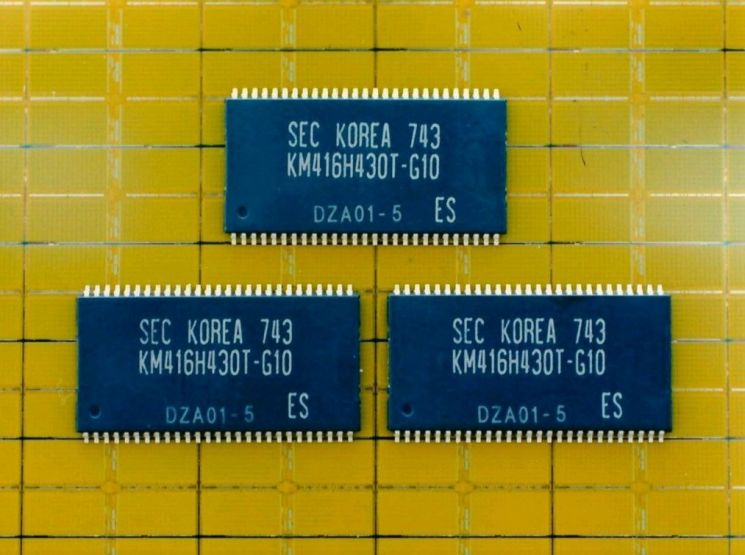 The first graphics card GeForce 256, released by Nvidia in 1999, was equipped with a 64-megabit SDR synchronous DRAM (SDR SDRAM) made by Samsung Electronics. The collaboration between the two companies began at this time. Samsung Electronics
Samsung Electronics is already supplying HBM3E to major global customers and has completed shipments of HBM4 samples to all customers who requested them. The company plans to begin mass production and shipments in earnest starting next year and is continuing to invest in expanding HBM production lines and facilities to meet the rapidly increasing demand for AI semiconductors.
Along with expanding memory supply, Samsung Electronics is also accelerating the full-scale implementation of its "AI Factory," which applies AI technology to every stage of semiconductor production. The AI Factory is an intelligent production system where AI analyzes and predicts every step of manufacturing in real time, including design, processing, equipment, and quality control. By enabling AI to learn from data, predict defects, and automatically adjust processes, the company can simultaneously improve both production efficiency and quality.
To achieve this, Samsung Electronics will introduce more than 50,000 Nvidia graphics processing units (GPUs) and build a "Digital Twin" environment based on Nvidia's simulation platform Omniverse. This approach recreates the exact conditions of real factories in a virtual space, allowing AI to detect process anomalies in advance and suggest optimal production conditions.
Additionally, Samsung Electronics will adopt Nvidia’s AI computing technologies, "CuLitho" and "CUDA-X," to correct circuit distortions that may occur in advanced processes in real time and has increased process simulation speeds by more than 20 times compared to previous methods. The company is also establishing an integrated control system capable of real-time monitoring and failure prediction of production facilities, accelerating the intelligence of the entire semiconductor manufacturing process.
Samsung Electronics plans to expand these AI manufacturing technologies not only in Korea but also to major overseas production bases, including its plant in Taylor, Texas, USA. The company stated, "The AI Factory will drive qualitative growth in the national manufacturing ecosystem and contribute to the transformation of small and medium-sized partners into smart factories."
Samsung Electronics is also expanding its cooperation with Nvidia into next-generation technology fields such as AI models, humanoid robots, and intelligent base stations (AI-RAN). The company is developing its own AI models using the large-scale language learning framework "Megatron" based on Nvidia GPUs and is advancing robot autonomy technologies using the "RTX Pro 6000 Blackwell Server Edition" platform.
Samsung Electronics stated, "Supplying next-generation memory, including HBM4, and building the AI Factory will become a new growth engine for the AI semiconductor market," adding, "We will lead the global industrial paradigm shift through AI-centered innovation in semiconductor manufacturing."
© The Asia Business Daily(www.asiae.co.kr). All rights reserved.

















