Meta and Microsoft Weaken on Increased AI Capital Expenditures
Fed Cuts Rates for Second Consecutive Time
Powell's "December Rate Cut Not a Given" Remarks Dampen Sentiment
US-China Trade Agreement Supports Market Downside
The three major indexes of the New York Stock Exchange showed mixed movements on October 30 (local time). Investors are proceeding cautiously amid concerns as they digest earnings from big tech companies and the Federal Reserve's hawkish rate cut. However, the downside was limited as the United States and China temporarily resolved their trade conflict during the summit.
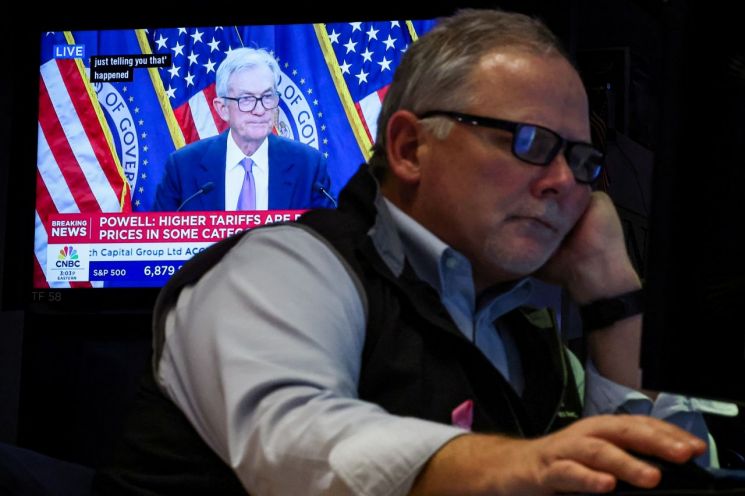 On the 29th (local time), at the New York Stock Exchange (NYSE) trading floor in the United States, a trader is working while a screen behind him shows Federal Reserve Chairman Jerome Powell holding a press conference after announcing an interest rate cut. Photo by Reuters Yonhap News
As of 10:21 a.m. on the New York Stock Exchange, the blue-chip Dow Jones Industrial Average was up 245.67 points (0.52%) from the previous trading day, standing at 47,877.67. This was due to a rotation of funds from technology stocks to other sectors. The S&P 500, which focuses on large-cap stocks, was down 27.12 points (0.39%) at 6,863.47, while the tech-heavy Nasdaq Composite had dropped 210.951 points (0.88%) to 23,747.522.
By stock, Meta, the parent company of Facebook, and Microsoft were down 11.71% and 2.41%, respectively, despite strong earnings the previous day. Increased capital expenditures related to artificial intelligence (AI) have heightened investor concerns. On the other hand, Alphabet, the parent company of Google, was surging by 5.12% on the back of strong earnings. Apple and Amazon, which are set to release their earnings after the close, were down 0.17% and 1.6%, respectively.
Matt Maley, chief market strategist at Miller Tabak, commented on the increased AI capital expenditures by big tech companies, saying, "This does not mean that the AI bubble is bursting or that a major reversal in the stock market is imminent, but it does increase the likelihood of a short-term correction in the near future."
Hawkish remarks from Federal Reserve Chairman Jerome Powell are also weighing on investor sentiment. The Federal Reserve, at its regular Federal Open Market Committee (FOMC) meeting the previous day, cut the benchmark interest rate by 0.25 percentage points to a range of 3.75% to 4.0%, marking the second consecutive rate cut. However, at the press conference immediately following the FOMC, Powell poured cold water on market expectations by stating, "A rate cut in December should not be taken for granted." Additionally, among the 12 FOMC members with voting rights on rate decisions, two cast dissenting votes, with one favoring a 0.5 percentage point cut and the other favoring a hold, highlighting internal disagreements over December monetary policy and increasing uncertainty over the future path of interest rates.
As expectations for additional rate cuts within the year have weakened, U.S. Treasury yields are rising. The yield on the 10-year U.S. Treasury note, a global benchmark for bond yields, rose 4 basis points (1bp = 0.01 percentage point) from the previous day to 4.09%. The yield on the 2-year Treasury note, which is sensitive to monetary policy, rose 3 basis points to 3.62%.
However, the smooth conclusion of the U.S.-China summit is supporting the downside of the stock market. On October 30 (Korea Standard Time), U.S. President Donald Trump held a roughly 100-minute meeting with Chinese President Xi Jinping at Gimhae Air Base in Busan. After the meeting, Trump announced that the tariff on all Chinese imports of fentanyl would be reduced by 10 percentage points from the previous 20%. In addition, China agreed to suspend its rare earth export controls for one year and resume imports of U.S. soybeans. U.S. Treasury Secretary Scott Besant said in a Fox News interview that "China has agreed to purchase 12 million tons of U.S. soybeans this year and at least 25 million tons annually for the next three years," adding, "With the U.S.-China trade negotiations concluded, the two sides are expected to exchange signed agreements next week."
In the market, there is an assessment that, while this may not be a 'big deal,' the two countries have managed to patch up their conflict with a trade truce and have bought time to move on to the next stage.
© The Asia Business Daily(www.asiae.co.kr). All rights reserved.

















