37th Anniversary Survey by The Korea University News: University Student Awareness
40% of Respondents Rate New Government's Administration as "Average"
High Awareness of Low Birth Rate Issue, but Low Willingness for Marriage and Childbirth
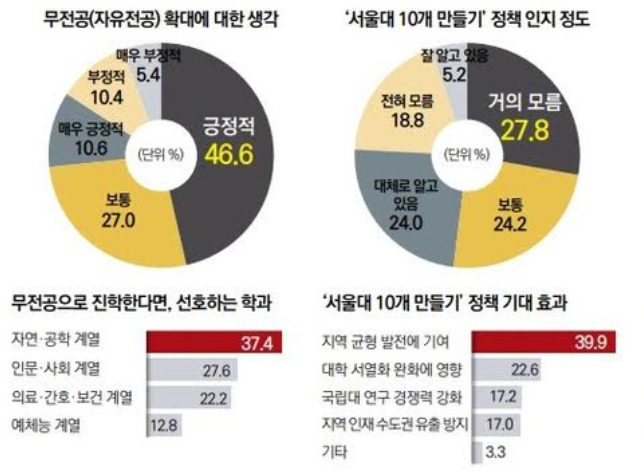
The new administration is promoting the “Creating 10 Seoul National Universities” policy as part of its education and balanced development initiatives. However, a recent survey found that more than 4 out of 10 university students responded that they are “not aware” of this policy.
According to The Korea University News on October 30, a survey was conducted from September 26 to October 5 among 1,212 university students nationwide (members of The Korea University News student evaluation panel). The survey, which has a 95% confidence level and a maximum margin of error of ±4.4%, revealed that 46.6% of respondents (27.8% “barely know,” 18.8% “do not know at all”) said they “do not know about the ‘Creating 10 Seoul National Universities’ policy.”
The government is pushing forward with the “Creating 10 Seoul National Universities” policy to address the extreme hierarchy among universities in Korea. However, a significant number of university students are not aware of the policy, indicating that its purpose and objectives have not been effectively communicated.
Regarding the overall administration of state affairs by the new government, 40.0% of respondents answered “average.” Those who rated it as “doing well” accounted for 28.9%, while 31.0% said it was “doing poorly.”
When asked whether university and admissions policies are moving in a desirable direction, 44.6% evaluated them as “average.” Moreover, negative responses (“not really” 28.2%, “not at all” 12.8%) outnumbered positive responses (“yes” 13.0%, “very much so” 1.4%).
As for the most urgent area in university and admissions policies that needs improvement, the admissions system ranked first again this year at 39.9%. This was followed by university hierarchy (25.8%) and the establishment of teachers’ authority and protection of students’ learning rights (20.2%), showing that fundamental problems in the education field remain unresolved.
When asked about the main purpose of attending university, “to gain favorable conditions for employment” topped the list at 43.2%.
Regarding the expansion of “admission without a declared major,” 57.2% of university students evaluated it positively, an increase of 11.8 percentage points from last year. On the effectiveness of policies encouraging international students to settle in Korea, 38.8% of students responded “average.”
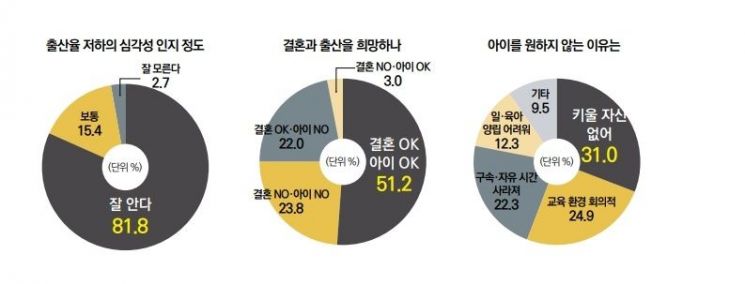
When asked about low birth rates, the most urgent social issue, more than half of university students (54.6%) answered that they “know well” about the problem. Including those who answered “know very well” (27.2%), a total of 81.8% are aware of the low birth rate issue. In contrast, only 51.2% of students said they “want to get married and have children,” while 23.8% responded that they “do not want either marriage or children.”
In terms of daily life, university students are increasing their proportion of high-value financial investments. More than half, or 54.2%, said they are “currently investing,” a sharp rise from 44.8% last year. In particular, the proportion of high-value investments exceeding 10 million won reached 17.0%, up 4.6 percentage points from the previous year. The main investment vehicles were stocks or funds (47.6%) and bank savings or installment deposits (36.2%), followed by overseas investments (8.8%), indicating a clear trend toward diversification of investment targets.
Awareness of ESG (environmental, social, and governance) management, a principle of sustainable business, is also spreading. In last year’s survey, the combined proportion of respondents who said they “have heard of ESG management but do not know exactly” (33.0%) and “have never heard of it” (23.0%) reached 70%. In this year’s survey, however, the proportion of those who answered “know about it” exceeded 70%.
© The Asia Business Daily(www.asiae.co.kr). All rights reserved.


















