Ban on Entrance Exams for Preschoolers, Including the "4-Year-Old Test" and "7-Year-Old Test"
Government and National Assembly Agree on the Need for Stronger Regulations
Academy Associations Argue for Allowing Class Placement Evaluations, Not Entrance Exams
"If you do not meet the cutoff score on the level test, it is virtually impossible to enroll."
On October 29, a representative from an English academy in Mokdong, Yangcheon-gu, stated, "Class placement is determined by the test results, and currently, the only available class is the highest-level elite class." This effectively means that whether a child can register depends on their entrance score, though it is indirectly expressed as "there is no class suitable for their level."
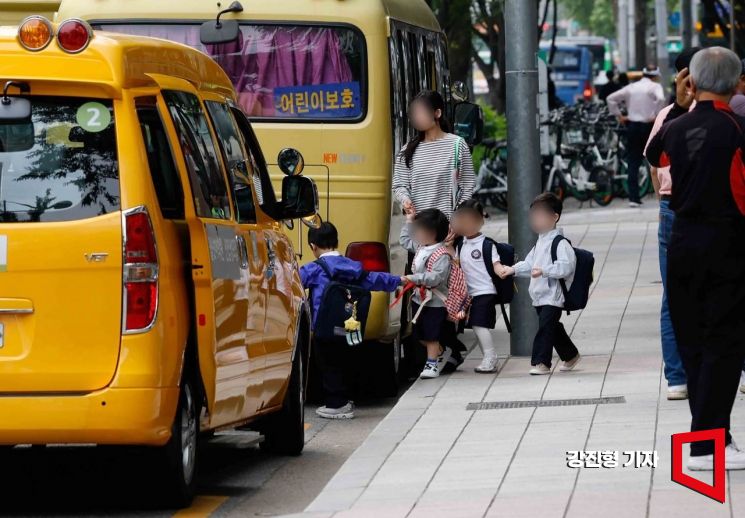 Children who have finished their classes at an English kindergarten in the academy district of Mokdong, Yangcheon-gu, Seoul, are boarding the kindergarten bus. Photo by Kang Jin-hyung
According to the education sector on October 30, as level tests at academies have recently been expanded to include even preschoolers, the government and National Assembly have begun imposing strict regulations. However, academy associations are pushing back, arguing that these measures are excessive regulation.
Assemblywoman Kang Kyungsook of the Innovation Party for the Motherland sponsored a bill last September that would prohibit not only entrance selection tests at academies for young children but also any tests or evaluations for the purpose of class placement by level. The rationale is that entrance exams such as the so-called "4-year-old test" and "7-year-old test," which do not take into account developmental stages, lead to excessive competition, hinder healthy child development, and fuel the early intensification and burden of private education. If this amendment to the "Act on the Establishment and Operation of Private Teaching Institutes and Extracurricular Lessons" passes, academies will no longer be able to conduct level tests as they do now.
Recently, top education officials, including Education Minister Choi Gyojin and National Education Commission Chairperson Cha Jeongin, have also emphasized the need for government-level sanctions against excessive early private education, raising expectations that the bill will pass. A staff member from Assemblywoman Kang's office said, "There is now a strong consensus on the necessity of this bill," adding, "There is also very active support from the political community."
All provincial and metropolitan offices of education nationwide are voicing unified support as well. Assemblywoman Jin Sunmi of the Democratic Party of Korea asked the superintendents of education at all 17 regional offices whether they agreed with banning level tests for preschoolers, such as the "4-year-old test" and "7-year-old test," under the academy law. All responded that they agreed.
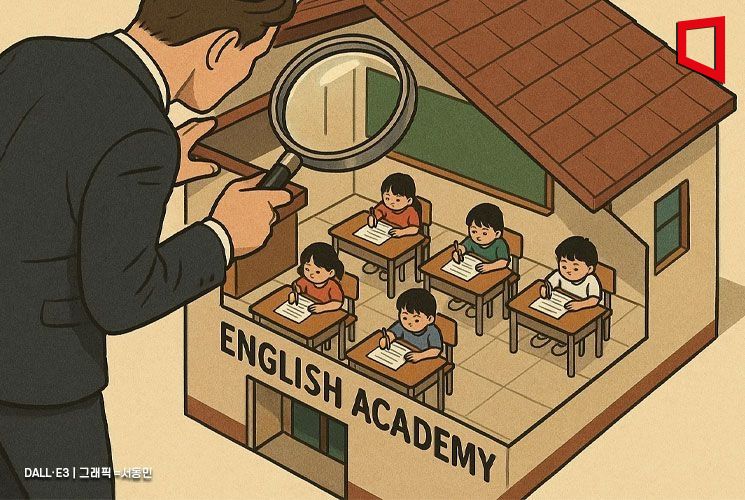
However, academy associations are resisting, arguing that a complete ban on not only entrance exams but also class placement evaluations is excessive regulation. The National Council of Foreign Language Education under the Korea Association of Private Academies stated on October 29, "Children's English proficiency and developmental pace vary widely," and "If a child is placed in a class that is too difficult or too easy, they may experience boredom or frustration. Therefore, it is necessary to assign them to an appropriate class through child-friendly diagnosis and observation." They further argued, "Class placement diagnosis serves as a safeguard to help children adapt."
However, the association agreed with the intent of the bill regarding entrance selection tests. "Entrance selection tests are competitive exams that create dropouts and have been widely criticized for violating children's rights," the council said. "We propose banning entrance exams and operating class placement diagnosis at a minimal level." This means they are open to clearly distinguishing level tests as "entrance exams," "class placement diagnosis," and "mid-term exams," and to imposing restrictions based on the purpose (selection or placement). The council added, "Considering social demands for children's rights and fairness, entrance exams are not desirable," and "We have strongly recommended a ban to our member institutions."
On the same day, Kim Youngho, Chairperson of the National Assembly Education Committee, said in a phone interview, "It is not right to require kindergarteners to take level tests," and added, "There is a strong consensus in favor of the bill to ban level tests." He continued, "However, rather than simply abolishing them punitively, it is better to propose alternatives and resolve the issue in that way," and emphasized, "We need to seriously consider what measures are truly necessary for the changes in Korea's education system, analyze the situation accurately, and develop alternatives accordingly."
© The Asia Business Daily(www.asiae.co.kr). All rights reserved.


















