"Korea Secures Cap on U.S. Cash Investment
Outcome Better Than Expected"
Korean Peninsula experts in Washington, D.C. assessed on the 29th (local time) that the summit between President Lee Jae-myung and U.S. President Donald Trump, held in Gyeongju, produced meaningful outcomes in both economic and security aspects. In particular, they analyzed that the trade agreement was a better-than-expected result for Korea, considering that the negotiations were finalized despite last-minute difficulties surrounding Korea's investment approach toward the United States.
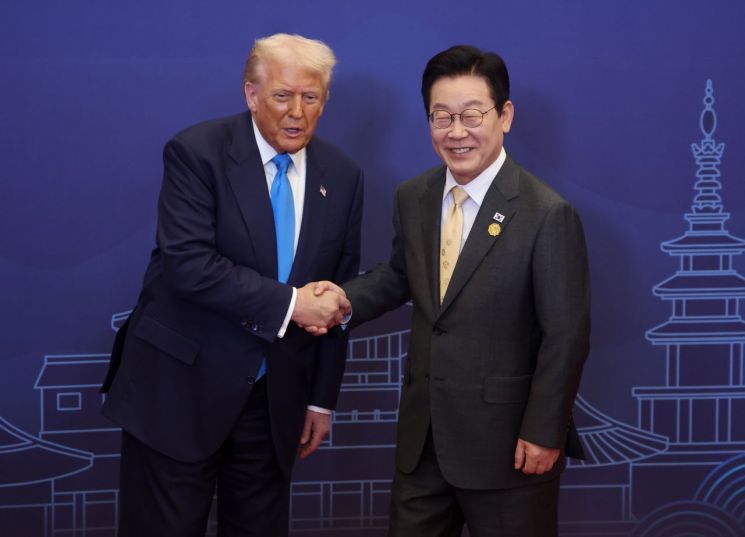 President Lee Jae-myung is welcoming U.S. President Donald Trump ahead of the special summit dinner hosted by the president at the Hilton Hotel Grand Ballroom in Gyeongju, Gyeongbuk on the 29th. Photo by Yonhap News
Patrick Cronin, Chair for Asia-Pacific Security at the Hudson Institute, stated, "President Lee secured a balanced economic agreement," adding, "Korea's investment in the United States has been capped at 20 billion dollars per year, and the two countries agreed to deepen strategic cooperation in the shipbuilding sector." He continued, "Korea requested support for acquiring nuclear-powered submarines, which could significantly enhance the Korean Navy's capabilities for blue-water and undersea operations."
However, he pointed out, "The issue does not lie in transactional agreements, but in the absence of a comprehensive strategy to deal with hostile countries," emphasizing, "A transactional approach without a strategic framework poses a risk, as it could allow competitors with clear long-term plans to surpass us."
Andrew Yeo, Korea Foundation Chair at the Brookings Institution, referred to the cap on cash investment in the United States and the reduction of automobile tariffs, saying, "The outcome appears more favorable for Seoul than initially expected." He also predicted, "President Trump's trade agreements will, in the long run, normalize the 'MAGA' trade approach, which uses tariffs as leverage to pressure both allies and adversaries."
Robert Rapson, former Charg? d'Affaires at the U.S. Embassy in Korea, commented, "Both sides made very positive statements reaffirming strengthened cooperation in security, semiconductors, and shipbuilding." However, he added, "When it comes to the substantive agreements from the summit, the devil is still in the details," noting that the specifics of the trade deal could become variables in the U.S.-Korea alliance and bilateral relations.
Former Ambassador Rapson also suggested that the North Korea-U.S. summit, which fell through this time, could be reconsidered in early 2026, using President Trump's visit to China as a stepping stone. He said, "Attention is now shifting to the possibility of the two leaders holding talks," and added, "If President Trump's visit to China actually takes place, it could serve as an opportunity to resume the meeting."
© The Asia Business Daily(www.asiae.co.kr). All rights reserved.

















