Mayor Oh Sehoon Announces 2026 Budget Proposal
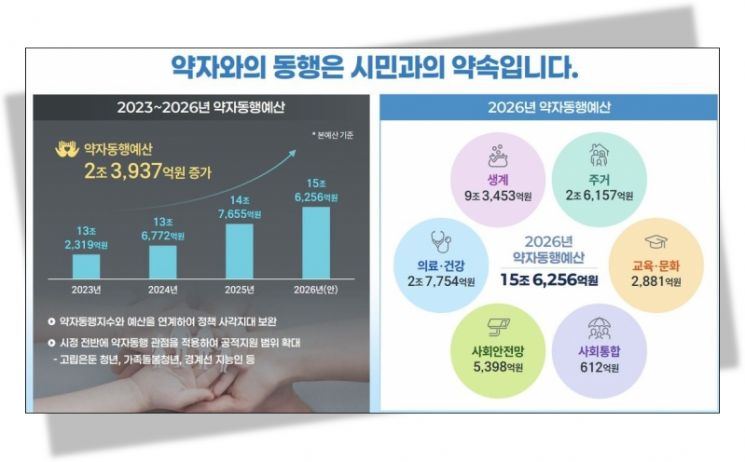
15.6 Trillion Won for Policies Supporting the Vulnerable
4.7 Trillion Won Allocated for Welfare Benefits
Over 1 Trillion Won Invested in 24,000 Public Rental Units
Mayor Oh: "We Will Not Increase the Debt for Future Generations"
The Seoul Metropolitan Government has set its 2026 budget proposal at a total of 51.506 trillion won. With a stronger focus on its core policy of "Walking Together with the Vulnerable," the city plans to allocate over 15 trillion won solely to related initiatives. Although government-issued livelihood recovery consumption coupons have increased the city's debt, Seoul's policy is to maintain sound fiscal management by efficiently distributing resources.
On the morning of October 30, Seoul Mayor Oh Sehoon announced the "2026 Budget Proposal" at Seoul City Hall, stating, "With a determination not to increase the debt that future generations will have to repay, we will continue to expand policies that bring revolutionary changes to citizens' lives next year."
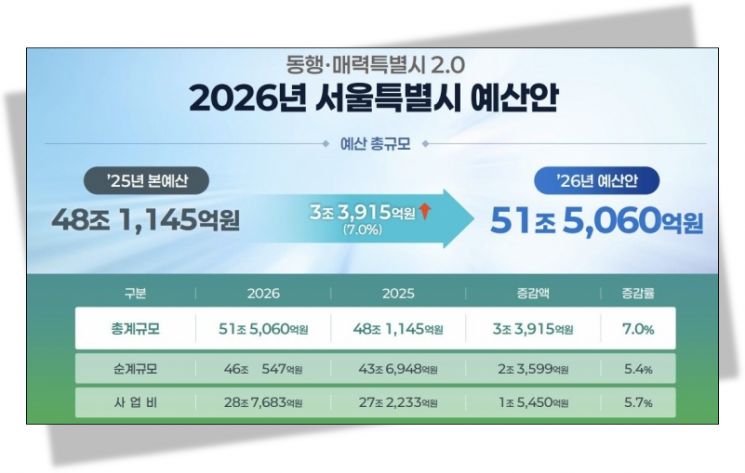
The most notable feature of next year's budget proposal is the concentrated allocation of funds to policies for the vulnerable. The total budget has increased by nearly 3.4 trillion won compared to this year, with the "Yakja Donghang" budget for supporting the vulnerable rising by 800 billion won to 15.6256 trillion won. Mayor Oh explained, "Although the national treasury subsidy budget has significantly increased, including a 1.0851 trillion won rise in large-scale government welfare projects, we have maintained a sound fiscal stance without increasing the debt."
A total of 4.7645 trillion won will be allocated to support the four major welfare benefits, expanding basic livelihood security and providing thorough welfare through initiatives such as the Care SOS program (36.1 billion won). The city will also invest 58.9 billion won in public jobs for people with disabilities, creating 5,500 positions-an increase of 383 over the previous year-and expand opportunities for social participation through the opening of the Eoullim Plaza (9.8 billion won) and sports centers (10.6 billion won).
To provide stable housing for vulnerable groups, young people, and newlyweds, the city will invest 1.0622 trillion won with the goal of supplying 24,000 public rental units. Mayor Oh added, "We will vigorously pursue redevelopment and reconstruction policies to rapidly supply high-quality housing."
Support for small business owners, SMEs, and vulnerable workers will also continue. The city will expand comprehensive support for small businesses (31.1 billion won), increase new loans (48.7 billion won), and enhance public delivery service promotion and payback programs (3.5 billion won). The number of "direct jobs" will be increased by 16,000 year-on-year to a record high of 225,234 positions.
Investment in "citizen safety" will be strengthened to proactively respond to urban disasters caused by climate change, such as heavy rainfall, ground subsidence, and fires. The city will improve the durability of infrastructure by allocating 447.7 billion won for the maintenance of water and sewage pipelines over 30 years old, 6 billion won for the replacement of aging heat transmission pipes, and 92.3 billion won for the replacement of old facilities on subway lines 1 to 8, while diversifying inspection methods.
New risk factors such as cyberattacks, digital service disruptions, and electric vehicle fires will be addressed through investments in digital safety infrastructure (33.2 billion won) and smart fire detection systems (900 million won). The city will also begin full-scale structural solutions for areas prone to flooding, including excavation of three deep underground rainwater drainage tunnels and the construction and expansion of rainwater pumping stations.
A total of 693.9 billion won has been allocated for the construction of metropolitan railways such as GTX-A and urban railways in the Seoul metropolitan area. The city plans to invest 149.5 billion won in improving the structure of major roads such as Yangjae-daero, aiming to connect living zones more conveniently not only within Seoul but also throughout the metropolitan area.
Another feature of next year's budget is the detailed allocation of funds for citizens' health. Six billion won will be used for projects such as "Wrist Doctor 9988 2.0" and certifying 3,000 "Whole Grain Meal" restaurants that encourage whole grain consumption. Eight billion won will be allocated to the Seoul Mind Convenience Store, which diagnoses and provides counseling for loneliness, to support citizens' mental health.
The city will also invest in nurturing future talent to strengthen Seoul's competitiveness. With a focus on "AI and STEM talent development" and "industrial promotion," 131.5 billion won will be allocated for youth job training schools and STEM scholarships, and 10 billion won out of the 49.7 billion won future industry R&D budget will be invested in the AI sector.
The creation of new landmarks in Seoul will also be accelerated. The city will begin full-scale work on the Namsan Gondola project (17 billion won), aiming for operation in 2027, and will focus on developing the Nodeul Island Global Art Island (28.7 billion won) and the second Sejong Center for the Performing Arts (21 billion won). Mayor Oh stated, "Although debt increased this year due to livelihood recovery consumption coupons, we have upheld the principle of sound fiscal management with a determination not to increase the debt that future generations will have to repay," adding, "We will move forward vigorously toward a 'Premier Seoul' recognized by the world."
© The Asia Business Daily(www.asiae.co.kr). All rights reserved.


















