Korea Employers Federation "Intergenerational Job Forum"
Extending the Statutory Retirement Age Fuels Intergenerational Conflict
Career Transition Support and Youth Incentives Also Proposed
While labor unions are advocating for a legal extension of the retirement age from the current 60 to between 63 and 65, there is criticism that the previous legal mandate of a "mandatory retirement age of 60" was the worst method for maintaining employment among middle-aged and older workers. As it caused serious side effects such as intergenerational job conflicts, experts emphasize the importance of companies voluntarily seeking alternatives such as "rehiring after retirement."
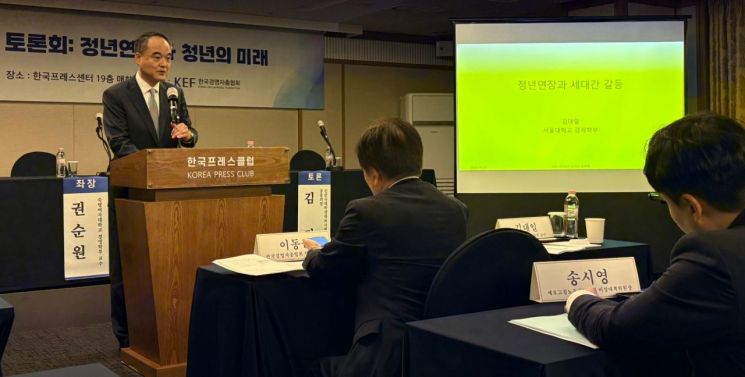 Professor Daeil Kim of the Department of Economics at Seoul National University is speaking at the "Intergenerational Job Forum: Retirement Age Extension and the Future of Youth" held on the 29th at the Press Center in Jung-gu, Seoul. Photo by Youngju Jeon
Professor Daeil Kim of the Department of Economics at Seoul National University stated at the "Intergenerational Job Forum: Retirement Age Extension and the Future of Youth" held on the 29th at the Press Center in Jung-gu, Seoul, "The 2013 legislation was the worst method," adding, "A viable alternative is for employees to retire at the statutory age and then be rehired with wages adjusted to their productivity." This forum was hosted by the Korea Employers Federation.
When the government in 2013 raised the statutory retirement age from 58 to 60 and above, side effects such as reduced new hiring and worsened personnel bottlenecks emerged. Professor Kim explained, "Employment among those aged 55 to 59 increased, but as companies could not bear the associated costs, they inevitably responded by reducing new hires among young people," adding, "This led to serious side effects, namely intergenerational job conflicts."
Against this backdrop, the argument has been made that rehiring after retirement is an alternative that can maintain employment for middle-aged and older workers while minimizing the reduction of jobs for young people. Professor Kim emphasized, "There needs to be a voluntary agreement between labor and management regarding post-retirement reemployment," and added, "Rather than mandatory legislative measures, the approach should be to provide and expand support, such as corporate tax cuts for companies excelling in reemployment or reductions in the four major social insurance contributions for rehired workers."
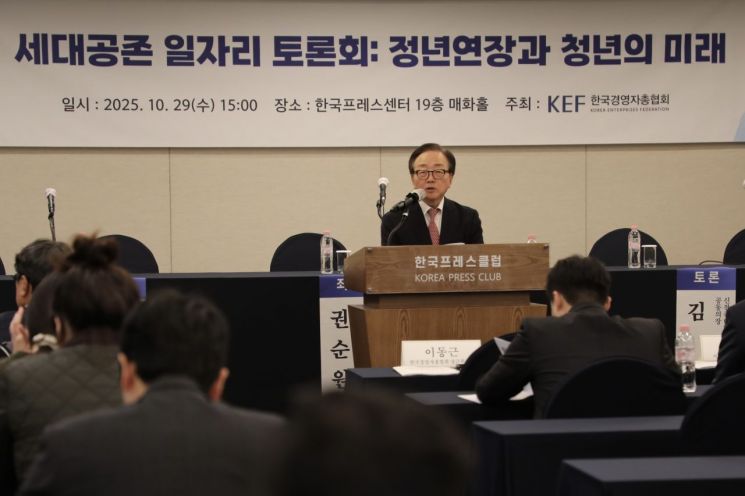
Dongkeun Lee, Executive Vice Chairman of the Korea Employers Federation, also stressed, "Policies for employing older workers should not be limited to simply extending the retirement age." He added, "By offering practical pathways for older workers to continue working-such as post-retirement reemployment, career transition support, and job redesign-we can also protect job opportunities for young people."
Song Siyoung, Acting Chairman of the Saerogochim Labor Council, a prominent labor union coalition representing Millennials & Gen Z, said during the forum, "While I agree on the need to extend the retirement age, legislating it is premature. It would structurally reduce the number of quality jobs available to young people." He added, "We should first establish institutional measures such as expanding incentives for companies that rehire retirees or hire young people."
© The Asia Business Daily(www.asiae.co.kr). All rights reserved.


















