"Weak Real Economy, Strong Financial Markets"
"U.S.-China Conflict Brings Both Challenges and Opportunities"
Shipbuilding Industry to Sail Smoothly Thanks to MASGA Effect
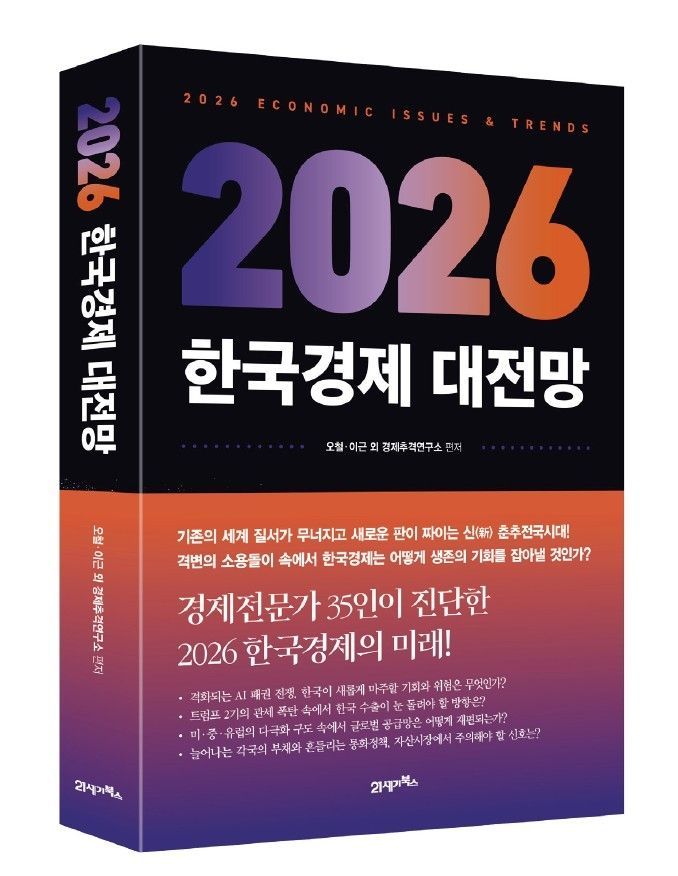
It has now been ten years since the keyword "Korea Economic Outlook" has been used to forecast the following year's economy. The number of contributing authors started at 17 in the early days, increased to 33 last year, and has grown to 35 this year. The book's sales have also steadily risen, now selling in the tens of thousands of copies annually. Among the contributors, three have been selected to join the presidential office under the Lee Jaemyung administration: Ryu Deokhyun, Fiscal Planning Advisor; Ha Jeongwoo, Chief Secretary for AI Future Planning; and Ha Junkyung, Chief Secretary for Economic Growth, all of whom have been involved with "Korea Economic Outlook."
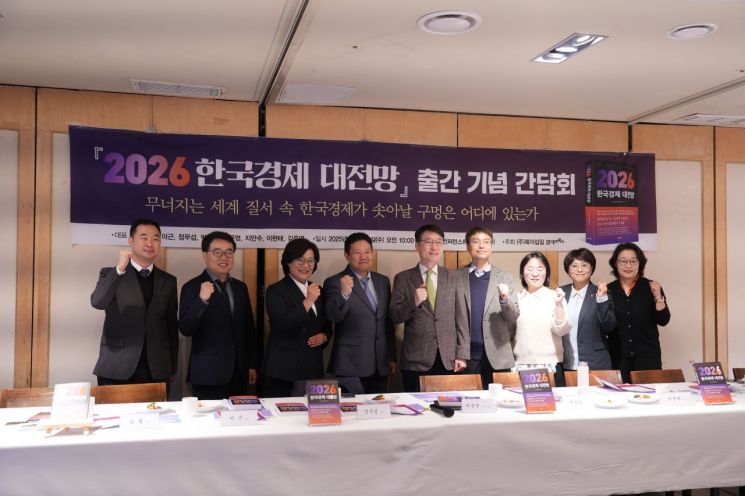 Authors of the new book "2026 Korea Economic Outlook" are holding a publication commemorative meeting at a restaurant in Jung-gu, Seoul on the 29th. Provided by 21st Century Books
This year, the 35 economic experts who contributed to the book identified the key words for Korea's economy in 2026 as "Payongunran" (waves surging, clouds in chaos) and "Cheonbungyuhyeol" (even if the sky collapses, there is a way out). As the saying goes, "Even in a phase of turbulent waves and chaotic clouds, there is always a way out," meaning that although the Korean economy faces a massive crisis, there are still opportunities within the crisis. The experts observed that, due to U.S. tariff policies, traditional Western countries are distancing themselves from the U.S., while India and China, which have often been at odds within BRICS (Brazil, Russia, India, China, and South Africa), are now forming new alliances. As a result, the U.S.-China dynamic may shift toward a tripolar or multipolar structure involving the U.S., Europe, and BRICS. They predicted that 2026 would be an exceptionally challenging year, with numerous variables creating turmoil both domestically and internationally.
First, they believe that uncertainty will increase in areas such as exchange rates, exports, economic conditions, interest rates, and domestic demand, all of which will have a significant impact on the Korean economy. However, they also noted that domestic demand is showing signs of recovery, the growth of future industries such as artificial intelligence (AI) platforms is promising, and sectors like shipbuilding, defense, and nuclear power are expected to gain momentum. They also anticipate benefits from participating in post-war reconstruction projects following the end of the Russia-Ukraine war.
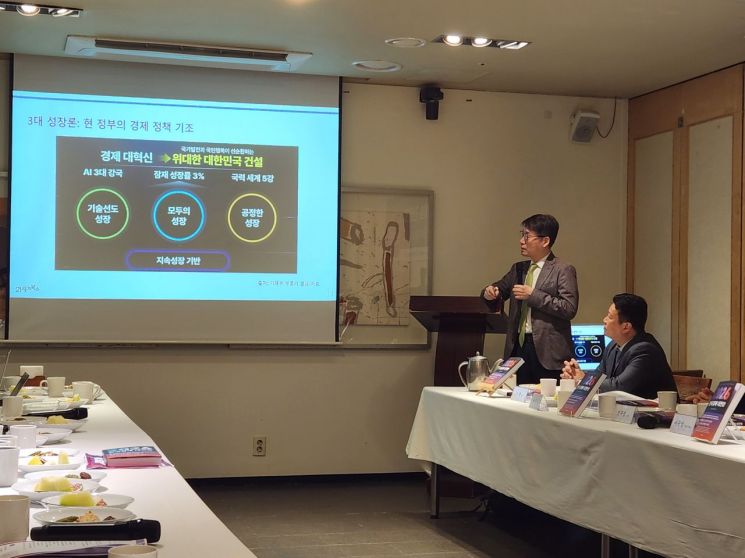 Author Lee Geun, Professor Emeritus at Seoul National University, is presenting at a publication commemorative meeting on the 29th at a restaurant in Jung-gu, Seoul, for the new book "2026 Korea Economic Outlook." Photo by Seo Mideum
On the 29th, ten authors gathered for a publication discussion at a restaurant in Jeong-dong, Jung-gu, Seoul. At the event, Lee Geun, Professor Emeritus at Seoul National University, stated, "Next year's economy will be somewhat weak in the real sector, but the financial, stock, and real estate markets will remain strong. The divergence between real and financial assets will be a key theme."
Professor Lee explained that the government's economic policy is focused on achieving a potential growth rate of 3 percent, but to reach this goal, the emphasis is placed on innovation and productivity improvements centered on artificial intelligence (AI), rather than on capital or labor. However, he noted that it will take time for the effects of AI to become apparent.
Professor Lee also pointed out that the U.S.-China conflict could have a significant impact on Korean companies. He explained, "During Trump's first term, the U.S. targeted only China, which benefited Korea as an alternative to China. However, in Trump's potential second term, the U.S. is targeting all countries, so it is important to view the situation differently."
He added, "Rather than simply containing China, the U.S. is pursuing a MAGA (Make America Great Again) policy that targets everyone, which is causing damage to the global economy, including Korea. As the anti-China front becomes fragmented, China may see the current situation as more favorable."
Furthermore, Professor Lee explained that the widespread expectation that China would surpass the U.S. economy by the 2030s has proven to be completely off the mark. In economic terms, the U.S. is currently standing alone at the top, solidifying its hegemony. Nevertheless, he analyzed that the U.S. continues to confront China because it is losing its leadership in advanced industries such as batteries, artificial intelligence (AI), and semiconductors, and is facing difficulties in the military sector as a result.
The U.S.-China trade dispute is expected to be a boon for the domestic battery industry. Since the battery industry has benefited as a counterbalance to Europe's strong environmental regulations, it is not inherently highly competitive. It is heavily influenced by environmental factors, but the U.S.-China trade dispute is acting as a positive factor. Professor Lee stated, "Although there is the challenge of slowing demand for electric vehicles, the trend toward electric vehicles remains clear. If the U.S. blocks China in the international market, Korea will be the only option left. There is an opportunity."
The shipbuilding industry, which drew attention during U.S.-Korea tariff negotiations with the MASGA (Make American Shipbuilding Great Again) project, is expected to continue to perform well.
Lee Boram, Senior Research Fellow at the Korea Institute for International Economic Policy, said, "In 2026, the MASGA, a U.S.-Korea shipbuilding cooperation project, will enter full swing. Although global demand for shipbuilding is expected to weaken, Korean companies will maintain stable profitability thanks to ongoing cooperation with the U.S. and a sufficient backlog of orders."
There was also an opinion that, aside from temporary fluctuations, housing prices will ultimately rise.
Kim Deokrae, Head of the Housing Research Division at the Housing Industry Research Institute, commented, "Overall, there are still factors that make it inevitable for housing prices to rise. While macro factors and regulations may cause temporary fluctuations, it will be difficult to stop the long-term upward trend in the housing market."
Director Kim analyzed that, although the number of marriages and households is increasing and foreign purchases of housing are becoming more active, the decline in housing starts and supply volume means that the growing housing demand cannot be met.
In the cultural industry, there was a call for a proper evaluation of online video services (OTT) in the film market. It was argued that the industry should move away from the traditional large-theater-centric system and include the newly emerging OTT platforms in film metrics. Kim Yoonji, Senior Research Fellow at the Overseas Economic Research Institute of the Export-Import Bank of Korea, pointed out that the number of domestic film releases last year dropped to one-third, highlighting the reality that the emergence of OTT has completely transformed the competitive landscape of the film industry. She explained, "From the perspective of large theaters, the film industry is struggling, but in terms of video content, it is not. OTT platforms are performing well. Even OTT content outside the traditional film category should be properly released and rights secured, requiring a restructuring of the industry."
There was also criticism regarding the low utilization of artificial intelligence (AI). Sung Hoyong, Professor of Economics at Sungshin Women's University, pointed out that while Korea's AI infrastructure ranks sixth in the world, its operational capability ranks only thirty-fifth, suggesting that the country needs to consider both the speed and capacity of AI adoption.
© The Asia Business Daily(www.asiae.co.kr). All rights reserved.
![User Who Sold Erroneously Deposited Bitcoins to Repay Debt and Fund Entertainment... What Did the Supreme Court Decide in 2021? [Legal Issue Check]](https://cwcontent.asiae.co.kr/asiaresize/183/2026020910431234020_1770601391.png)

















