Metropolitan Transportation Network Forum Held at Gwangju City Council
"Need for Cost-Effective Railway and Integrated Organization"
"The success or failure of the Gwangju-Jeonnam megacity depends not on administrative integration, but on the integration of transportation networks."
At the metropolitan transportation network forum held at the Gwangju City Council on the 29th, experts proposed the construction of a railway network and the utilization of existing lines, aiming to achieve a 30-minute commute zone for the Gwangju area and a one-hour commute zone for the Jeonnam area.
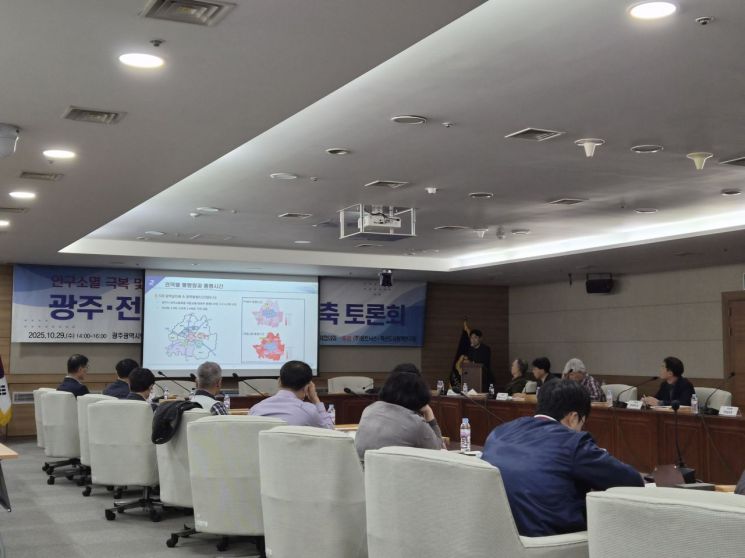 On the afternoon of the 29th, Professor Lim Kwanggyun of Songwon University gave a keynote presentation at the "Gwangju-Jeonnam Metropolitan Transportation Network Construction Forum for Overcoming Population Extinction and Creating a Megacity" held in the main conference room of the Gwangju City Council. Photo by Song Bohyun
This forum, which addressed the construction of a metropolitan transportation network to respond to the population extinction crisis in Gwangju and Jeonnam and the concentration of population in the Seoul metropolitan area, was co-hosted by Gwangju Jeonnam Future Vision, the Gwangju City Council, and the Gwangju Citizens’ Coalition, with sponsorship from Optonics Co., Ltd. and the Innovation City Policy Research Institute.
Lim Kwanggyun, Professor of Railway Operations and Management at Songwon University, emphasized in his keynote presentation, "The success of the Gwangju-Jeonnam megacity must begin not with administrative integration, but with the integration of the transportation network." He proposed the following measures to achieve a 30-minute commute zone for the Gwangju area and a one-hour commute zone for the Jeonnam area: the creation of a multi-modal transfer center at Gwangju Songjeong Station, expansion of a BRT-level metropolitan public transportation network, construction of a circular metropolitan railway network of about 350 kilometers, and the establishment of the "Gwangju-Jeonnam Metropolitan Transportation Organization" (tentative name).
He added, "By strengthening the transfer system between railways and buses centered on Gwangju Songjeong Station and introducing a circular metropolitan railway using existing railway lines, it is possible to unite 12 cities and counties in Gwangju and Jeonnam into a single living sphere."
Cho Jinsang, Professor Emeritus of Urban Planning at Dongshin University, presented a cost-effective and efficient metropolitan railway model utilizing existing lines as an alternative. He pointed out, "The metropolitan railway projects currently under discussion require investments on the scale of trillions of won, take more than 20 years to complete, and inevitably result in hundreds of billions of won in annual operating deficits. Such high-cost, long-term projects have low effectiveness."
He then introduced the Daegu-Gumi-Gyeongsan metropolitan railway as an example, explaining, "It is the first metropolitan railway outside the Seoul metropolitan area to succeed by utilizing existing lines, with a total project cost of 200 billion won." He further added, "Once the dedicated high-speed rail line between Gwangju and Mokpo is completed, the existing line will remain. By connecting this line with Yeongam-Boseong, the Jeolla Line, the Gyeongjeon Line, and Gwangju-Damyang, it will be possible to quickly connect major cities at low cost."
Panelists in the designated discussion included Naju Mong, Professor of Economics at Chonnam National University; Park Pilsun, member of the Gwangju City Council’s Industry and Construction Committee; Ki Usik, Secretary General of the Gwangju Citizens’ Coalition; and transportation officials from the Gwangju and Jeonnam provincial governments. The discussants exchanged opinions on ways to promote the integration of metropolitan railways, roads, and public transportation, as well as the financial feasibility of such efforts.
© The Asia Business Daily(www.asiae.co.kr). All rights reserved.

















