Food Standards Shift to 'Safe Consumption'
The True Shelf Life of 179 Food Categories
Since 2023, the government has been phasing out the "sell-by date" system and fully implementing the "use-by date labeling system." As a result, "sell-by dates" are disappearing from supermarket shelves and product packaging. While the sell-by date was based on the "last date for sale," the use-by date is based on the "last date for safe consumption."
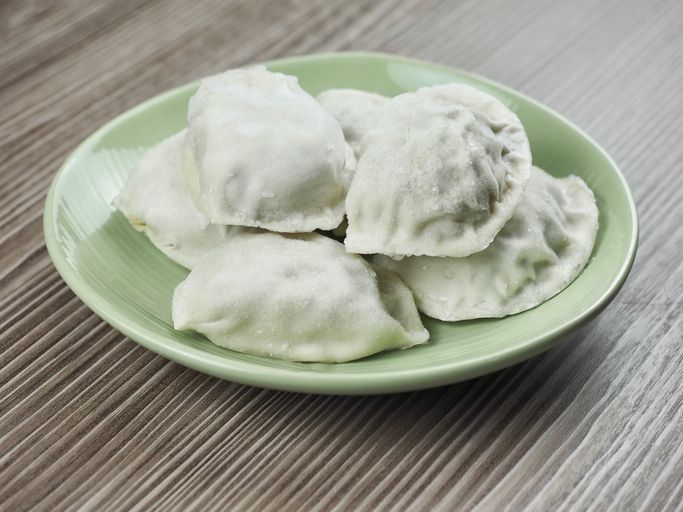
The use-by date system informs consumers of the "actual period during which food can be safely eaten." The Ministry of Food and Drug Safety explained, "The use-by date is the period during which quality is maintained without safety issues," adding that "it is on average 30 to 50 percent longer than the sell-by date." This means that food in your refrigerator that is one day past the date may not necessarily need to be thrown away.
The 'Real Shelf Life' Proven by Ministry of Food and Drug Safety Experiments
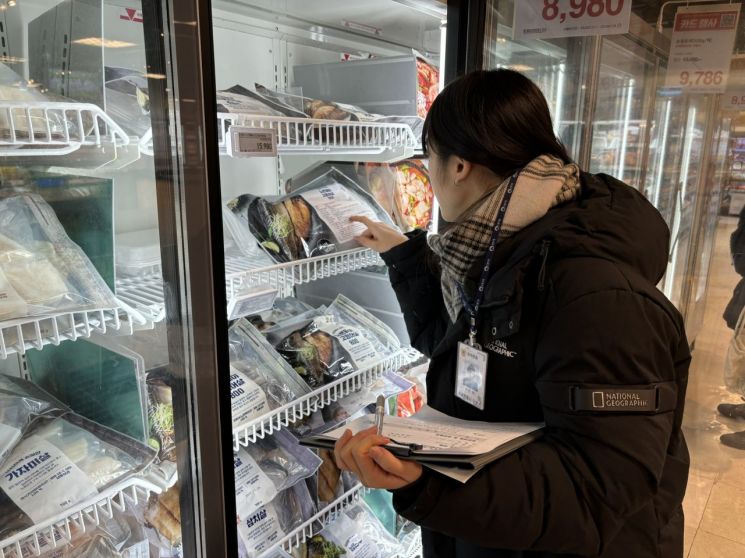 An employee of Dobong District is visiting Seongsu Food Manufacturing and Sales Business to check the product's expiration date and other details.
According to the Ministry of Food and Drug Safety and industry sources on November 2, the ministry conducted experiments over the past three years on 179 types of food and 1,450 items. By recreating laboratory, storage, and distribution environments, they comprehensively evaluated changes in quality, microbial growth, rancidity, and sensory assessments to calculate a "scientifically verified shelf life."
For snacks, the reference use-by period was 122 to 496 days, while for chocolate it was 121 to 294 days. Kimchi ranged from 31 to 106 days, and tofu was recorded at 33 to 38 days.
Oils were considered the most stable items. Sesame oil, perilla oil, sunflower oil, and soybean oil were confirmed to be safe for 11 to 32 months. In particular, rancidity was significantly delayed when these oils were stored in sealed containers protected from light. The same applied to soy sauces. The use-by period for Korean soy sauce, brewed soy sauce, and blended soy sauce ranged from 16 months to 996 days (about 2 years and 7 months). Soy sauces have high salt content and low pH, making it difficult for bacteria to grow.
Tofu, which must be refrigerated, has a use-by period of 22 to 28 days. For meat, there was a clear difference depending on whether it was cooked. Raw meat had a use-by period of about 48 days, while heated or processed products such as ham and sausage lasted 50 to 90 days. Condiments such as mayonnaise and ketchup had an average use-by period of 11 months, and frozen dumplings or ready-to-cook meal kits maintained safety for about 500 days at temperatures below -18°C.
Microbial activity in frozen foods is virtually halted, but "refreezing" should be avoided. When food thaws and is refrozen, moisture forms, increasing the risk of bacterial growth. Frozen foods should be cooked immediately after thawing.
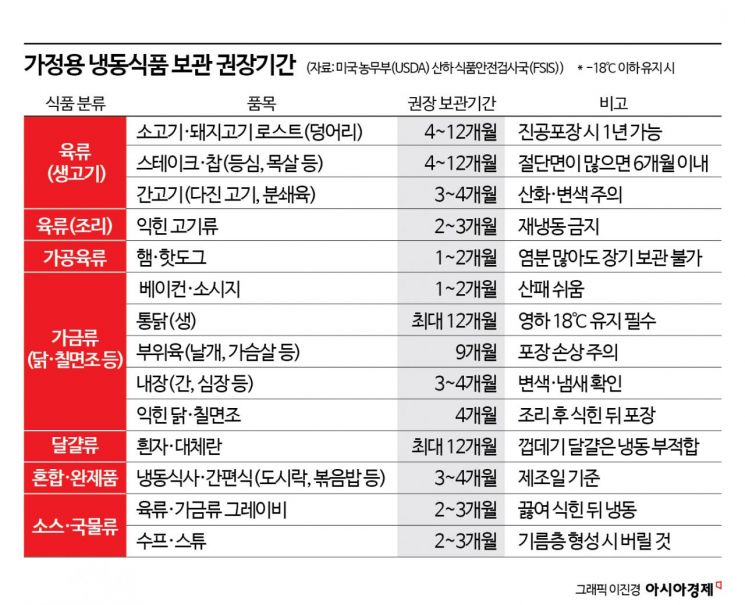
Does Freezing Make Food Last Longer? Still, Discard After One Year
The United States Department of Agriculture (USDA) stated in a report that "foods kept frozen continuously at -18°C (0°F) or below remain nutritionally and microbiologically safe indefinitely." However, "safety" and "quality" are different. Freezing halts bacterial activity, but texture and flavor gradually deteriorate. Home freezers are frequently opened and closed, making it difficult to maintain a consistent temperature. As a result, actual quality declines more rapidly than in industrial freezers.
The USDA provided recommended "quality retention periods" for various foods based on experiments. Beef and pork, for example, experience a rapid decline in quality after just 3 to 5 days in refrigeration, but can be stored for up to 12 months (1 year) when frozen. Even after 9 months, frozen steak showed less than 10 percent protein denaturation and less than 5 percent color change.
Fresh fish spoils easily, but when flash-frozen immediately after being caught at below -18°C, quality was maintained for 6 to 8 months. Fatty fish (such as salmon and mackerel) lasted 2 to 3 months, while lean fish (such as cod and pollock) lasted 6 to 8 months. Shellfish such as shrimp, crab, and lobster were safe for 10 to 12 months, while clams and mussels were safe for 3 to 6 months. The "fishy smell" of frozen fish is due more to protein denaturation during thawing than to oxidation. Thawing slowly in the refrigerator (below 4°C) can reduce odor and moisture loss.
The USDA considers the freezing limit for cooked meats to be 2 to 3 months. This is because the cells are already damaged during cooking, and after refreezing and thawing, moisture is lost and texture deteriorates.
The USDA recommends that vegetables be blanched before freezing to inhibit enzyme activity. Spinach and broccoli can be stored for 10 to 12 months, while corn and peas can be stored for 8 to 10 months. Eggs should not be frozen in their shells, as they will expand and crack; only egg whites or substitute egg products are recommended for freezing, and in these cases, quality can be maintained for up to one year.
According to the Korea Rural Economic Institute, over 30 percent of food waste in Korea is due to "expired sell-by dates." The Ministry of Food and Drug Safety expects that the use-by date system and improved refrigeration and freezing management could reduce annual food waste by more than 20 percent.
© The Asia Business Daily(www.asiae.co.kr). All rights reserved.



















