Women Aged 60 and Above Top Returns at 27%
Men in Their 20s Lag Behind with Short-Selling and Frequent Trading
This year, the KOSPI has recorded the highest growth rate in the world, continuing an unprecedented surge. Amid this rally, "female investors aged 60 and above" achieved the highest investment returns among all age groups. Male investors, regardless of age, posted lower returns than their female counterparts, with "male investors in their 20s" ranking last in terms of returns. Experts point out that frequent trading aimed at short-term gains and "contrarian bets" have held back younger male investors.
‘Grandma Buffet’ Who Bought and Held Came Out on Top
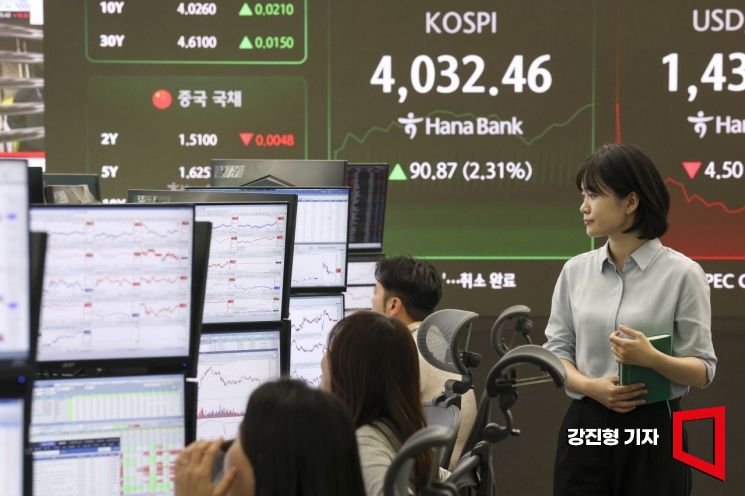 On the 27th, when the KOSPI, the country's representative stock index, surpassed the 4000 mark for the first time in history, dealers were working in the dealing room at the Hana Bank headquarters in Jung-gu, Seoul.
According to an analysis by the NH Investment & Securities Data Center on the 29th, which examined more than 2.24 million active accounts with a balance of at least 100,000 won that traded domestic stocks from January to September this year, women aged 60 and above recorded an average return of 26.9%, ranking first overall. They were followed by women in their 40s (25.9%) and women in their 50s (25.7%), with middle-aged and older women dominating the top ranks.
Experts attribute the strong performance of older female investors to three main factors: a keen sense for market-leading sectors, focused investment in blue-chip stocks, and a long-term holding strategy that is not swayed by short-term fluctuations. These so-called "Grandma Buffet" investors-a term combining "grandmother" and "Warren Buffett"-are known for holding a single stock for an extended period and riding the market trends.
Men in Their 20s Held Back by Frequent Trading and Contrarian Bets
In contrast, the average return for male investors was 21%, more than 3 percentage points lower than that of female investors (24.4%). While men aged 60 and above (23.3%) and those in their 50s (21.1%) performed relatively well, men in their 30s (19.8%) and 20s (19.0%) failed to reach even 20%.
 The average return on investment for male investors was 21%, which was more than 3 percentage points lower than that of female investors (24.4%). The Asia Business Daily database
It is analyzed that excessive trading and contrarian bets have hindered male investors. The most purchased stock by male investors this year was the "KODEX 200 Futures Inverse 2X" ETF, which aims for double returns when the KOSPI falls. As a result, they suffered losses by investing in "double inverse" ETFs during a rising market.
Over the past month, major double inverse ETFs such as TIGER 200 Futures Inverse 2X (-32.4%), RISE 200 Futures Inverse 2X (-32.6%), PLUS 200 Futures Inverse 2X (-32.5%), and KIWOOM 200 Futures Inverse 2X (-31.1%) have all recorded losses of around 32%. Meanwhile, since last month, the KOSPI index has risen by as much as 16.4%.
There was also a clear gender gap in "turnover rate," which indicates trading frequency. The average turnover rate for men was 181.4%, more than twice that of women (85.7%). This means that with an initial investment of 10 million won, they bought and sold stocks worth 36.2 million won over the course of a year. In every age group, men showed a higher turnover rate than women.
JPMorgan Issues Bold Forecast: "KOSPI Could Reach 5000 Next Year... Even 6000 Possible"
 US-based investment bank JPMorgan announced on the 28th (local time) a surprising forecast that "a KOSPI of 6000 points is possible in a bull market scenario." The 12-month target was raised to 5000 points. The Asia Business Daily DB
Meanwhile, US-based investment bank JPMorgan announced on the 28th (local time) a surprising forecast that "a KOSPI of 6000 points is possible in a bull market scenario." The 12-month target was raised to 5000 points.
In its report released that day, JPMorgan stated, "The potential for further gains in the Korean stock market is clearly real." The bank pointed out that the issue of resolving the "Korea Discount" (the undervaluation of the Korean stock market) related to government policy has not yet been reflected at all in current stock prices, suggesting that such positive developments could significantly boost the market going forward.
While some have raised concerns that the KOSPI's rise of over 70% since the beginning of the year is excessive and have questioned the effectiveness of capital market reform policies, JPMorgan reaffirmed the enduring appeal of the Korean stock market. The bank emphasized, "Korea remains our top 'OverWeight' market in the Asia region."
© The Asia Business Daily(www.asiae.co.kr). All rights reserved.
![Clutching a Stolen Dior Bag, Saying "I Hate Being Poor but Real"... The Grotesque Con of a "Human Knockoff" [Slate]](https://cwcontent.asiae.co.kr/asiaresize/183/2026021902243444107_1771435474.jpg)













