Simpson Thacher & Bartlett Report
Overseas Authorities Shift Focus to Domestic Cases
Bid Rigging and Information Exchange Collusion Persist in Korea
In 2024, while the total amount of cartel fines in major economic regions such as the United States and the European Union (EU) decreased, Korea saw an increase. Global law firms have analyzed that competition authorities in each country are shifting their focus from international cartels to domestic cases. In Korea, however, bid rigging and information exchange-type collusion continue to occur, resulting in no reduction in the amount of fines imposed.
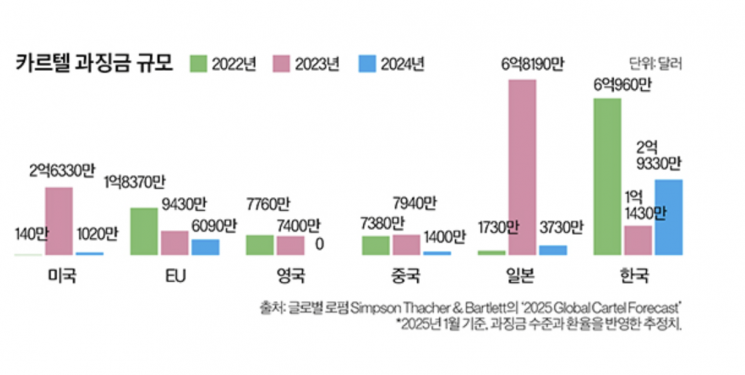
Global Fines Drop from $1.9 Billion to $600 Million
According to the '2025 Global Cartel Outlook Report' by the global law firm Simpson Thacher & Bartlett, the total amount of cartel fines in the United States in 2024 was $10.2 million, a significant decrease from $263.3 million in the previous year.
This downward trend was also observed in the EU, the United Kingdom, China, and Japan. The EU imposed fines of 54 million euros ($60.9 million) in 2024, a decrease of about 67% compared to 2022. In the United Kingdom, not a single cartel fine was imposed in 2024, whereas in 2023, fines amounted to 60.2 million pounds ($74 million).
Another global law firm, A&O Shearman, also reported in its 'Global Antitrust Enforcement Report' that the total amount of cartel sanctions across 31 jurisdictions dropped sharply from $1.9 billion in 2023 to $602.5 million in 2024.
Simpson Thacher & Bartlett attributed the decrease in cartel sanctions to competition authorities shifting their investigations to domestic cases due to geopolitical tensions. A&O Shearman analyzed that in 2024, there were almost no large-scale cases exceeding $100 million each, and the number of leniency applications in the United States, United Kingdom, and EU declined, which may have influenced the reduction. Attorney Lee Byungju (Judicial Research and Training Institute, 34th class) of Jipyung LLC commented, "International cartels, which were frequent in the early to mid-2010s, have recently been on the decline," adding, "It appears that changes in competition authorities' policies due to reshoring and the reorganization of global supply chains have had an impact."
Korea Moves Against the Trend
Korea moved in the opposite direction of this global trend. Cartel fines in Korea decreased from $609.6 million in 2022 to $114.3 million in 2023, but rebounded to $293.3 million in 2024. Attorney Lee Heejae (34th class) of HwaWoo LLC stated, "In Korea, there were sanctions on large-scale collusion cases in 2024, such as the bid rigging for built-in special furniture purchases (fines of 93.1 billion won) and the Alpensia Resort bid rigging (51 billion won)," adding, "While large-scale collusion cases have been detected and sanctioned less frequently in the global market due to a decrease in leniency applications, in Korea, bid rigging and information exchange-type collusion still appear to be occurring."
AI and Algorithmic Collusion
Both global law firms identified artificial intelligence (AI) and algorithms as key areas of focus for future competition law. They cited the joint statement issued in July 2024 by the U.S. Department of Justice (DOJ), the UK Competition and Markets Authority (CMA), and the European Commission (EC) regarding the competitive risks of generative AI, as well as the warning issued in October of the same year by competition authorities from the Group of Seven (G7) nations about the potential for collusion through AI and pricing algorithms.
Seo Hayoun, The Law Times Reporter
※This article is based on content supplied by Law Times.
© The Asia Business Daily(www.asiae.co.kr). All rights reserved.
![Clutching a Stolen Dior Bag, Saying "I Hate Being Poor but Real"... The Grotesque Con of a "Human Knockoff" [Slate]](https://cwcontent.asiae.co.kr/asiaresize/183/2026021902243444107_1771435474.jpg)
















