Trump Says "Bad Fuel Could Be the Cause"
U.S. Forces in the Middle East Face Successive Accidents, Full-Scale Investigation Underway
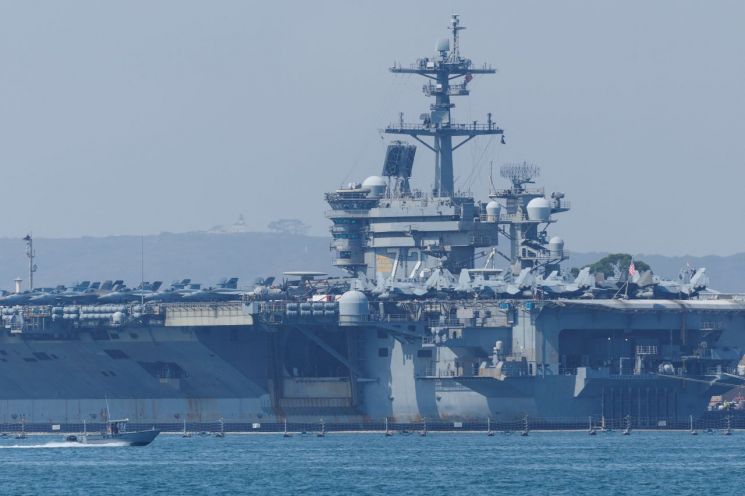
As a series of accidents involving the crash of military aircraft, including fighter jets and helicopters, have occurred on U.S. Navy aircraft carriers, President Donald Trump has drawn attention by stating that "bad fuel" might be to blame. Since the aviation fuel used by the U.S. Navy is the same as that used by U.S. military personnel deployed worldwide, there are concerns that if defective fuel is confirmed as the cause, a comprehensive investigation will be conducted. Alongside these crashes, it has been revealed that various aircraft malfunctions have occurred within the U.S. fleet, raising further concerns about a decline in the U.S. military's operational capabilities.
Fighter Jets and Helicopters Crash Successively on U.S. Aircraft Carrier... Trump Says "Bad Fuel Could Be the Problem"
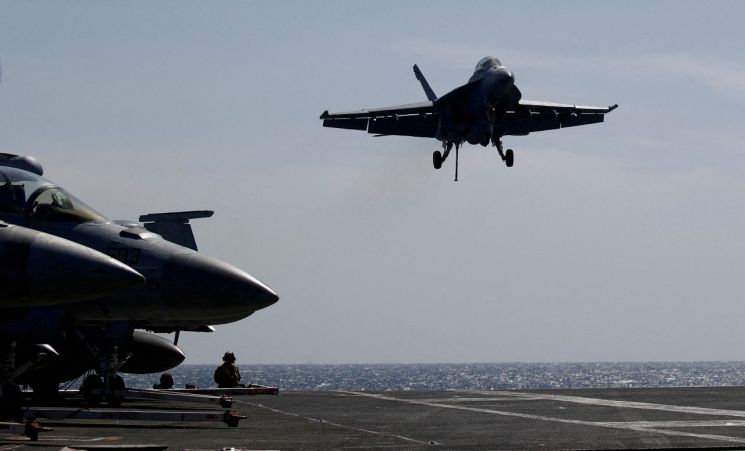
According to the U.S. Navy Pacific Fleet, on October 26 (local time), two carrier-based aircraft crashed in succession while taking off from the USS Nimitz aircraft carrier during training in the South China Sea. The aircraft involved were an MH-60R Seahawk helicopter and an F/A-18F Super Hornet fighter jet. The U.S. Navy stated, "The two aircraft crashed 30 minutes apart, and the cause is currently under analysis," adding, "All five crew members-three from the helicopter and two from the fighter jet-were safely rescued."
With President Trump raising the issue of fuel as a possible cause, the U.S. Navy is focusing its investigation on the fuel aspect. Immediately after the accident, President Trump said at a press conference, "The cause of this highly unusual crash may be bad fuel," adding, "Once the Navy's assessment is complete, more details will be provided and nothing will be concealed."
According to CNN, the Navy's initial investigation has already identified fuel contamination as a primary cause. This is because if it were a simple mechanical defect, it would be unlikely for different types of aircraft-a helicopter and a fighter jet-to crash simultaneously. The U.S. Navy is currently inspecting the JP-5 aviation fuel stored on the aircraft carrier. The final results and official report of the investigation are expected to be released in several months.
The aviation fuel used on U.S. aircraft carriers is standardized as JP-5. This fuel is known for its high flash point, which is intended to reduce the risk of fires onboard ships, making its handling and storage significantly more challenging than regular fuel. The U.S. Navy typically inspects aviation fuel multiple times from the moment it is loaded onto ships, and it is filtered several times before being supplied to aircraft.
It is known to be rare for aircraft to crash due to water or impurities mixed into aviation fuel. In September 1999, however, an incident occurred at the 16th Fighter Wing of the Republic of Korea Air Force, where an F-5 fighter jet crashed after being supplied with fuel contaminated with water, resulting in the deaths of two pilots.
U.S. Navy Faces Successive Accidents Due to Misfires and Mechanical Failures... Concerns Over Declining Operational Capability
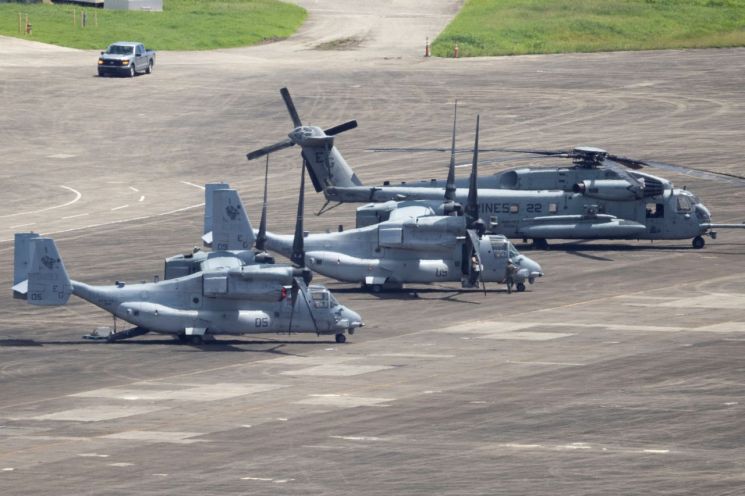
In addition to the recent crashes, the U.S. Navy has experienced a series of accidents during operations and training over the past several months, raising concerns about a possible decline in its operational capability. This is particularly due to increasing difficulties in maintaining and repairing aging ships and aircraft, which has led to frequent malfunctions.
According to the U.S. Navy, several incidents also occurred late last year on the USS Harry S. Truman, which was deployed to the Middle East in response to the Houthi rebels' blockade of Red Sea routes. These included a fighter jet being shot down by friendly fire, and another fighter jet skidding off the hangar deck and falling into the sea while preparing to take off. There was also an incident where a malfunctioning arresting cable caused a fighter jet to crash into the sea during landing. Although there were no fatalities in these incidents, the series of malfunctions has prompted the U.S. Navy to launch a large-scale investigation.
Both inside and outside the U.S. Navy, there are criticisms that maintenance, repair, and overhaul (MRO) are not being properly carried out. The U.S. Navy spends over $7 billion (about 10 trillion won) annually on MRO alone, but it is struggling to keep up with the maintenance demands of aging vessels. Since the U.S. shipbuilding industry has sharply declined since the 1980s, it has become increasingly difficult to maintain and repair the more than 150 ships currently operating worldwide.
To address this, the U.S. government has been working to ease regulations that previously limited warship construction and repairs to within the U.S. or at U.S. military bases, and is seeking to collaborate with South Korean companies. The MRO business of South Korean shipyards, which was previously limited to non-combat ships, is expected to expand to include various warships and aircraft carriers in the future.
© The Asia Business Daily(www.asiae.co.kr). All rights reserved.
![Clutching a Stolen Dior Bag, Saying "I Hate Being Poor but Real"... The Grotesque Con of a "Human Knockoff" [Slate]](https://cwcontent.asiae.co.kr/asiaresize/183/2026021902243444107_1771435474.jpg)


















