Despite the Stock Market Rally, Securities Firms Say "Dividends Difficult for Insurers"
Insurance CEOs in Unison: "Surrender Value Reserve System Must Be Improved"
Financial Authorities Begin Review of Rationalization Measures
As the KOSPI surpasses the 4,000 mark and the stock market gains momentum with the year-end dividend season approaching, expectations for dividends from major listed companies are rising. However, insurance companies are facing a different situation and are less optimistic. Due to the burden of managing the capital adequacy ratio (K-ICS, also known as KICS) and setting aside reserves for surrender value refunds, it is expected that they will have difficulty paying dividends again this year.
According to the financial sector on October 29, there is a growing consensus among securities firms that insurance companies will find it difficult to pay dividends based on this year's financial results. Jeon Bae-seung, a researcher at LS Securities, published a report on Hyundai Marine & Fire Insurance the previous day titled "If Only Dividends Were Resumed." Jeon noted, "Hyundai Marine & Fire Insurance is thoroughly neglected in terms of valuation compared to domestic and international insurers with similar earnings, as its price-to-book ratio (PBR) stands at only 0.4." He analyzed that "this is because the company is unable to pay dividends due to relatively low KICS and capital regulations." He went on to predict that Hyundai Marine & Fire Insurance would not pay dividends this year either. The company was unable to pay dividends last year for the first time in 23 years.
Kim In, a researcher at BNK Investment & Securities, stated in a report on Hanwha General Insurance on October 17, "Although the company's competitiveness has been greatly strengthened, we maintain a 'Hold' investment opinion until dividends become possible." Hanwha General Insurance resumed dividends in 2023 after a five-year hiatus but suspended them again last year, just one year later. Kim did not specify when the company might resume dividend payments.
On the same day, Hong Yeran, a researcher at Korea Investment & Securities, analyzed Hanwha Life Insurance by saying, "If the rationalization of reserves for surrender value refunds becomes a reality, we will be able to gauge the possibility and timing of dividend resumption." She predicted that Hanwha Life Insurance would not pay dividends this year, following last year. The outlook is that dividends may become possible starting next year.
Kim Jiwon, a researcher at Daol Investment & Securities, also judged that it would be difficult for Tongyang Life Insurance to pay dividends this year. Overall, the securities industry maintains a negative outlook on insurance companies' dividend prospects. Last year, out of 12 listed insurance companies, only four-Samsung Life Insurance, Samsung Fire & Marine Insurance, DB Insurance, and Korean Re-paid cash dividends.
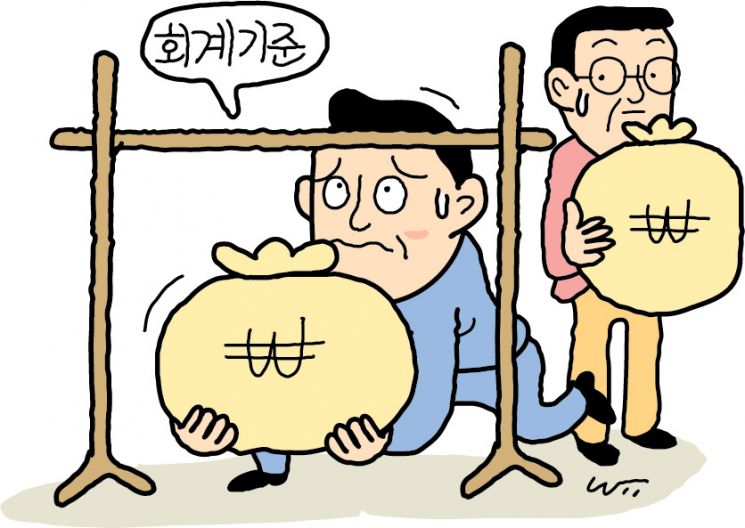
The main factor cited by the securities industry as blocking dividends is the reserve for surrender value refunds. This system, introduced under International Financial Reporting Standards (IFRS17) in 2023, is based on the amount that must be returned to customers if they cancel their insurance contracts (surrender value). If the accounting insurance liability is less than the surrender value, the difference must be set aside as a reserve for surrender value refunds. This reserve is classified as a statutory reserve under commercial law and is deducted from distributable profits. The more reserves are set aside, the less capacity there is for dividend payments.
Insurance companies have long called for improvements to this system. In response, financial authorities revised the system twice, last year and this year. The revision allows for a lower reserve ratio if a certain KICS level is maintained. As of this year, if the KICS is 170% or higher, only 80% of the reserve needs to be set aside, down from the previous 100%. However, due to factors such as the base interest rate cut, insurance companies' KICS ratios have been declining, meaning few benefit from the improved system. This is why, at a meeting with Financial Services Commission Chairman Lee Eog-weon on the 16th, insurance company CEOs called for further improvements to the reserve for surrender value refunds.
Another issue is that the current reserve for surrender value refunds system conflicts with the basic capital KICS regulations scheduled for introduction within this year. While the reserve is classified as basic capital, if it exceeds retained earnings, it is counted as supplementary capital, which can undermine the soundness of basic capital. An industry insider said, "The reserve for surrender value refunds restricts dividend capacity and runs counter to the government's value-up (corporate value enhancement) policy," adding, "A comprehensive review is needed, not just linking it to KICS." Financial authorities have recently begun reviewing rationalization measures for the reserve for surrender value refunds.
© The Asia Business Daily(www.asiae.co.kr). All rights reserved.
![Clutching a Stolen Dior Bag, Saying "I Hate Being Poor but Real"... The Grotesque Con of a "Human Knockoff" [Slate]](https://cwcontent.asiae.co.kr/asiaresize/183/2026021902243444107_1771435474.jpg)
















