Seongdong-gu Cafe Bans Chinese Customers
"Racism" vs "Disorder to Blame" ? Heated Debate Among Netizens
Following the recent decision to allow group tourists from China to enter South Korea without a visa, negative perceptions and anti-China protests against Chinese tourists have intensified in the country. Amid this climate, a cafe in Seongsu-dong, Seongdong-gu, Seoul, announced that it would not accept Chinese customers, leading to divided opinions among internet users. As the controversy grew, Chinese nationals and other foreign residents in Korea raised concerns about 'racial discrimination,' prompting the head of the local government to step in and promise a response.
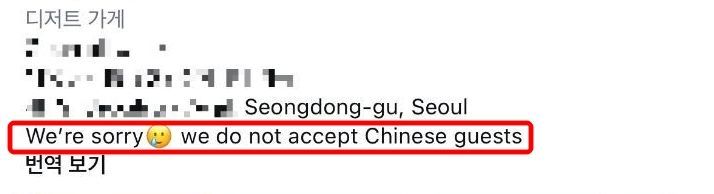 A cafe in Seongsu-dong, Seongdong-gu, Seoul, has sparked controversy after posting a notice stating that it does not accept Chinese customers. Seongdong-gu cafe Instagram
On the 27th, Jung Won-oh, Mayor of Seongdong District in Seoul, addressed the issue on his social media, stating, "I deeply share the concerns you have sent," regarding the cafe in Seongsu-dong. He added, "As Seongsu-dong is emerging as a representative tourist destination in South Korea, attracting not only domestic tourists but also visitors from various countries overseas, I will do my best to persuade the establishment in question." This was in response to a netizen who tagged the mayor and asked, "Is there really no way to sanction such a discriminatory business in Seongdong-gu?"
Previously, a post on social media rapidly spread, claiming that a Chinese customer was denied entry at the cafe. A Chinese national, Mr. A, who has lived in Korea for nine years, wrote on his social media, "I went to the cafe with a friend, and the owner told us, 'We do not accept Chinese customers,' and asked us to leave. This is the first time I've heard such words while living in Korea." Mr. A continued, "I don't know what the owner has experienced, but I am convinced that this is an act of targeting and disrespecting a specific country. It is truly regrettable that such things can happen in Seoul, South Korea, in 2025."
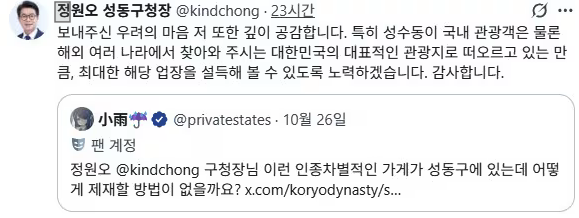 On the 27th, Jung Won-oh, Mayor of Seongdong District in Seoul, posted on his social media, "I deeply share the concerns you have sent," regarding a cafe in Seongsu-dong. He added, "As Seongsu-dong is emerging as a representative tourist destination in South Korea, attracting not only domestic tourists but also visitors from various countries overseas, I will do my best to persuade the establishment in question." Jung Won-oh, Mayor of Seongdong District, SNS
As the controversy surrounding the cafe grew, Henry (real name Li Xinyang), a Chinese influencer living in Korea, shared the cafe's post on his social media and criticized it as "the most racist cafe I've seen in Korea," further fueling the debate. In fact, the cafe's official social media account includes a notice in English stating, "Sorry, but we do not accept Chinese customers."
"Cafe Owner: 'A Measure Taken in Consideration of Widespread Anti-China Sentiment in Society'"
The debate over the cafe has sparked heated arguments in the comments section. While many pointed out that banning Chinese customers is clear discrimination, others defended the cafe by criticizing the disorderly behavior of some Chinese tourists. One user commented, "There must have been a lot of trouble with Chinese customers for them to do this. I personally witnessed a Chinese person threatening a convenience store owner with a weapon, so I understand." Another user questioned, "What would the owner do if a Chinese person who speaks Korean and an American who only speaks English visited the cafe together?" Yet another remarked, "Is the owner far-right or a racist? No decent Korean would go to a cafe that discriminates like this."
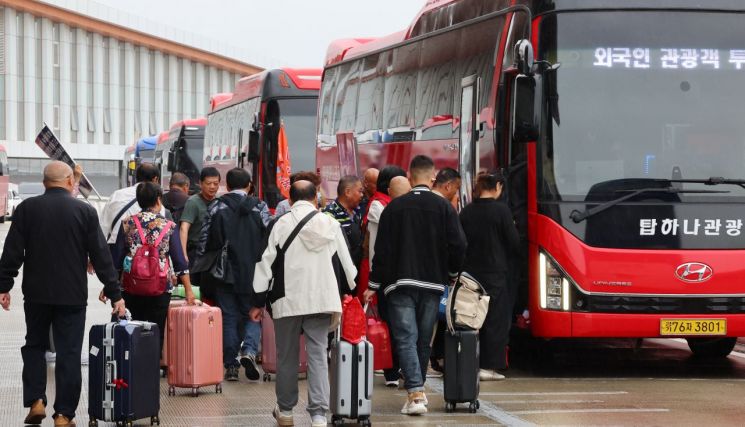 Meanwhile, according to a survey conducted by the polling firm K Stat Research at the request of MBC Radio's "Kim Jongbae's Focus," from the 14th to the 17th, 2014 adults aged 18 and over nationwide were surveyed on their perceptions of neighboring countries. The results showed that negative perceptions of China were overwhelmingly high at 69%, compared to positive perceptions at 22%. Yonhap News Agency
As the controversy escalated, the cafe owner explained that the measure was taken in consideration of the growing anti-China sentiment in society. In an interview with Pressian, the owner, Mr. B, said, "When Chinese customers come in, Korean customers react by saying things like, 'There are Chinese people here' or using slurs. I didn't want to create such reactions. While it may be perceived as racial discrimination, I am only doing this to protect my business." He added, "If anti-China sentiment in society subsides, I will consider accepting Chinese customers again."
Meanwhile, according to a survey conducted by the polling firm K Stat Research at the request of MBC Radio's "Kim Jongbae's Focus," from October 14 to 17, 2014 adults aged 18 and over nationwide were surveyed on their perceptions of neighboring countries. The results showed that negative perceptions of China were overwhelmingly high at 69%, compared to positive perceptions at 22%. The main reasons for negative perceptions of China were 'dislike of Chinese people's attitudes, such as a lack of public order (23%)', 'because it is a one-party communist state (15%)', 'because it is a military threat due to its alliance with North Korea (14%)', and 'because it tries to interfere in domestic politics (14%)'. However, when it came to 'anti-China protests,' 53% said they 'do not sympathize,' while 43% said they 'do sympathize.'
© The Asia Business Daily(www.asiae.co.kr). All rights reserved.
![Clutching a Stolen Dior Bag, Saying "I Hate Being Poor but Real"... The Grotesque Con of a "Human Knockoff" [Slate]](https://cwcontent.asiae.co.kr/asiaresize/183/2026021902243444107_1771435474.jpg)


















