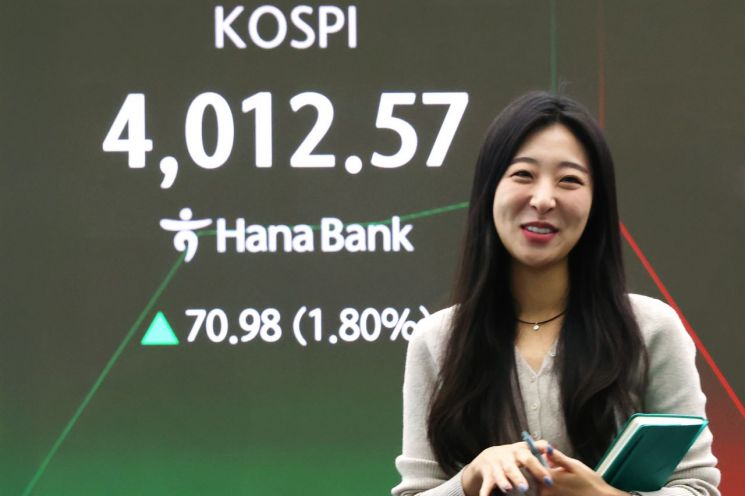
With the KOSPI surpassing the 4,000 mark for the first time in history and setting a new milestone in the Korean stock market, analysts have suggested that this represents a normalization of the previously undervalued index, and that it is premature to discuss overheating.
As of October 28, the KOSPI has risen by approximately 67% compared to the beginning of the year, recording the most impressive growth rate not only among major global stock markets but also across key asset classes. This performance far exceeds the gains seen in the Nasdaq and even the recent surge in gold prices.
Park Sanghyun, a researcher at iM Securities, stated, "The KOSPI is moving out of a phase where it was undervalued due to factors such as a domestic economic slowdown, political uncertainty, and price competition from China. It is now entering a normalization stage." He added, "It is also encouraging to see that the recent trend in the KOSPI is increasingly synchronized with the artificial intelligence (AI) cycle and the Magnificent 7 index, which has been driving the U.S. stock market."
Park explained, "This synchronization is occurring because the AI cycle, which was previously dominated by a few big tech companies, has now entered a phase of expanded investment and widespread adoption, allowing the trickle-down effect of the AI cycle to take hold. This trend is similar to what was observed in the early 2000s with the popularization of the internet and in the 2010s with the widespread adoption of smartphones, both of which led to boom cycles in the domestic semiconductor industry."
Although the sharp rise in the KOSPI this year has raised concerns about overheating, Park believes it is too early to talk about a bubble. He said, "If we recalculate the KOSPI's gains since the end of 2022, when the index underwent a correction during the U.S. Federal Reserve's rate hike cycle, the growth is either in line with or slightly below the average of other major stock markets. This is because the Korean stock market experienced a correction in 2023 and 2024, unlike other markets."
Park also expects that the so-called 'three lows' effect-low interest rates, low oil prices, and a weak dollar-along with the trickle-down impact of the AI cycle, such as soaring semiconductor prices, will continue to serve as additional growth drivers for the Korean economy and stock market for the time being.
© The Asia Business Daily(www.asiae.co.kr). All rights reserved.

















