Bank of Korea Releases Preliminary Q3 Real GDP Figures
Recovery in Consumption and Investment, Strong Exports
Growth Exceeds 1.1% Forecast
With a significant improvement in private consumption, the South Korean economy grew by 1.2% in the third quarter of this year.
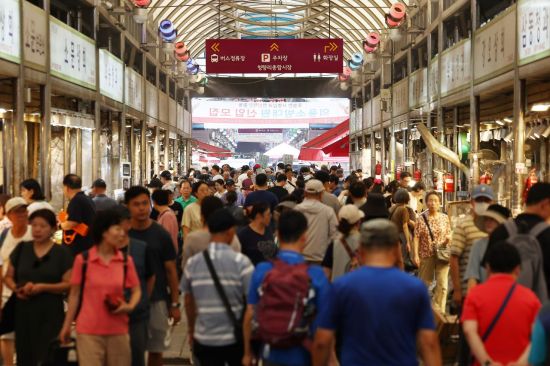
The Bank of Korea announced on October 28 that the preliminary real gross domestic product (GDP) growth rate for the third quarter increased by 1.2% compared to the previous quarter. This slightly exceeds the Bank's forecast of 1.1% released in August and matches the previous peak recorded in the first quarter of last year (1.2%).
This is the first time in six quarters that the quarterly growth rate has reached the 1% range. After a surprise growth in the first quarter of last year, the South Korean economy plummeted to -0.2% in the second quarter, and only managed 0.1% growth in both the third and fourth quarters. In particular, the first quarter of this year saw a return to negative growth, deepening concerns about prolonged low growth. However, with a rebound to 0.7% in the second quarter, the economy broke the cycle of stagnation and raised hopes for recovery.
This increase in the growth rate was driven by domestic demand. In particular, private consumption rose significantly, and the decline in construction investment, which had previously dragged down growth, slowed considerably, contributing to the higher growth rate.
Private consumption increased by 1.3% compared to the previous quarter, as spending on goods such as passenger cars and communication devices, as well as services like restaurants and healthcare, all rose. Government consumption also grew by 1.2%, mainly due to increased spending on goods and health insurance benefits. Construction investment decreased by 0.1% quarter-on-quarter, marking six consecutive quarters of negative growth, but the decline was much smaller compared to the second quarter (-1.2%). Facility investment expanded, rebounding by 2.4% mainly due to machinery such as semiconductor manufacturing equipment.
Exports continued to rise, driven by a boom in semiconductors. In the third quarter, exports grew by 1.5% compared to the previous quarter, led by semiconductors and automobiles. Although the upward trend continued, the growth rate slowed compared to the second quarter (4.5%). Imports increased by 1.3%, mainly due to machinery, equipment, and automobiles.
Looking at the contribution by expenditure category in the third quarter, the rebound in consumption is clear. The contribution of domestic demand to growth increased from 0.4 percentage points in the second quarter to 1.1 percentage points in the third quarter. Specifically, consumption's contribution rose from 0.5 percentage points to 0.8 percentage points, and by economic agent, the contribution of private consumption (0.6 percentage points) was higher than that of the government (0.2 percentage points). During the same period, the contribution of net exports (exports minus imports) decreased from 0.3 percentage points to 0.1 percentage points.
By industry, the improvement in the service sector was notable. The service sector grew by 1.3% compared to the previous quarter, mainly due to wholesale and retail, accommodation and food services, finance, and insurance. Manufacturing increased by 1.2%, led by transportation equipment, computers, and electronic and optical devices, continuing the growth trend from the second quarter (2.5%). The electricity, gas, and water supply sector grew by 5.6%, mainly due to electricity. The construction sector remained at the previous quarter's level, as an increase in civil engineering was offset by a decline in building construction. The agriculture, forestry, and fisheries sector decreased by 4.8%, mainly due to a decline in crop production.
Real gross domestic income (GDI) in the third quarter increased by 0.7% compared to the previous quarter, falling short of the GDP growth rate.
© The Asia Business Daily(www.asiae.co.kr). All rights reserved.
![Clutching a Stolen Dior Bag, Saying "I Hate Being Poor but Real"... The Grotesque Con of a "Human Knockoff" [Slate]](https://cwcontent.asiae.co.kr/asiaresize/183/2026021902243444107_1771435474.jpg)











