Over 2,000 Participants from More Than 70 Countries Gathered
A Forum for Diverse Discussions
"Geopolitical Risks Must Not Be Overlooked"
From October 16 to 18 (local time), the Arctic Circle Assembly in Reykjavik, Iceland, became the stage for heated debates over the development and protection of resources in the Arctic region. As glaciers continue to melt, environmental protection in the Arctic is the most pressing issue from a climate crisis perspective. However, competition among major powers to pioneer Arctic shipping routes and secure resource development is also intensifying.
Olafur Ragnar Grimsson, Chair of the Arctic Circle Assembly and former President of Iceland, said during the plenary session on the 16th (local time), "More than 2,000 people have gathered here, representing their countries, to discuss issues crucial to the future of the planet." He added, "This is a forum to discuss glaciers and oceans, the transition to clean energy, the utilization of natural resources, and the respect and participation of indigenous peoples and diverse local communities worldwide." The Arctic Circle Assembly is the world’s largest forum on Arctic issues, attended not only by countries within the Arctic region but also by non-Arctic states such as Korea, Japan, China, and India. This year, more than 2,000 people participated, including prime ministers and ministers from 70 countries, representatives of research institutes and multinational corporations, and leaders of Arctic indigenous communities.
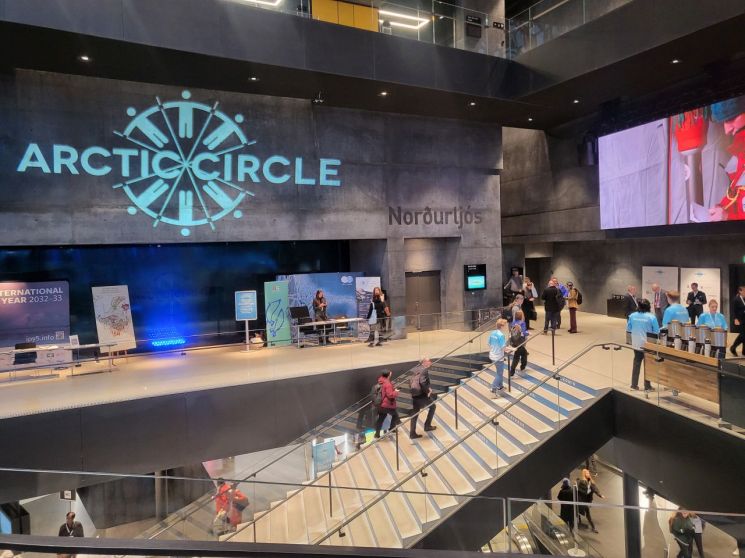 A scene from the Arctic Circle Assembly held on the 16th (local time) in Reykjavik, Iceland. Photo by Lee Hyunju
The Arctic was once a region of low geopolitical tension, but it has now become one of the hottest geopolitical hotspots. Russia’s prolonged war with Ukraine and former U.S. President Donald Trump’s expressed interest in purchasing Greenland have fueled tensions. In addition, China’s collaboration with Russia to pioneer the Arctic route has turned the region into a battleground for hegemony.
Due to the veto on Russia, this year’s assembly focused discussions on the Northwest Passage and the Trans-Arctic Route, rather than the Northeast Passage, which borders Russia. Jessica Shadian, CEO of the Canadian think tank Arctic360, who led the session on "Northwest Passage Management," commented, "It may seem as if geopolitical discussions on the Arctic have only just begun, but in fact, 15 years ago, a Chinese ambassador gave a speech at an Arctic Council reception in Norway, highlighting how important the Arctic is to China’s national interests." She noted, "At the time, it was explained under the guise of science and climate change, but the current situation is entirely different." She added, "Russia has already spent more than a decade modernizing Arctic infrastructure and military capabilities, strengthening resource development and access control. We need to discuss why Canada and the United States have not responded during this period."
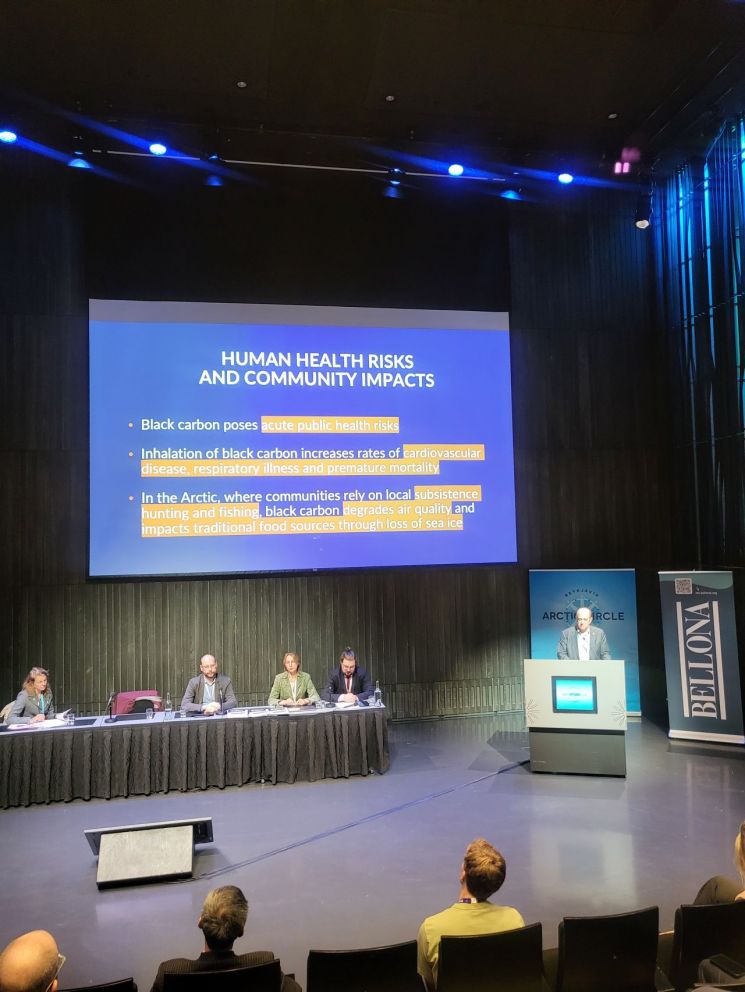 On the 17th (local time), a session opposing the pioneering of the Arctic route was held at the Arctic Circle Assembly in Reykjavik, Iceland. Photo by Lee Hyunju
Experts predict that the Trans-Arctic Route, which is essentially located in international waters, will be less prone to geopolitical conflict. However, the possibility of accidental escalation always exists, and the likelihood of disputes is expected to increase if Arctic routes are developed. Stephanie Pezard, Associate Director of Defense and Political Science at the RAND Corporation, explained, "Not all countries will benefit equally from the opening of new maritime routes."
There was also clear opposition to resource development in the Arctic by major powers. Vivian Motzfeldt, Greenland’s Minister for Foreign Affairs and Research, stated, "Over the past year, as international attention has grown, it has become increasingly necessary to clearly articulate what we stand for, what our rules and regulations are, and what our priorities are." She emphasized, "We are the owners of our country and have a responsibility for what we call home. We ourselves determine the destiny and future of our people and nation."
Warnings were also raised that, rather than economic opportunities, the intensification of geopolitical risks could lead to the expansion of military facilities and environmental destruction. Dmitrii Gorchakov, nuclear safety advisor at the Bellona Environmental Transparency Center, pointed out the potential for radioactive contamination along Arctic shipping routes. Gorchakov noted, "The Russian military nuclear fleet in the Arctic operates as part of Russia’s Northern Fleet and is the region’s oldest nuclear facility operator." He added, "After nearly 70 years of operation, the Northern Fleet has become a major source of nuclear waste and accidents in the Arctic." He further warned, "The continued militarization of the Arctic will only increase the risk of radioactive hazards."
Andrey Danilov, a human rights activist and member of the Russian Indigenous Peoples’ International Community, delivered a proxy statement, saying, "Speaking about the Sami people of the Kola Peninsula, our population has dwindled to about 1,500 and we are now an endangered people." He expressed concern, "For us, the Arctic route may not be a symbol of progress but rather a path toward extinction."
This article (content) was produced with the support of the Korea Press Foundation.
© The Asia Business Daily(www.asiae.co.kr). All rights reserved.
![Clutching a Stolen Dior Bag, Saying "I Hate Being Poor but Real"... The Grotesque Con of a "Human Knockoff" [Slate]](https://cwcontent.asiae.co.kr/asiaresize/183/2026021902243444107_1771435474.jpg)

















