Colatecs Located in Areas with High Elderly Populations
The Area Around Colatecs Becomes a 'Senior Entertainment District'
Conflicts Occur, but... "Leisure Spaces for the Elderly Are Needed"
At around 2 p.m. on the 25th of last month, elderly people were constantly coming and going from a commercial building in Cheongnyangni, Dongdaemun-gu, Seoul. The building’s elevator shuttled non-stop between the first floor and the second basement level, carrying elderly passengers. Their destination was a colatec on the second basement floor, where they could dance to lively music. Most of the elderly visitors, while not extravagantly dressed, wore neat outfits to the colatec. Some showcased themselves in blue suits, red shirts, or glittery clothes. When the door to the colatec opened, the “ppongjjak” music favored by seniors could be heard from inside.
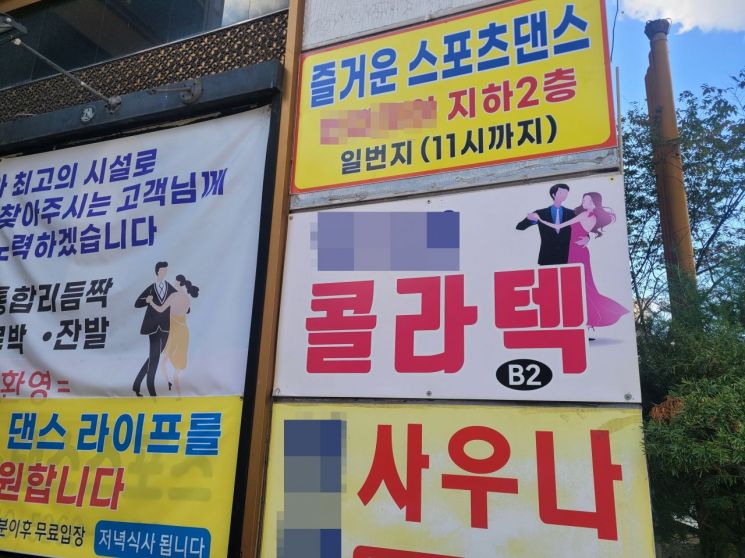 A karaoke room in Cheongnyangni, Dongdaemun-gu, Seoul, visited on the 25th of last month. Photo by Byungseon Gong
The Cheongnyangni colatec served as a social gathering place for the elderly. Elderly men with mousse in their hair and women with pale makeup waited expectantly to enter. One man in a white suit made a loud phone call, saying, “Where are you? I came to dance for two hours. I’ll buy you some meat at the market later. Hurry up!” Of course, the colatec is not just a place for friends to hang out. It was common to see elderly men and women holding hands around the colatec. They would buy hotteok together in front of the venue or head to the market for drinks. When asked how they ended up at the colatec, one elderly couple simply walked away without answering.
Colatec is a portmanteau of “cola” and “discotheque,” literally meaning a place where you can drink cola and dance. In the past, colatecs targeted teenagers who could not drink alcohol, but as clubs, karaoke rooms, and PC rooms became more popular, they evolved into spaces for seniors. In fact, well-known colatecs in Seoul are located in areas with high elderly populations, such as Cheongnyangni, Jongno, and Yeongdeungpo.
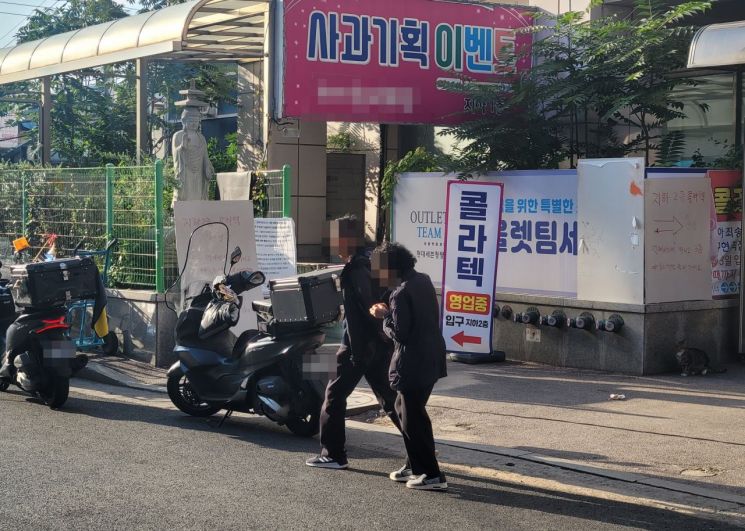 On the 25th of last month, elderly men and women were seen holding hands and walking around a karaoke bar in Cheongnyangni, Dongdaemun-gu, Seoul. Photo by Gong Byungseon
The colatec industry, which struggled during the COVID-19 pandemic, has recently been experiencing a gradual recovery. According to the Ministry of Culture, Sports and Tourism, the number of ballroom businesses dropped from 70 in 2015 to 55 in 2020. However, the number increased again to 72 in 2022 and 69 in 2023. In Cheongnyangni, a colatec that reopened in May this year has seen a steady stream of visitors. The entrance was lined with congratulatory flower wreaths celebrating the reopening.
At one colatec in Cheongnyangni, visitors can dance and enjoy themselves all day for just 3,000 won. Inside, there are also restaurants and cafes, making it possible to eat and hold gatherings. The area around the colatec has effectively become a “senior entertainment district.” Since alcohol is not allowed inside the colatec, patrons step outside to drink. Elderly people leaving the colatec often head to the nearby Cheongnyangni Traditional Market. Even during the day, it is common to see seniors enjoying fried chicken and beer at market eateries. In addition, a “Pumba” performance hall, popular with elderly audiences, is located in the same building as the colatec.
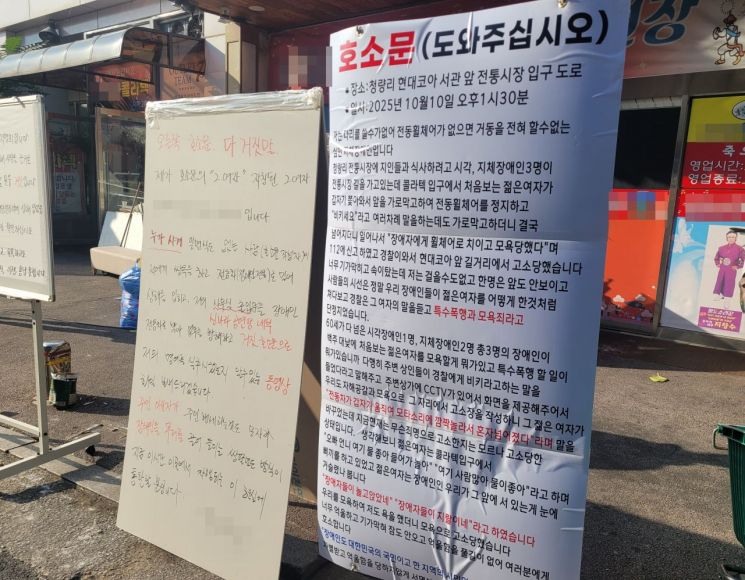 On the 25th of last month, a fight broke out in front of a colatec in Cheongnyangni, Dongdaemun-gu, Seoul, where a plea expressing grievance was posted. Photo by Gong Byungseon
However, colatecs have also caused issues in the local community. On the same day, a plea expressing grievance was posted in front of a colatec in Cheongnyangni after a fight broke out. The plea claimed that a disabled person in a motorized wheelchair and a woman had insulted each other in front of the colatec. Young passersby glanced at the sign in the middle of the street and quickly walked past.
There have also been cases where incidents at colatecs have escalated into criminal cases. In April 2023, Judge Lee Youngsook of the Daegu District Court’s 8th Criminal Division sentenced a man, Mr. A (58), to a fine of 500,000 won and ordered him to complete 40 hours of a sexual violence treatment program for charges including obscene acts using telecommunications and violation of the law on the punishment of stalking crimes. Mr. A persistently requested meetings and sent sexually harassing text messages to a woman in her 60s whom he met at a colatec.
Despite this, seniors hope that colatecs will continue to exist as leisure spaces. They say that if colatecs disappear, there will be nowhere left for them to go. Mr. Lee (69), whom we met in front of a colatec, said, “I know that the welfare center runs various programs, but it’s much more fun to dance and meet people at the colatec. It’s not the colatec that’s strange, it’s the people who cause trouble there.”
Korean seniors are experiencing what is known as “leisure poverty,” unable to find places for recreational activities. According to the Ministry of Health and Welfare’s “Survey on the Actual Conditions of the Elderly,” as of 2023, 81.3% of the elderly population participated in leisure activities over the past year, but 51.8% of them engaged in solitary activities such as walking or listening to music. Only 18.7% enjoyed leisure through social activities, such as meeting other people.
Experts emphasize that colatecs contribute to elderly leisure and should not be stigmatized. Jung Soondul, a professor of social welfare at Ewha Womans University, said, “It is unrealistic for the government to take full responsibility for all elderly leisure and welfare issues. The private sector, including colatecs, must also play a role. If communities create spaces where not only the elderly but also younger generations can mingle, it could help alleviate the problem of leisure poverty.”
© The Asia Business Daily(www.asiae.co.kr). All rights reserved.
![User Who Sold Erroneously Deposited Bitcoins to Repay Debt and Fund Entertainment... What Did the Supreme Court Decide in 2021? [Legal Issue Check]](https://cwcontent.asiae.co.kr/asiaresize/183/2026020910431234020_1770601391.png)

















