Trump Outraged by Ontario Advertisement
"No Plans to Meet with Canadian Prime Minister"
Federal Government Opts for Caution Over Strong Response
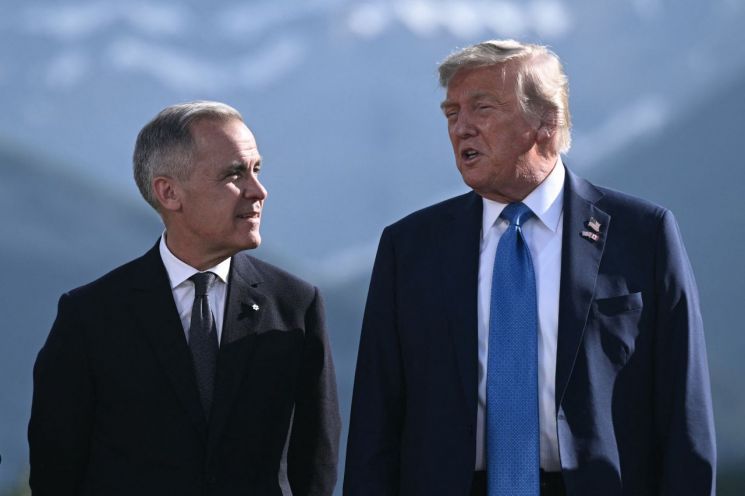 U.S. President Donald Trump (right) and Canadian Prime Minister Justin Trudeau are seen conversing at the Group of Seven (G7) summit held last June in Alberta, Canada. Photo by AFP
The efforts of the Canadian federal government, which had pursued a conciliatory strategy toward the United States-including the withdrawal of retaliatory tariffs-have been rendered futile in the wake of the "Ontario anti-Trump advertisement" controversy. Canadian Prime Minister Mark Carney had planned to use the Asia-Pacific Economic Cooperation (APEC) summit in Gyeongju, South Korea this week as an opportunity to initiate "tariff talks" with President Donald Trump, but this now appears unlikely.
According to ABC and CNN on the 26th (local time), President Trump stated aboard Air Force One on the 25th that he had "no plans to meet with Prime Minister Carney." This stands in stark contrast to Carney's remarks a day earlier, in which he expressed his willingness to "resume trade negotiations with the United States" and signaled an intent to resolve the situation.
President Trump, after being infuriated by Ontario's "anti-U.S. tariff" advertisement, declared that he would "completely halt trade with Canada" and threatened to "impose an additional 10% tariff on Canada," among other remarks.
Since the 23rd, Ontario has aired an advertisement using a speech by former President Ronald Reagan from April 1987, in which Reagan explained the background of imposing tariffs on Japan. President Trump regarded this as a direct challenge to his own trade policy.
The majority of Canadian exports are exempt from tariffs under the United States-Mexico-Canada Agreement (USMCA). However, Canadian products not covered by the agreement face a 35% tariff (10% for energy products), while steel and aluminum sectors are subject to a 50% tariff.
As a result, Canada has suffered across its steel, aluminum, lumber, and potash industries. Ontario, the province that aired the advertisement, has seen its automotive industry severely impacted by the Trump administration’s high tariff measures. Stellantis, for example, announced plans to relocate its production line from Ontario to Illinois in the United States.
After President Trump denounced the advertisement as a "fraudulent and unacceptable act," Ontario Premier Doug Ford announced that the advertisements would be suspended starting on the 27th. However, this was insufficient to quell President Trump’s anger. In fact, following Trump’s public criticism, the advertisement was aired again during Game 1 of the World Series on the 24th, prompting another round of critical posts from the president.
With anti-American sentiment rising among Canadians, Prime Minister Carney, who has taken a conciliatory approach toward the U.S. government, is expected to see his political standing further eroded. Despite criticism, Carney has focused on building a relationship of trust with the Trump administration by withdrawing retaliatory tariffs against the U.S. and, in June, retracting plans to impose a Digital Services Tax (DST) on major American tech companies such as Amazon, Google, and Meta.
Reuters reported that "the Ontario advertisement has caused unnecessary friction in the sensitive trade negotiations between Canada and the United States," but also noted that "the Canadian federal government is adopting a cautious approach, leaving room for negotiations to resume rather than responding immediately with strong countermeasures."
© The Asia Business Daily(www.asiae.co.kr). All rights reserved.
!["The Woman Who Threw Herself into the Water Clutching a Stolen Dior Bag"...A Grotesque Success Story That Shakes the Korean Psyche [Slate]](https://cwcontent.asiae.co.kr/asiaresize/183/2026021902243444107_1771435474.jpg)
















