Besant, U.S. Treasury Secretary, Speaks to Major Broadcasters
"China to Withdraw Rare Earth Controls, U.S. to Withdraw 100% Tariff"
Agreements Reached on Soybeans, Fentanyl, TikTok, and Other Key Issues
U.S. Formalizes Series of Trade Deals
U.S. Treasury Secretary Scott Besant stated on the 26th (local time) that he does not expect China to implement export controls on rare earth elements and, in turn, the United States will not impose an additional 100% tariff on Chinese goods. As both sides found common ground during preliminary talks ahead of the U.S.-China summit scheduled for the 30th in Busan, analysts believe that the two countries have at least laid the groundwork to prevent an escalation of the trade war and to move toward a truce that could resolve ongoing trade tensions.
Following a series of trade agreements between the United States and Southeast Asian nations, the prospect of a deal with China has become more tangible. This has increased the burden on South Korea, which continues last-minute negotiations with the United States over the details of a $350 billion investment in the U.S., conditioned on tariff reductions, right up to the U.S.-Korea summit.
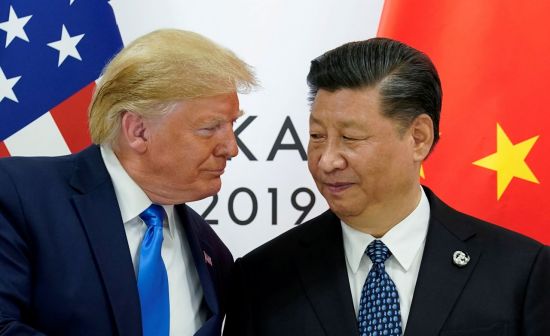 U.S. President Donald Trump (left) and Chinese President Xi Jinping are meeting for a bilateral talk at the G20 summit held in Osaka, Japan, in June 2019. Photo by Reuters Yonhap News
U.S. Treasury: "China to Withdraw Rare Earth Controls, U.S. to Withdraw 100% Tariffs"
In interviews with major networks such as NBC, CBS, and ABC, Secretary Besant described the trade negotiations with China held in Kuala Lumpur, Malaysia, as highly productive, stating that both countries had established a framework agreement.
In an interview with ABC News, he said, "(President Donald Trump) provided me with maximum leverage by threatening to impose an additional 100% tariff if China implemented rare earth export controls," adding, "As a result, I believe we will avoid the imposition of tariffs." On CBS News, he predicted that China's rare earth export control policy would be suspended for about a year while the policy is under review.
Regarding this, Jamieson Greer, a representative of the U.S. Trade Representative (USTR), told Fox News that resolving the rare earth sanctions issue "was one of the main objectives of this summit, and we are making very good progress toward that goal."
Beyond rare earths and tariffs, the two countries also agreed during the negotiations to increase China's purchases of U.S. agricultural products and to strengthen controls on precursor chemicals for fentanyl. Secretary Besant stated, "China has promised significant purchases of agricultural products to support American farmers, and has also agreed to help us address the issue of precursor chemicals for the terrible fentanyl crisis devastating our country," evaluating the meeting overall as "very positive."
He also reported progress regarding the sale of TikTok's U.S. operations, a Chinese video-sharing platform. He told CBS News, "We reached a final agreement in Madrid, and today all the details have been finalized," emphasizing, "The two leaders will formally conclude this deal in Korea on Thursday (the 30th)."
He also hinted that China would resume imports of U.S. soybeans, which had recently been suspended. He said, "Once the deal with China is announced, our soybean farmers will be very pleased not only about this season, but also about what lies ahead in the coming years."
Additionally, Secretary Besant mentioned that the trade negotiations demonstrated the potential for the two countries to cooperate on global issues. He told NBC News, "The two leaders will also discuss President Donald Trump's vision for global peace, which is expanding to include Asia, the Middle East, and even the Ukraine-Russia issue."
Trump and Xi Jinping Signal Breakthrough in Trade Deal at Busan Summit
These developments indicate that tensions between the two countries over the trade war are shifting toward a more relaxed atmosphere. Previously, the U.S. and China attempted to ease tensions by declaring a "tariff truce" through four rounds of high-level trade negotiations. However, ahead of the summit between the two leaders at the Asia-Pacific Economic Cooperation (APEC) summit in Gyeongju, South Korea, China strengthened export controls on rare earths, and the U.S. hinted at imposing an additional 100% tariff on Chinese goods starting next month, reigniting the conflict. Rare earth elements are essential materials for advanced industries such as semiconductors and electric vehicle batteries, and the U.S. has strongly objected, viewing China's actions as targeting a critical vulnerability.
With both sides finding a compromise in these high-level negotiations, attention is focused on whether President Trump and Chinese President Xi Jinping, meeting face-to-face for the first time in six years at the summit on the 30th, can reach a substantive agreement through trade talks. While a comprehensive "big deal" may be difficult, most observers expect the two countries to avoid confrontation and transition to a truce phase that allows for conflict management. President Trump also told reporters after attending the Association of Southeast Asian Nations (ASEAN) summit, "I expect a good agreement with China," adding, "They want a deal, and we want a deal."
However, some observers warn that even if a trade agreement is reached, it could prove to be a "fragile truce" that could break down at any time.
U.S. Nears Trade Agreement with China After Southeast Asia Deals... U.S.-Korea Tariff Talks Remain Uncertain
The momentum for a provisional U.S.-China trade deal emerged as President Trump, during his first Asia tour since the start of his second term, concluded and formalized trade agreements with Malaysia, Cambodia, Thailand, and Vietnam.
In contrast, despite reaching a broad agreement at the end of July, South Korea's negotiations with the U.S. have been delayed due to disagreements over the specific terms of the $350 billion investment in the U.S., which the Korean government promised in exchange for tariff reductions. President Trump, responding to questions from the press about the U.S.-Korea tariff negotiations on the 25th, stated, "If they are ready, I am ready," effectively placing the onus on South Korea to make a decision and move the talks forward. It remains uncertain whether the U.S.-Korea tariff negotiations will be concluded during President Trump's visit to Korea on the 29th, which is scheduled to last for two days and one night.
© The Asia Business Daily(www.asiae.co.kr). All rights reserved.

















