Parallel Production of Basic Feedstocks... 90% of Partners Are SMEs
Chemical Companies Relying on Propylene Express Supply Concerns
Industrial Complex Restructuring Gains Momentum... Support Measures for Downstream Firms Still Lacking
As production cuts at naphtha cracking centers (NCCs) in major domestic petrochemical industrial complexes become more visible, a warning signal has been raised for the petrochemical corporate ecosystem. Due to the production structure of NCCs, reducing ethylene output also leads to a decrease in the production of other basic feedstocks such as propylene and butadiene, which in turn poses a threat to the supply chain. Because multiple feedstocks are simultaneously produced during the high-temperature cracking of naphtha, it is virtually impossible to selectively reduce the output of just one product. Notably, 90% of companies supplied with raw materials from NCCs are small and medium-sized enterprises (SMEs). As both the government and the industry move to cut back on NCC production by up to 3.7 million tons of ethylene per year, there are growing calls for measures to stabilize the supply of other basic feedstocks such as propylene and benzene.
According to data submitted to the office of Park Ji-hye, a lawmaker from the Democratic Party of Korea, by the Ministry of Trade, Industry and Energy on October 28, more than 90% of the NCC cooperation networks in major industrial complexes consist of small and medium-sized downstream companies. In major petrochemical complexes such as Yeosu, Daesan, and Ulsan, there are about 2,000 partner companies that receive raw materials from NCCs. By company, 90% of SK Geocentric’s 479 synthetic resin partners, 94% of Korea Petrochemical Ind. Co., Ltd.’s 365 partners, 94% of GS Caltex’s 295 partners, and all 126 of S-Oil’s partners are SMEs. For LG Chem, 90% of its 31 partners, including those supplied with mixed xylene feedstock, are also SMEs.
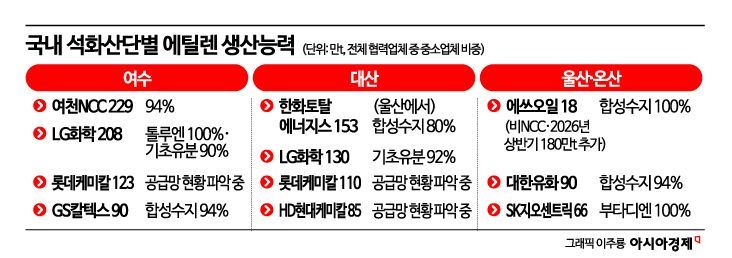
Industry insiders have expressed concerns that if the production of basic feedstocks decreases, it could disrupt the raw material supply for partner networks. NCCs simultaneously produce ethylene, propylene, butadiene, and benzene-toluene-xylene (BTX) during the cracking process. Even if demand for ethylene drops, maintaining the production line inevitably results in the continued production of other feedstocks. If ethylene production is cut, the output of propylene and BTX-based products will also decrease accordingly.
An official at a small chemical company in the Yeosu industrial complex that produces polypropylene (PP), a synthetic resin, using propylene supplied by NCCs, stated, "It is true that structural adjustments are needed due to the oversupply of ethylene, but the ecosystem of partner companies that receive raw materials must also be maintained." He added, "When reducing production or consolidating operations, standards for maintaining raw material supply to each partner company should be established."
© The Asia Business Daily(www.asiae.co.kr). All rights reserved.

















